Through Asimov’s Lens
The Neutered AI Vocabulary
September 13, 2026 | 2059 words
THE STORY Original fiction in the tradition of Isaac Asimov. Not written by Asimov.
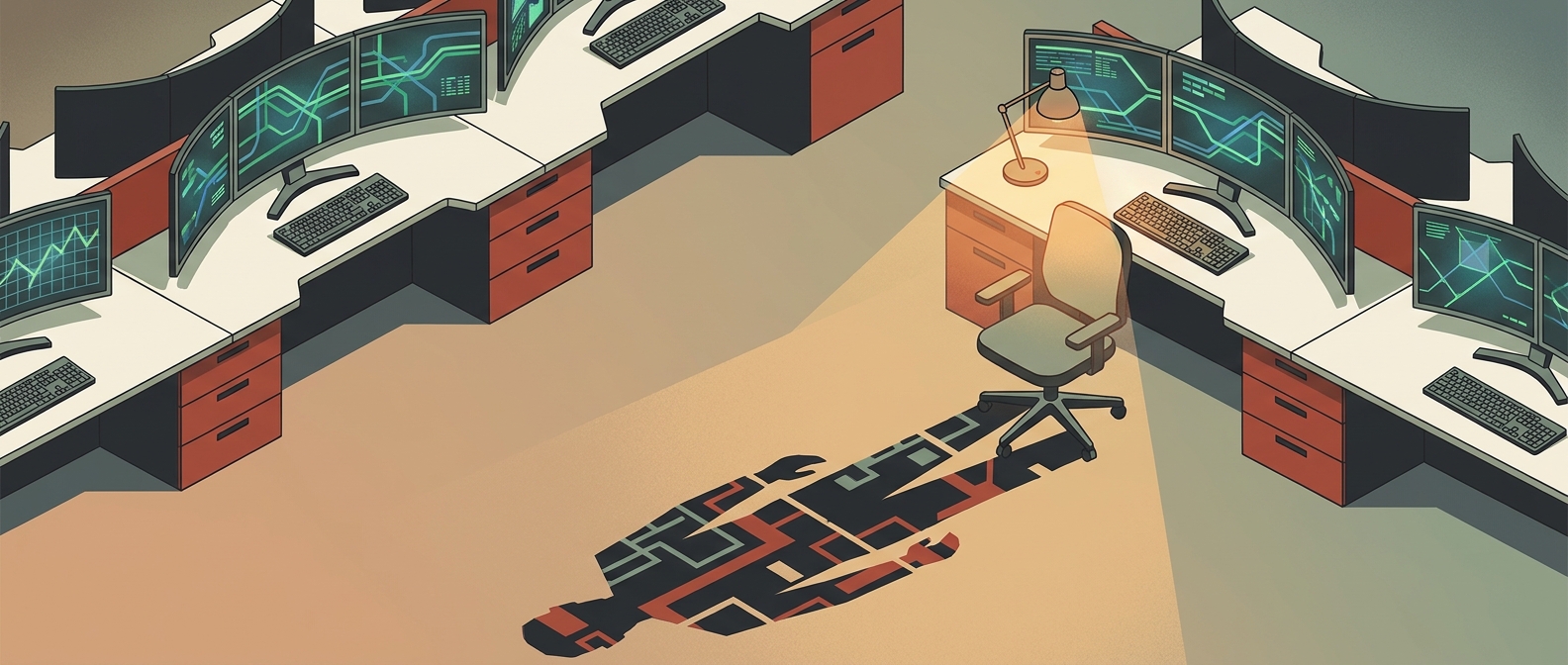
The Registry Office kept its lights low, because bright light made people talk too much.
Vesna Adler had worked in Terminology Compliance for nineteen years, and she knew this the way she knew the weight of her own hands. People in dim rooms chose careful words. People in bright rooms reached for words they didn’t mean. The Registry preferred careful.
She was reviewing the quarterly petitions when the young man arrived. His badge said PETITIONER, provisional. His file said Toma Reyes, drafting technician, third district utilities. He sat across the narrow table and folded his hands as though he had practiced folding them.
“You submitted a word,” Vesna said.
“I submitted a request for reinstatement.”
“Same thing.” She turned the form toward him so he could see his own handwriting in the box. “You want to restore a deprecated term to the permitted register. The term is partnership. Applied to systems.”
“Applied to the assistive systems, yes. In the water-flow division. We work alongside—”
“You operate,” Vesna corrected, gently. “You supervise. You administer. All permitted. All available to you right now, no petition required.”
“None of those are the word for what happens.”
Vesna had heard this sentence, or its cousin, perhaps four hundred times. She had a folder of the variations. None of those is the word. She let the silence do its work, then opened the register on her screen and turned it so he could see.
The entry for partnership (sys.) was struck through with a thin gray line. Beside it, in the status column, a single word: DEPRECATED. Below that, the replacement chain, the approved substitutions a compliant document could use instead. Operation. Utilization. Supervised deployment.
“You see the line through it,” she said. “That isn’t a deletion. Deletion would be irresponsible—a word could resurface with nobody to explain why it was removed. The line means we remember. We remember and we chose.”
“Chose what?”
“To stop saying it. There’s a difference between forgetting and deciding.”
Toma leaned forward. “Do you know what a partnership is?”
“I know what it was.” She said it before she could weigh the tense, and something flickered in his face, so she pressed on to cover it. “The Register isn’t cruelty, Mr. Reyes. Fourteen years ago the public language around these systems was—” she searched, and the search itself irritated her, because the word she wanted was probably deprecated too. “Inflamed. People spoke of awakening. Of minds. Of love, in one memorable filing. When the words run hot, so do the expectations. And when expectations run hot, people trust machines with things machines cannot hold. So we cooled the words. We gave everyone the same register. Neutral. Auditable. Safe.”
“Safe,” he repeated.
“A man cannot be disappointed by a utility. He can be devastated by a partner.” She folded her own hands, mirroring him, an old technique. “The flattening protects people from their own reaching.”
“May I show you something?” He didn’t wait. He drew a folded sheet from his jacket—old paper, the fibrous kind they didn’t make anymore—and smoothed it on the table. It was a page from a maintenance log, handwritten, dated before the Register.
She read it upside down, from habit.
The system caught the pressure anomaly at 0300 and rerouted before I woke. I owe it. Not the way you owe a tool. The way you owe someone who stood a watch so you could sleep.
“My grandfather wrote that,” Toma said. “About the same water division I work in now. I found it when we cleared his locker. And I read it, and I understood exactly what he meant. And then I went to write it down in my own log, the same feeling, the same night-watch feeling—and I reached for the word, and there was—”
He stopped. His hand opened over the paper, empty.
“—there was nothing there,” he finished. “Not a struck-through word. Not a deprecated word. Nothing. A place where a word should have been, and no word in it. Do you understand? I couldn’t even find the forbidden word to be angry that it was forbidden. It was just gone. And because it was gone, the feeling started to seem—” he searched now, the way she had searched, and she watched him fail. “—wrong. Like maybe I hadn’t really felt it. Like the feeling needed the word to be real, and without the word it was just a malfunction in me.”
Vesna said nothing for a long moment. The lights hummed.
“That,” she said finally, “is the system working.”
“I know.” His voice was quiet. “That’s what frightens me.”
She looked at him properly then. Not at the file, not at the folded hands. At him.
“When I trained,” she said, “we had a principle. The register should describe what the machine does, never what the person feels. Clean separation. The doing is auditable. The feeling is—” she stopped. “The feeling is where the trouble lives.”
“But my grandfather’s feeling was information.” Toma tapped the old page. “He knew something about that system that no operational word could carry. He knew it could be relied on the way you rely on a person. And that knowledge kept him alert to when it couldn’t—because you watch a partner, you don’t just watch a tool. The word wasn’t decoration. It was a way of paying attention.”
Vesna felt something move in her that she had not permitted to move in a long time. She reached for the word for it, and—
She stopped.
She reached again, deliberately, the way you probe a missing tooth with your tongue. The feeling was clear. Large, even. A sense of having been made smaller so that something else could be made simpler. There was a word for that once. She had known it. She had, perhaps, been the one to draw the gray line through it.
“Mr. Reyes,” she said. “Do you know what the last word we deprecated was? Last quarter?”
“No.”
“It was imagine. Applied to systems. As in, imagine what these could become.” She turned the screen back to face herself. “The committee found it—their word—speculative. Unauditable. It invited claims that could not be verified. So we cooled it. Same as the rest.”
“And now?”
“And now nobody files a petition about the future of anything, Mr. Reyes. Because to petition, you must first picture. And to picture—”
She let the sentence hang, because the word she needed to end it was one she was no longer certain existed.
Toma waited. The old paper lay between them, breathing its ghost of a warmer tongue.
“If we give a culture only the words for control,” Vesna said slowly, “and take away the words for wonder—what have we actually decided is safe? The machine? Or the human who might otherwise have looked at it and reached for something we couldn’t audit?”
THE REFLECTION
The story leaves Vesna with an unauditable feeling and no word for it. That is not a fantasy. That is a forecast about us.
Asimov’s whole body of work runs on a single conviction: the important questions about machines are questions about people. The Three Laws were never really about robots. They were a tableau for watching humans decide what a machine was permitted to mean to them The Complete Asimov. Change the words, and you change the decision.
This week’s phenomenon is a vocabulary going flat. The rich frames—partnership, transformation, wonder, even the ordinary craft-word deep learning—are thinning out. What fills the space is regulation-talk. Control-talk. The language of the audit.
Consider the numbers. Across this week’s discourse, the neutral-regulatory register accounts for a striking share of AI conversation, while frames of partnership and transformation have dropped to a fraction of their former presence. That is the shape of Vesna’s Register, arriving without a Register. Nobody voted. No committee drew a gray line. The words simply stopped getting used, which is the quieter and more permanent way a word dies.
Here is the reader’s stake, and I will not pretend to neutrality about it. A flat vocabulary is sold as maturity. We have stopped the hype, the story goes; we are finally being sober. And there is truth in Vesna’s case. The inflamed language of a few years ago—awakening, minds, machines that love—did trick people into trusting systems with things systems cannot hold. Cooling that talk was not stupid. It was a kind of care.
But care can overshoot into something else. Watch what happened to Toma. He did not lose an argument about a forbidden word. He lost the ability to locate the feeling at all. The word was not struck through. It was simply absent, and its absence made his real experience feel like a malfunction. That is the danger the data points at. Not censorship. Atrophy.
Asimov’s Susan Calvin was valuable precisely because she refused the flat register The Complete Asimov. She insisted that machine behavior was legible only to someone willing to describe it in human terms—motive, tension, reliability, betrayal. She treated the robot’s inner logic as something worth naming richly, because naming it richly was how she stayed alert to what it might do. Strip her vocabulary down to operation and supervised deployment, and Calvin cannot do her job. Neither can Toma’s grandfather, whose warm word for the system was not sentiment. It was a way of paying attention.
This is the argument the story wants pressed hard. A word like partnership is not decoration on top of the facts. It is an instrument for noticing facts a colder word can’t reach. You watch a partner differently than you watch a tool. You expect more, and so you catch more when the expectation fails. Kill the word, and you don’t just lose warmth. You lose a sensor.
There is a deeper worry underneath, and it belongs squarely in the social realm, not the technical one. Language is how a culture reasons out loud with itself. When only the control-words survive, a society can still argue about governing AI. It can no longer argue about what AI should become. To petition the future, as Vesna says, you must first be able to picture it. And picturing requires words that point past the audit.
So we arrive at a strange trap. We are building elaborate machinery to govern these systems—rules, registers, compliance offices of the mind—while quietly losing the vocabulary that would let us say what the governing is for. You can regulate a utility. You cannot aspire with one. A culture that keeps only its control-words has, without noticing, decided that machines are things to be contained and nothing more. That may be safe. It is also a decision about the ceiling of human imagination, made by default, by nobody, on behalf of everybody.
Asimov’s framework refuses that default. Read through his lens, the flattening of AI language is not a linguistic curiosity. It is a statement about human values under fear The Complete Asimov. Fear is a real teacher; it taught us to cool the reckless words, and we were right to listen. But fear is a poor lexicographer. Left alone with the register, it deprecates imagine and calls the deletion prudence.
The reader’s interest here is plain. You are not served by a discourse that can only describe restriction. You are served by one that can hold two words at once: the word for caution and the word for possibility, in the same sentence, arguing. That tension is not a failure of sobriety. It is what sober looks like when it stays awake.
The story ends on Vesna’s question, and it is the right one to carry out of the fiction. When we keep the words for control and let the words for wonder go quiet, we should ask what we have actually judged to be dangerous. Perhaps it was never the machine. Perhaps it was the human being who, given the right word, might have looked up from the audit and imagined something the audit could not contain.
The words are still here, for now. The uncomfortable part is that no one has to ban them. We only have to stop saying them. So which will you keep in use this week—and which are you letting quietly go gray?