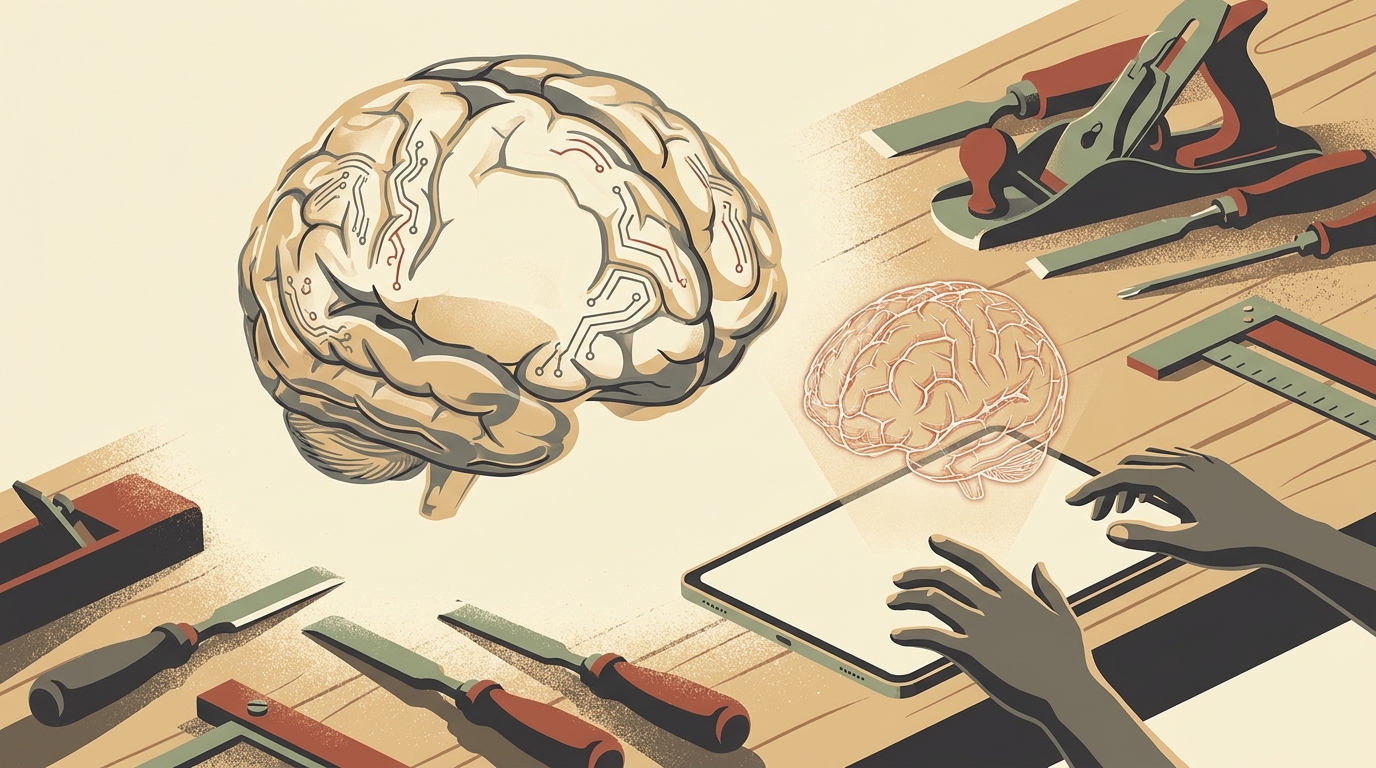
The Debt That Came Due Early
I. The question of the week
The phrase arrived fully formed, as if it had always existed: cognitive debt. It borrows the grammar of finance and software engineering — the sense of an obligation quietly accruing interest while you look away — and applies it to the human mind under the influence of generative AI. The claim beneath the metaphor is that every time a student lets a chatbot draft the paragraph, solve the proof, or summarize the reading, some faculty goes unexercised, and that the unexercised faculty atrophies, and that the atrophy compounds until one day the bill comes due in the form of a generation that cannot think.
It is a serious claim, and it deserves to be taken seriously rather than merely repeated. Over roughly a year, a handful of studies moved from journal preprints into headlines, and the headlines moved into a settled cultural conviction that AI is making us stupid. The trajectory is worth tracing because it is unusually clean: a scientific finding, a metaphor, a panic, and — in the same window — a quieter counter-current arguing that the tools might be redesigned to teach rather than to replace.
What this column wants to establish is the gap between what the research actually measured and what the word “debt” persuaded us it proved. The concern is real; cognitive offloading is real; the tradition that prizes critical thinking is older and more embattled than any chatbot. But the metaphor did work the evidence had not yet earned, and in doing so it flattered both the alarmists and the vendors, each of whom had something to sell. The arc runs from a February survey to a viral brain-scan study to a classroom framework, and it bends, once, in the middle — from alarm toward design, then back toward alarm — in a way that tells us more about our appetite for the story than about the state of anyone’s mind.
II. What we’ve been saying
The rhetoric began in a register of measured warning and escalated, predictably, into a register of loss. In January 2025, when a study reported that heavy AI use correlated with weaker critical thinking among more than 650 people aged seventeen and over in the United Kingdom, the coverage was cautious enough — AI Tools Diminishing Critical Thinking Skills Of Students, Study Finds hedged its verbs and named its sample. Within weeks the hedges were gone. By February the same body of work had become Is AI Making You Dumber? Shocking Findings on Critical Thinking and Cognitive Skills!, a headline that answers its own question before the reader arrives.
The pivotal input was a study jointly conducted by Microsoft and Carnegie Mellon, which reported that knowledge workers who trusted AI more tended to exercise less independent judgment. The finding was reported almost identically across outlets — AI dependency weakens critical thinking, study finds and AI Reliance: How Microsoft’s Study Reveals Critical Thinking Skills Are Being Eroded share not only a conclusion but a cadence — and the convergence itself is worth noticing. A single study, filtered through a wire-service logic, produced a chorus. When AI Dependency Linked to Reduced Critical Thinking Skills, Study Warns of Cognitive Offloading Risks named the mechanism — cognitive offloading — the discourse acquired a technical anchor, a term of art it could point to as evidence of rigor.
That term did quiet argumentative work. Cognitive offloading is a real and old idea: we have always externalized memory and computation onto tools, from the abacus to the address book. But in the 2025 coverage it was deployed less as description than as indictment, the neutral fact of externalization recast as a moral failing. Cognitive Offloading: How AI is Quietly Eroding Our Critical Thinking makes the move explicit in its adverb — quietly, as if the erosion were a theft committed while we slept.
Then, in the second quarter, the register changed. The pieces that appeared between April and June were noticeably more interested in design than in doom. New AI education initiatives show the way for knowledge retention in enterprises reframed the problem as “digital amnesia” and proposed that tools be built to reinforce learning rather than short-circuit it. To Improve Literacy, Improve Equality in Education, Not Large Language Models pushed back against the idea that language models could remedy declining cognitive skills at all, relocating the problem from the tool to the structure — educational inequity — that the tool was being sold to fix. Even the alarm softened into instruction: Cognitive offloading shrinks mental muscles. Here are 4 ways students can stay sharp. kept the muscle metaphor but pivoted from diagnosis to regimen. The scholarly literature grew more careful, too; Cognitive Erosion or Extension? The Psychological Impact of Outsourcing Thinking to AI posed the question as a genuine fork rather than a foregone conclusion.
This was the inversion — the one place in the arc where the optimistic framing briefly outnumbered the critical. It did not last. By late summer the doom register returned, and it returned with a stronger word. The coinage cognitive debt crystallized around a study measuring brain activity, and the coverage leaned hard on the neuroscience: Study warns overusing AI tools may weaken critical thinking, brain activity and, in the plainest possible terms, Why your mind risks going soft with AI, and how to sharpen it again. The rhetorical arc had completed a circle, but a rung higher: not merely weaker thinking, now, but a physically softened brain, and a debt that would have to be repaid.
Our own briefings tracked this drift from the adjacent territory of AI literacy. As an earlier analysis noted in our briefing of 2025-02-23, the field’s stated purpose was to “enhance learning outcomes and prepare students for future challenges” — an optimism that, by our briefing of 2025-09-16, had curdled into an emphasis on “fact-checking abilities” and defense against a world of automated persuasion. The literacy conversation and the cognitive-debt conversation are the same conversation viewed from opposite ends: one asks what to teach, the other mourns what is being lost.
III. What’s been happening
Underneath the rhetoric sat a small and specific body of evidence, and its specificity is the whole story. The studies that drove the panic were, almost without exception, correlational, self-reported, and short in horizon.
Consider the anchor. The UK study behind the January headlines surveyed more than 650 people and found a negative association between self-reported AI use and performance on a critical-thinking measure, an association most pronounced among younger participants, as AI Tools Diminishing Critical Thinking Skills Of Students, Study Finds reported. An association is not a mechanism. People who reach for AI most readily may already differ — in schooling, in confidence, in the kind of work they do — from those who don’t, and a cross-sectional snapshot cannot separate the tool’s effect from the traits of the people drawn to it. The study’s own framing acknowledged this; the headlines did not.
The Microsoft and Carnegie Mellon work had the same shape and the same ceiling. It asked knowledge workers how much they trusted AI and how much effort they felt they expended, and found that higher trust travelled with lower perceived effort — a finding about self-perception that AI dependency weakens critical thinking, study finds translated into a finding about capacity. The distance between “I felt I thought less” and “I became less able to think” is the distance the word “debt” quietly closed.
The Oregon State research narrowed the lens to STEM students and named a self-reinforcing loop — students who lean on generative AI lose the drive to understand, which makes them lean harder — as Study warns AI reliance erodes STEM students’ thinking skills described. The loop is plausible and worth studying; it is also, as reported, a pattern observed rather than a decline measured over time. Similar caution applies to the classroom-scale work: The Negative Effects of Over-Reliance on AI Tools in IT Student Learning documented drawbacks among IT students without establishing that the tools caused a durable loss.
The study that gave the whole arc its keyword — the brain-activity work behind the cognitive debt coinage — was the most rhetorically powerful and the most methodologically fragile. Measuring reduced neural engagement while a person uses a chatbot to write, as Study warns overusing AI tools may weaken critical thinking, brain activity recounted, tells us that the brain works less hard when the work is done for it. This is nearly a tautology; a calculator would produce the same EEG. That reduced engagement in the moment compounds into lasting deficit is the inferential leap the term “debt” performs, and the study — small, short, and circulated ahead of the full peer-review cycle — did not itself take that leap.
What the more careful literature actually converged on was subtler and more useful than the headlines. The distinction between erosion and extension that Cognitive Erosion or Extension? The Psychological Impact of Outsourcing Thinking to AI posed is the real research frontier: whether offloading frees cognition for higher-order work or hollows out the foundation such work stands on. And the equity argument in To Improve Literacy, Improve Equality in Education, Not Large Language Models pointed to a fact the panic obscured — that critical-thinking capacity was unevenly distributed long before generative AI, and that the tools are as likely to widen the gap as to cause it.
Meanwhile the institutions began, slowly, to metabolize the concern into practice. By autumn the conversation had produced not just warnings but frameworks: How to avoid cognitive debt by building critical thinking skills offered K-12 educators concrete moves, and Paying the Cognitive Debt: An Experiential Learning Framework for Integrating AI in Social Work Education turned the metaphor into a curriculum design — an attempt, notable for its honesty, to use the debt framing while integrating rather than banning the tools. University libraries did the quiet work of guidance; Critical Thinking - AI Resource Guide reminded students that a chatbot, like a search engine before it, presents information “as though” it were settled fact. The reality, in other words, was messier and more constructive than the rhetoric: not a generation losing its mind, but a set of institutions arguing over how to keep teaching one.
IV. Where they meet, where they miss
The rhetoric and the reality meet on a genuine premise: we do offload cognition onto our tools, and what we do not practice, we do less well. This is not controversial and not new. What the arc reveals is a metaphor that outran its evidence and, in doing so, served interests that had little to do with any student’s mind.
Begin with the word. “Debt” carries three implications the studies did not establish. It implies accrual — that each act of offloading adds to a running balance. It implies interest — that the cost compounds. And it implies inevitability — that the balance must be paid. The research supports none of these cleanly; it supports, at most, a moment-to-moment reduction in effort and a correlation, in cross-section, between heavy use and weaker performance. The leap from correlation to compounding liability is a rhetorical achievement, not an empirical one, and it is worth naming as such. The financial metaphor smuggled in a certainty the science was still assembling — precisely the substitution against which the critical-thinking tradition warns. As the Critical Thinking - The MIT Press Essential Knowledge series frames it, the point of the discipline is to make choices “through reason rather than through the emotional judgments and/or tribalism” that dominate public argument; a metaphor that does our concluding for us is the enemy of exactly that.
Notice, too, who profits from the panic in either direction. The doom framing sells solutions — literacy curricula, “brain-sharpening” regimens, the four-step lists that Cognitive offloading shrinks mental muscles. Here are 4 ways students can stay sharp. promises. The optimism framing sells tools — the “learning-centered” designs of New AI education initiatives show the way for knowledge retention in enterprises, pitched by the same industry whose products created the anxiety. That Microsoft co-authored one of the foundational alarm studies is not a scandal, but it should sharpen our attention: an industry that can credibly warn about its product’s cognitive costs is an industry that can also sell the remedy. The reader is positioned, in both cases, as someone to be managed.
Where the two accounts most badly miss each other is on the question the equity argument raised. If critical thinking is unevenly distributed — and it is — then a story about AI “eroding” a shared human faculty misdescribes the problem. The tool does not lower everyone equally; it substitutes for the scaffolding that privileged students already possess and that under-resourced students never received. To Improve Literacy, Improve Equality in Education, Not Large Language Models is the most important piece in the whole arc precisely because it refuses the flattering universalism of “our brains are going soft” and asks whose brains, under what conditions.
And the panic misses something the older tradition would have caught immediately: critical thinking was already in trouble. The Critical Thinking - Complete volume catalogues a set of “barriers to critical societies,” observing that most people “are only superficially aware of critical thinking” and “habitually violate its standards, and in multiple ways.” That was written of a world before ChatGPT. To blame the chatbot for a deficit the discipline had been documenting for decades is to grant the technology a power it does not have and to let the culture that neglected the faculty off the hook.
V. The longer view
The honest reading of this year is not that generative AI is harmless to thought, nor that it is dissolving our minds. It is that a real and studiable phenomenon — the offloading of cognitive work onto a fluent, confident, frequently wrong machine — was handed a metaphor so good that it stopped us thinking about it. “Cognitive debt” named the fear precisely enough to feel like knowledge, and the naming outpaced the evidence by a year. The frameworks now emerging in social work education and K-12 classrooms are more valuable than any headline because they do the slow thing the panic skipped: they treat the tool as a condition to be taught within rather than a thief to be locked out.
The tradition the whole argument invokes offers the sturdiest defense we have. “It is our only guarantee against delusion, deception, superstition, and misapprehension of ourselves and our earthly circumstances,” the Critical Thinking - Complete volume writes of the trained critical faculty — and if that is true, then the faculty is needed most not to resist the machine but to read it, including to read the confident story we told about what it was doing to us.
The debt that came due early was never the students’. It was ours — the interest owed on decades of treating critical thinking as a slogan rather than a practice, now called in by a machine that does our thinking exactly as badly as we let it.
References
- AI and Cognitive Offloading: A Warning for Deep Learning
- Study warns AI reliance erodes STEM students’ thinking skills
- Cognitive Offloading: How AI is Quietly Eroding Our Critical Thinking
- Why Kids Can’t Resist Cognitive Offloading - Psychology Today
- AI dependency weakens critical thinking, study finds
- Is AI Making You Dumber? Shocking Findings on Critical Thinking and Cognitive Skills!
- AI Reliance: How Microsoft’s Study Reveals Critical Thinking Skills Are Being Eroded
- AI Dependency Linked to Reduced Critical Thinking Skills, Study Warns of Cognitive Offloading Risks
- AI Tools Diminishing Critical Thinking Skills Of Students, Study Finds
- Cognitive Erosion or Extension? The Psychological Impact of Outsourcing Thinking to AI
- Cognitive offloading shrinks mental muscles. Here are 4 ways students can stay sharp.
- The Negative Effects of Over-Reliance on AI Tools in IT Student Learning
- To Improve Literacy, Improve Equality in Education, Not Large Language Models
- New AI education initiatives show the way for knowledge retention in enterprises
- How to avoid cognitive debt by building critical thinking skills
- Why your mind risks going soft with AI, and how to sharpen it again.
- New research highlights the impact of AI on critical thinking skills.
- Study warns overusing AI tools may weaken critical thinking, brain activity
- Critical Thinking - AI Resource Guide
- Paying the Cognitive Debt: An Experiential Learning Framework for Integrating AI in Social Work Education
- Critical Thinking - The MIT Press Essential Knowledge series
- Critical Thinking - Complete