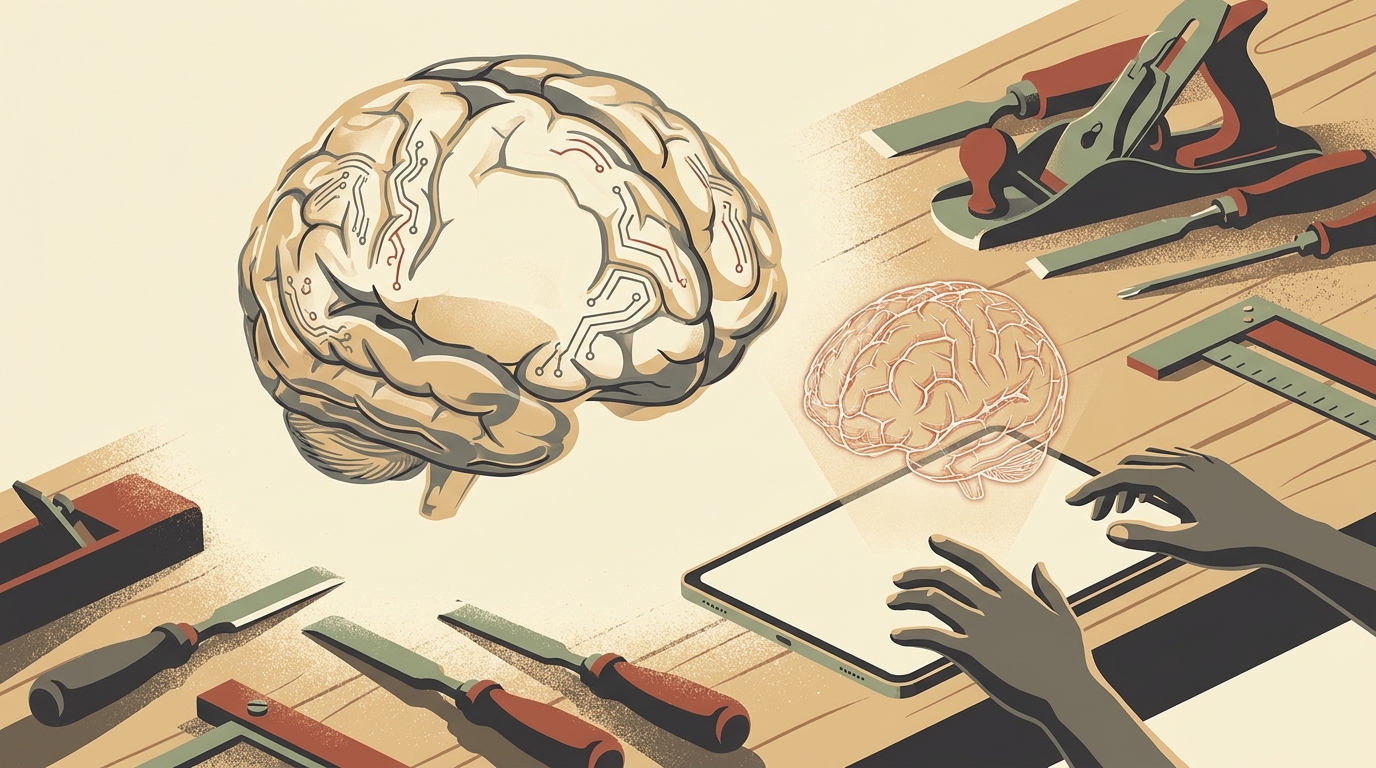
A Literacy for Users, Not Targets
I. The question of the week
The phrase “AI literacy” now travels with the moral weight of reading itself, and that borrowing is not accidental. When an advocate says a skill is the “new literacy,” the argument is already won before it is made: no one is against literacy, no one wants their grandchild left illiterate, and so the word arrives pre-approved. But ask what this particular literacy is meant to protect, and the answer, across most of the last year’s writing, turns out to be a résumé — the reader’s future employability, the nation’s competitiveness, the enterprise’s compliance posture. The narrower and more urgent cousin of that conversation is the one this column takes up: the project of teaching the people most likely to be deceived — the elderly, the isolated, children, anyone whose defenses the technology is specifically built to slip past — to recognize a voice that has been cloned from three seconds of audio, a video of a public official that was never filmed, a message from a “relative in distress” written by a system that never met the family.
The topic scored a total of 67 hits across three live quarters of 2025, and across that span the framing barely moved: optimism led every quarter, but never by much, and no inversion point ever registered. That stability is itself the story. The arc that follows traces two lines that ought to be the same line and are not. One is the rhetoric of AI literacy as it swelled through 2025 — confident, expansive, borrowing the authority of the alphabet. The other is the reality of who actually gets reached, by what, and against which threat. Where those lines meet, the consensus is real. Where they miss, a grandmother is answering a phone call that a curriculum was never written to prepare her for.
II. What we’ve been saying
Early in 2025 the register was economic, and it was confident. The World Economic Forum’s Blueprint for Intelligent Economies framed AI capability as a national maturity journey, a matter of regional collaboration and competitiveness; literacy, in that document, is what a workforce accumulates so an economy can climb. The AI Literacy Framework for the Global South inherited the same grammar, casting literacy as the ticket off the sidelines of the digital revolution — “from margins to momentum.” Even the scholarly work carried the developmental cast: a January study of AI literacy among library and information science students across Bangladesh, India, and Pakistan, with its 632 respondents, measured literacy as professional readiness. The threat model in all of this is falling behind. The victim, if there is one, is a country.
Notice what “literacy” is permitted to mean in this phase. The AI Literacy Program at the AI Center of Excellence opens by defining literacy the old way — the ability to read, write, speak, listen, and use numeracy and technology — and then extends the analogy to AI. It is a generous definition and a revealing one: it describes a person who produces and comprehends, never a person who is targeted. Deception does not appear. Defense does not appear. The literate subject is a competent user, and the whole moral force of the word is bent toward getting more people to that competence.
Through the second quarter the aperture widened from workforce to everyone. The Growing Importance Of AI Literacy In A Digital World declared understanding “no longer a luxury reserved for tech professionals.” A Kashmir-based commentary, Why AI and Digital Skills Matter More Than Ever, pressed the same universal claim, and by June the message had hardened into obligation with Why AI Literacy Is Becoming a Must, which at least named “capabilities and limitations” and “ethical implications” as part of the syllabus. This is the quarter the probe counts came nearest to even — eighteen optimistic framings against seventeen critical — and the contest was genuine. But read the critical framings and you find them arguing about hype, labor displacement, and ethics in general, not about the specific machinery of fraud aimed at specific vulnerable people.
When the discourse did reach toward the vulnerable, it reached in the empowerment register it already knew. The American Psychological Association’s advisory, reported in AI literacy: Why every teen needs to learn this essential skill, treats adolescents as learners to be equipped. A June study, Exploring Older Adults’ Experiences, Motivations and Preferences in Learning About Artificial Intelligence, took seniors seriously as students — but as students of how to leverage the technology, framing their limited knowledge as a barrier to participation rather than an exposure to harm. Even Inclusive Financial Literacy Education Driven by Generative AI, reporting a pilot in Bihar, deployed the very class of system capable of impersonation as the teacher of the resource-scarce. In each case the vulnerable person is someone to be included, not someone to be defended.
By the third quarter a new word entered the vocabulary: safe. The World Economic Forum’s Why AI literacy is crucial for safe, inclusive and strategic AI transformation put safety in the headline — but attached it to organizational transformation, authored from inside AI governance at an insurance group. Why the EU AI Act Is a Data Literacy Wake-up Call read safety as regulatory compliance for enterprises. Yale’s AI Guidance for Teachers leaned on a 2025 AAUP report to help faculty judge “whether AI is the most appropriate solution.” Safety, in other words, kept the company of institutions — workplaces, regulators, universities — and none of these has an office that answers to the pensioner receiving a call in her son’s stolen voice.
The rare piece that named deception directly stood out precisely because it was rare. Battle for truth in AI era, from March, put manipulation of what we “read, watch and believe” at the center rather than the margin. Among the library’s voices, only UNESCO’s Think Critically, Click Wisely carries this thread with any force, invoking the case of Cambridge Analytica to show, in its words, “how AI-driven content moderation and curation can impact democratic systems.” That the manipulation of belief registers as a democratic problem, and only faintly as a personal one, is a tell we will return to. As we noted in our own briefing of 2025-07-20 on the purpose and intent behind literacy initiatives, the explicit aim these authors state — preparing generations for a technology-driven world — quietly sets the terms of who the literacy is for.
III. What’s been happening
Underneath the rhetoric, the delivery infrastructure tells a plainer story: nearly every program that actually exists is attached to an institution, and institutions reach the enrolled. Schools reach students. The AI and digital literacy effort to prepare students, the higher-education work in The role of Artificial intelligence in Enhancing digital literacy, the teacher-facing Yale guidance — all presuppose a classroom and a roster. Governments reach constituents through services, as in Why AI Literacy Matters in Government. Enterprises reach employees through compliance. The one population defined by not being on any of these rosters — the retired, the homebound, the socially isolated, the very people fraud selects for — has no delivery mechanism at all.
Even inside the institutions, the reality lagged the promise. The AI education dilemma reported that in rural schools most teachers who use AI at all use it for text generation, and that “knowledge exists, but practical classroom application falls short.” If the classroom version stalls at content creation, the notion that a defensive curriculum — how to verify a voice, how to distrust a video — is quietly reaching the margins is optimistic. And the study of older adults confirmed the friction from the other side: seniors face real challenges “navigating and leveraging these technologies due to limited knowledge and understanding.” A person still working out how to use a tool is not yet positioned to interrogate its most sophisticated abuse.
What has actually been building is the asymmetry itself, and the library names it more sharply than the year’s advocacy ever did. The MIT Press Essential Knowledge volume AI Ethics makes the observation the whole literacy discourse steps around: “Some users of AI are also more vulnerable than others. Theories of privacy and exploitation often assume that the user is an autonomous and relatively young and healthy adult human being with full mental capacities.” That sentence is a quiet indictment of an entire genre. The default subject of “AI literacy” — the productive learner, the future worker, the compliant employee — is exactly the autonomous healthy adult the volume warns is a fiction when it comes to harm. The people fraud is engineered to reach are the ones the model of the literate user assumes away.
The same volume describes the mechanism that makes the deception work at scale: AI “can also be used for surveillance,” and “often people do not even know that data are being gathered, or that the data they provided in one context are then used by third parties in another context.” That is the supply chain of the modern impersonation scam stated in general terms — the harvested voice clip, the scraped photograph, the leaked contact list, recombined into a plausible emergency. The technology that a Bihar pilot uses to teach financial literacy and the technology that clones a voice to extract a wire transfer are not cousins; they are the same generative capability pointed in two directions, and only one direction has a curriculum.
The counter-evidence to my thesis, and it is real, is that the discourse is not blind. The World Bank’s Tipping the scales explicitly named AI’s “dual impact.” An October technical paper on Biases in Artificial Intelligence and Implications for AI Use in Public Administration — the quarter’s lone critical entry — insisted on an accessible account of the underlying mathematics so that non-specialists could judge the systems governing them. And UNESCO’s competency work does gesture at the right posture: its AI competency framework for teachers asks educators to practice “perspective taking” in ethical dilemmas, to reason from the standpoint of “marginalized groups.” The materials for a defensive, victim-centered literacy exist in fragments. What has not happened is their assembly into anything aimed at the person on the receiving end of the call.
IV. Where they meet, where they miss
They meet on a genuine consensus, and it should not be minimized: across the whole arc, from the World Economic Forum to the APA to UNESCO, no serious party disputes that people need to understand these systems, and several parties have taken the harder step of reaching toward populations the tech industry usually ignores — the elderly student, the rural teacher, the teenager, the unbanked. That reaching is real work, and the empowerment framing behind it is not a lie. A senior who learns to use AI confidently is, at the margin, a senior harder to bewilder.
But the two lines miss on the thing that matters most, which is the definition of the word itself. “AI literacy,” as the year’s writing overwhelmingly constructs it, is productive fluency — the capacity to use the tools well, to prompt, to comprehend, to deploy responsibly, to stay employable and compliant. It is almost never defensive suspicion — the trained reflex to doubt the familiar voice, to verify through a second channel, to treat urgency itself as the tell. These are not the same skill, and one does not deliver the other. You can be a fluent user of generative AI and still wire the money, because the scam does not attack your competence; it attacks your love for the grandchild whose voice it stole. The MIT Press AI Ethics volume caught the omission precisely: build your literacy for the autonomous healthy adult and you have built it for the person least likely to be defrauded.
Here the column will commit, because the pattern has an interested shape. A literacy defined as productive fluency serves the market that produces the tools — it manufactures capable customers. A literacy defined as defensive suspicion serves only the person, and sometimes serves them by teaching distrust of the very products the first literacy is selling. It is not a conspiracy that the discourse tilted toward the first; it is an incentive, and incentives do not need to be conscious to be decisive. When “safe” enters the vocabulary in the third quarter and immediately attaches itself to enterprise transformation and regulatory compliance rather than to the phone call, that is the incentive choosing its object. The word that could have meant safe from being defrauded was spent on safe to deploy.
Strip the mystification and the claim underneath most of the year’s “AI literacy” advocacy is modest: learn to use the products, and learn enough about their limits to use them responsibly. That is worth doing. But it is not what the topic of this week promised, and it is not what the grandmother needs at 9 p.m. when the voice on the line is sobbing in her son’s timbre. The discourse and the danger occupy the same vocabulary and different worlds. The literate user and the undefended target are, too often, the same person — reached by one program and abandoned by the other.
V. The longer view
The arc did not invert because it never had to; optimism led every quarter without ever having to defeat a rival account of who literacy is for, and the rival account — victim-centered, defensive, aimed at the phone call rather than the résumé — was never fully assembled to be defeated. What the year produced instead was a word doing borrowed moral work: “literacy,” carrying the authority of the alphabet, spent almost entirely on making people better users and almost never on making them harder marks. UNESCO’s insistence on perspective taking from the standpoint of the marginalized points at the correction, and the MIT Press AI Ethics reminder that the vulnerable user is not the autonomous adult the frameworks imagine names the population that correction would have to reach. Neither has yet been built into a curriculum with a delivery route to the isolated, the retired, the child — the people no roster contains.
The task ahead is not more literacy in the sense the year meant it. It is a second literacy, taught alongside the first and answerable to the person rather than the product: the trained instinct to hang up, to call back on a known number, to treat a perfect voice as evidence of nothing. Until that exists, the record will keep reading the way it read all through 2025.
A literacy that teaches the vulnerable to use AI but never to distrust the voice on the phone has protected the technology, not the people.
References
- AI Literacy Program - AI Center of Excellence
- Tipping the scales: AI’s dual impact on developing nations
- AI literacy: Why every teen needs to learn this essential skill
- Why AI Literacy Matters in Government - Center for Economic Development
- The AI education dilemma: Knowledge exists, but practical classroom application falls short
- AI Literacy Framework for the Global South: From Margins to Momentum
- Blueprint for Intelligent Economies - AI Competitiveness through Regional Collaboration 2025
- AI literacy of library and information science students: A study of Bangladesh, India and Pakistan
- Battle for truth in AI era
- Why AI Literacy Is Becoming a Must
- The Growing Importance Of AI Literacy In A Digital World
- Exploring Older Adults’ Experiences, Motivations and Preferences in Learning About Artificial Intelligence
- Inclusive Financial Literacy Education Driven by Generative AI: An Empirical Study on the Effectiveness of Adaptive Learning Platforms in Resource-Scarce Areas
- Why AI and Digital Skills Matter More Than Ever
- Why AI literacy is crucial for safe, inclusive and strategic AI transformation
- The role of Artificial intelligence in Enhancing digital literacy: challenges and opportunities in higher education
- Why the EU AI Act Is a Data Literacy Wake-up Call
- AI and digital literacy: Preparing students for a tech-driven future
- AI Guidance for Teachers: AI Literacy
- Biases in Artificial Intelligence and Implications for AI Use in Public Administration: A Technical Perspective
- Think Critically, Click Wisely — UNESCO
- AI Ethics - The MIT Press Essential Knowledge series
- AI competency framework for teachers — UNESCO