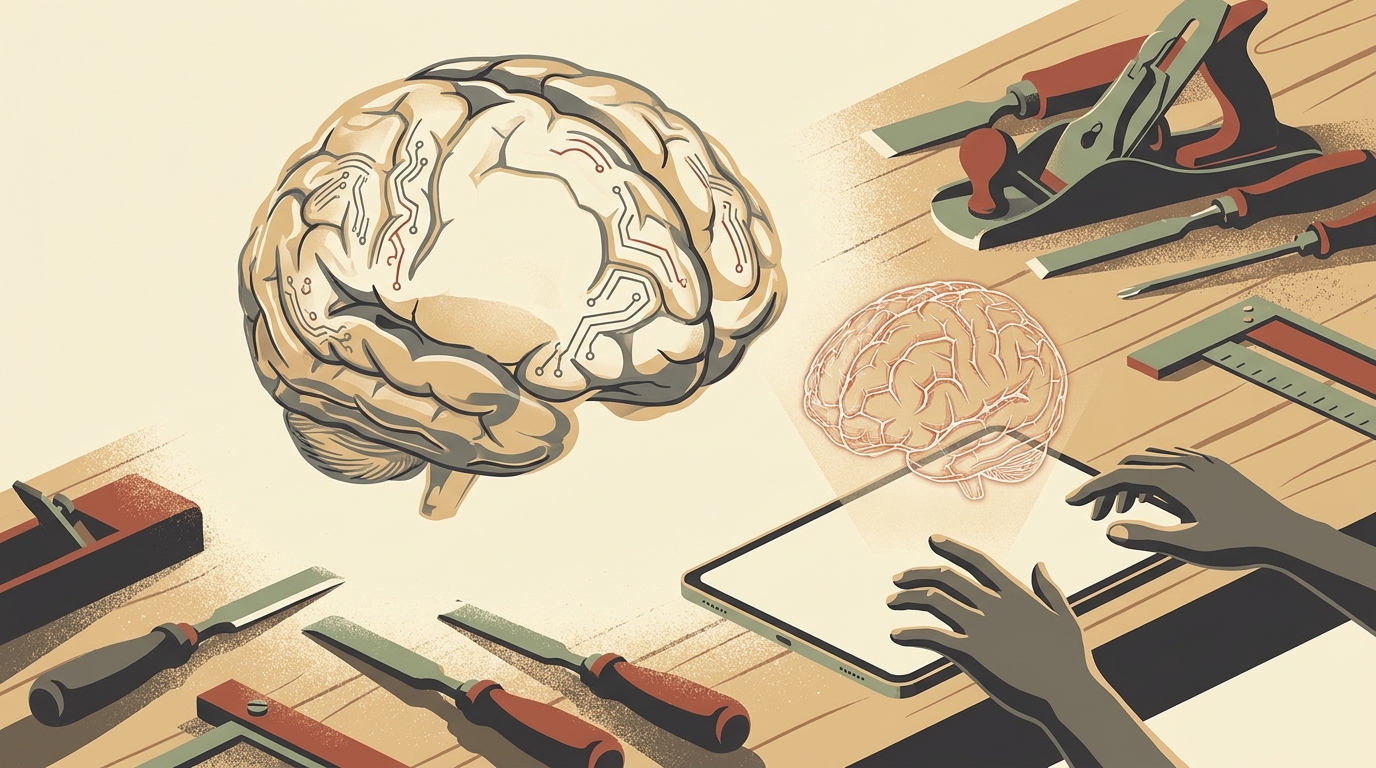
The Apprentice and the Autocomplete
I. The question of the week
The pitch for an AI coding assistant is disarmingly simple: it finishes your line before you do. Type a function name, and the suggestion arrives — grey ghost-text you accept with a keystroke. The productivity claim is real and measurable, and the industry has spent two years measuring it. The harder question, the one that has migrated slowly from the margins of the conversation to its center, is what the developer loses in the exchange. Not this quarter’s velocity, but next year’s judgment — the capacity to read a stack trace, to hold a system in the head, to know why the suggested code is wrong before the tests tell you.
The arc I want to trace runs from late 2024 to the end of 2025, and it is not an inversion. The optimists did not concede; the critics did not win. What happened instead is a shift of subject. The early conversation was about work — throughput, adoption, the augmented team. The later conversation is about cognition — memory, critical thinking, the brain that stops rehearsing what it no longer has to perform. Coding assistants were the first and cleanest test case, because programming is where the augmentation is most complete and the feedback loop most immediate, but the discourse rarely stayed with code. It kept generalizing outward, from the compiler to the mind.
The tension worth holding across the whole piece is this: the most robust empirical finding about these tools — that they help weaker performers most — is also the finding most likely to describe a hollowing-out. Leveling up the novice and eroding the formation of the expert may be the same mechanism observed at two points in a career. That is where the rhetoric and the reality have been circling each other, and mostly missing.
II. What we’ve been saying
The framing at the close of 2024 was almost entirely forward-facing and almost entirely calm. A December essay on Global AI and the future of work described AI as “one of the most transformative technologies of the 21st century” and organized its argument around reshaping, revolutionizing, redefining — the vocabulary of managed transition. Skill loss, where it appeared at all, was reframed as skill shift: the worker would move up the value chain, trade rote tasks for judgment, and emerge more human for the trade. This was the consensus register, and it held with remarkable consistency into the new year.
Through the first quarter of 2025 the dominant metaphor was partnership. Generative AI was, in the words of one representative piece, The Emerging Co-Worker Transforming Teams — a colleague, not a crutch. The co-worker framing did real rhetorical work: a colleague augments you, and no one worries that a good collaborator makes you worse at your job. Adjacent arguments insisted that the human residue was the valuable part. Uniquely human skills are more vital amid rising AI adoption proposed that empathy and ethical judgment would become “the most valuable assets at work,” and The future of work is leading towards adaptation, not extinction chose its title as a thesis. Even the anxieties of the quarter were institutional rather than cognitive — Employees Won’t Trust AI If They Don’t Trust Their Leaders located the problem in management, not in the developer’s own eroding fluency, and a companion piece warned that employers must focus on ethics before the tools “cause harm.” The harm was always somewhere in the organization. It was rarely inside the skull.
By the second quarter the vocabulary had a new keyword: literacy. AI literacy now becomes essential argued that knowing how to use these tools — “assessing” their output, prompting them well — was now a core competency for “developers, junior, and entry-level employees.” This is worth pausing on, because it marks a subtle reversal that the pieces themselves did not notice. The skill being valorized was no longer writing the code; it was managing the thing that writes the code. Our own critical analysis of the literacy discourse, in the briefing of 2025-06-08, noted how consistently these initiatives framed themselves around “equipping individuals with the skills necessary to navigate an increasingly AI-driven world” — navigation, not construction. The metaphor had quietly changed the destination. You were no longer learning to build the house; you were learning to supervise a contractor whose methods you would never fully inspect.
Then, across the third quarter, the register broke. The confident partnership language did not disappear, but it was crowded by something sharper and more physiological. Headlines stopped saying transform and started saying weaken. Study warns overusing AI tools may weaken critical thinking, brain activity is a sentence that could not have run, in that form, twelve months earlier. The economic-anxiety frame — AI takes your job — was explicitly demoted in favor of a subtler dread: Forget jobs, AI is taking away much more, the piece announced, naming creativity, memory, and critical thinking as the real casualties. By November a widely-shared essay could open its argument on Your Mind in the Age of AI: The Cognitive Risk and treat skill erosion not as a hypothesis but as a settled premise from which to reason.
What the longitudinal read shows, then, is not a debate that anyone won but a subject that quietly swapped itself out. We began by talking about the job — its tasks, its throughput, its org chart — and we ended by talking about the mind. The optimism didn’t lose. It got outflanked, because the critics stopped fighting on the terrain of productivity, which they could not win, and moved to the terrain of formation, where the optimists had never really built a position.
III. What’s been happening
The productivity numbers, meanwhile, were never in serious doubt, and they arrived early. The foundational study in this literature — the Generative AI at Work | NBER paper — tracked the staggered rollout of a conversational assistant across customer-service agents and found a result that the coding discourse would echo for two years: the tool raised output, and it raised it most for the least experienced workers. The industry’s own scorekeeper repeated the pattern. The AI Index Report 2024 documents that call-center agents using AI “handled 14.2% more calls per hour than those not using AI,” and, more consequentially, that “AI access appears to narrow the performance gap between low- and high-skilled workers,” with “notably larger gains for lower-skilled consultants using AI.” The compression of the skill distribution is the empirical spine of the optimistic case. It is also, read from a different angle, the empirical spine of the pessimistic one.
Because a gap that narrows can narrow from either end. The Stanford report presents the leveling as pure gain — the novice rises. But the same data is consistent with a world where the tool substitutes for the very struggle through which the novice would have become an expert. The literature on cognition began, through 2025, to describe exactly that substitution. A study surfaced in New research highlights the impact of AI on critical thinking skills put the mechanism plainly: “Using AI to do the thinking impacts not only quality of work but also the long-term acquisition of skills.” A library research guide, characteristically cautious, reached the same place, noting in its Critical Thinking - AI Resource Guide that “overreliance on GenAI has impacts on our critical thinking skills.” What the productivity studies measured as a boost, the cognition studies measured as a loan — output now, formation deferred.
For coding specifically, the deferral has a name in the tool’s own behavior. The assistant does not reason about your system; it predicts plausible tokens. It is very good at producing code that looks right, which is a different property from code that is right, and the gap between the two is precisely the thing an apprentice is supposed to learn to see. Janelle Shane’s account in You Look Like a Thing and I Love You (2019) named this failure mode before the coding-assistant boom made it a daily occurrence: programmers, she wrote, sometimes “don’t realize that their AI is solving a different, easier, problem than the one they had hoped it would solve.” The autocomplete solves the easy problem — what usually comes next — and presents it in the syntax of the hard one. A developer who has built the judgment to catch the substitution loses only time. A developer who never built it loses the ability to tell.
Adoption reality, though, complicated both stories at once. The tools did not conquer the workplace as cleanly as either camp assumed. A Boston Consulting Group survey, reported in AI usage is stalling out at work from lack of education and support, found deployment plateauing and the most-hyped category — autonomous agents — seeing low uptake. The bottleneck was human: people did not know how to use the tools, and organizations had not taught them. This is an awkward fact for the skill-erosion thesis in its strongest form, because you cannot be hollowed out by a tool you have not adopted. But it fits a more precise version of the worry. The New Multiverse report identified thirteen human skills whose absence was blocking adoption — the judgment, in other words, that makes a coding assistant useful is judgment the assistant does not build and may quietly consume. The tool needs expert supervision to be safe, and expert supervision is the thing the tool’s own convenience discourages people from developing.
Higher education became the sharpest field site for this, because it is where formation is the entire point. Reporting on how AI reshapes higher education amid rising concerns over critical thinking captured institutions caught in the contradiction of teaching students to use tools that may undercut the cognitive work the degree exists to produce. And the workplace research kept naming the trade-off in its own titles. A study in the Journal of the Association for Information Systems, covered as AI-powered work: Efficiency gains and human skills erosion, put both halves of the ledger in a single phrase. The efficiency was real. The erosion was real. The reporting rarely told you how to weigh one against the other, because that is not an empirical question — it is a judgment about what a career, and a mind, are for.
IV. Where they meet, where they miss
The meeting point is the finding both sides agree on and read in opposite directions: the tools help weaker performers most. The optimists call this democratization; the skeptics call it dependency; the AI Index simply calls it a narrowed gap. All three are describing one measurement. What separates them is a claim about time that no productivity study is built to test. Over a single sprint, the junior developer with an assistant outperforms the junior developer without one. Over a career, the question is whether the first developer ever becomes senior, or whether the scaffolding that made her productive on day one prevents the struggle that would have made her expert by year five. The rhetoric of Q1 2025 answered this by assumption — the human moves up the value chain — and the cognition research of Q3 answered it by measurement, finding that “using AI to do the thinking” degrades “the long-term acquisition of skills.” Those are not two opinions about the same evidence. They are evidence and its absence, dressed as a debate.
The miss is subtler, and it is a miss on both sides. The optimistic frame treated productivity and learning as the same axis — faster is better, and better compounds. It does not compound if the speed comes from skipping the part where you learn. But the pessimistic frame committed the mirror error, sliding from coding assistant to the human mind with a speed the evidence does not license. The alarm that AI is taking away creativity, memory and critical thinking generalizes from studies of specific tasks under specific conditions to a civilizational verdict about cognition itself. That generalization is a rhetorical move, not a finding, and it should be named as one.
Here the machines-beat-humans reflex is worth interrogating, because it structures how we panic. The AI Ethics volume in the MIT Essential Knowledge series opens on the scene the culture keeps returning to — DeepMind’s AlphaGo securing “a 4–1 victory in the game Go” in March 2016, two decades after Kasparov fell to Deep Blue, in a game “seen as one that only humans could play, using their intuition and strategic thinking.” The rhetorical structure of skill-erosion panic borrows directly from that moment: the machine crosses a line we thought was ours, and we narrate loss. But Go players did not get worse after AlphaGo; some got demonstrably better by studying its moves. The lesson the coding discourse should draw is that the relationship between a tool and a skill is not fixed by the tool. It is fixed by how we build the practice around it — whether the assistant is positioned as a thing to learn from or a thing to hide behind.
Which returns the argument to power, where it belongs. The BCG data showing adoption stalling for lack of education and support is the tell. The tools were shipped before the pedagogy for using them existed, and the burden of not being deskilled was quietly transferred to the individual developer — read as literacy, as adaptation, as the worker’s responsibility to stay sharp. That transfer is the move to watch. It is cheaper to sell autocomplete than to fund apprenticeship, and the erosion story, whatever its physiological truth, is also a story about who was made responsible for a competence that institutions stopped teaching.
V. The longer view
The apprentice system worked because struggle was not a bug. You wrote the bad code, watched it fail, read the trace, and the failure wrote something into you that no correct answer could. The coding assistant is, among other things, a machine for removing that struggle — and removing struggle is exactly what it should do when the struggle is waste, and exactly what it should not do when the struggle is the education. The discourse spent 2025 discovering that it could not tell these two cases apart, and neither, yet, can the tool. The optimists were right that the novice is more productive today. The skeptics are right that productivity is not the same as formation, and that the measurement we have is all of the first and almost none of the second. The honest position is not the midpoint between them but the one both keep gesturing past: that a skill is not a possession the tool can top up or drain, but a practice we either build the conditions to keep alive or quietly let lapse — and that decision is being made now, in defaults and onboarding docs, not by developers but for them.
The assistant will always finish the line. The only question that matters is whether you could have finished it yourself, and whether, a year from now, you still can.
References
- Global AI and the future of work
- Generative AI: The Emerging Co-Worker Transforming Teams
- Uniquely human skills are more vital amid rising AI adoption
- The future of work is leading towards adaptation, not extinction
- Employees Won’t Trust AI If They Don’t Trust Their Leaders
- With growth of AI assistants, employers must focus on ethics, says expert
- AI literacy now becomes essential
- Generative AI at Work | NBER
- AI-powered work: Efficiency gains and human skills erosion
- AI usage is stalling out at work from lack of education and support
- New Multiverse report identifies 13 human skills gaps that threaten the adoption of AI technologies
- Study warns overusing AI tools may weaken critical thinking, brain activity
- Forget jobs, AI is taking away much more: Creativity, memory and critical thinking are at risk
- Critical Thinking - AI Resource Guide
- New research highlights the impact of AI on critical thinking skills
- Your Mind in the Age of AI: The Cognitive Risk
- AI reshapes higher education amid rising concerns over critical thinking