AI Literacy for Citizen Participation Report
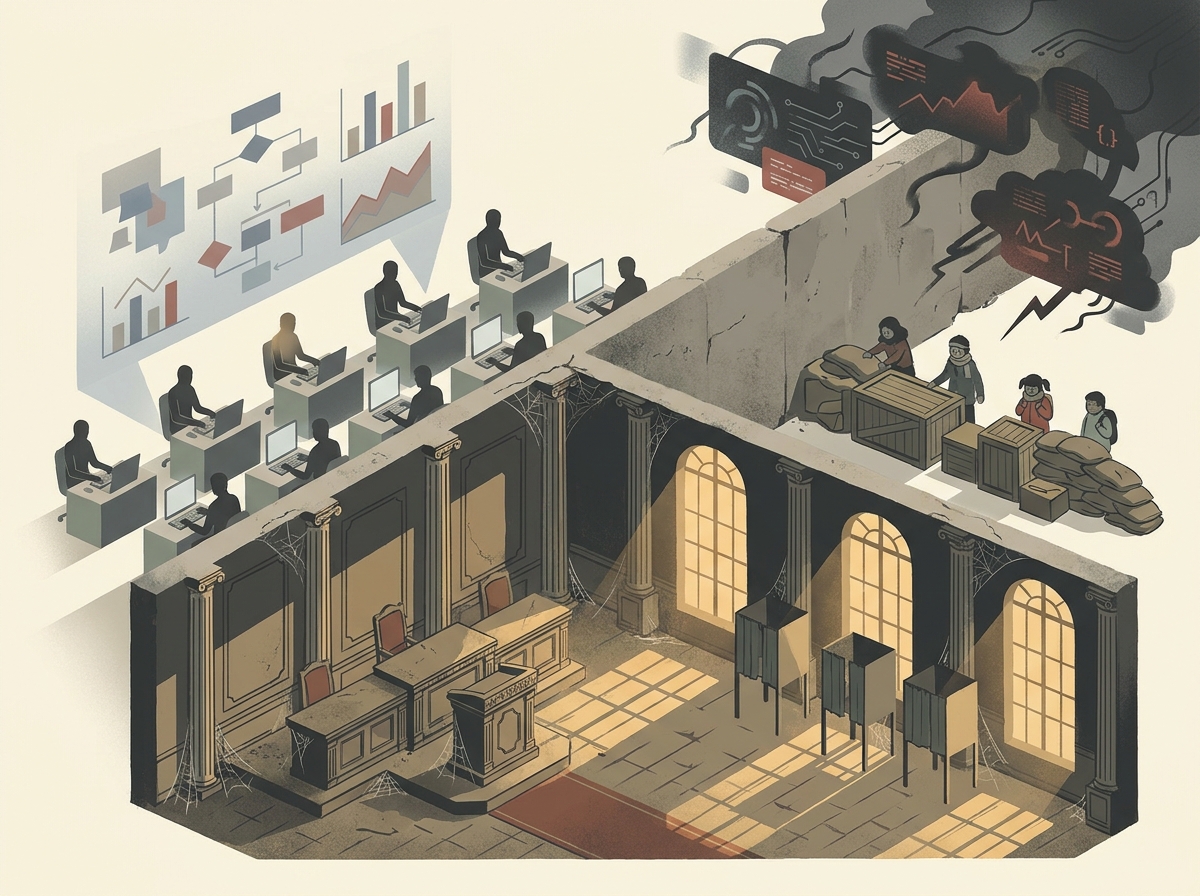
Analysis of the 1,019 AI-literacy sources surfaced this week — drawn from a corpus of 4,946 — reveals a discourse still organized around the individual as operator of AI tools while largely neglecting the individual as subject of them. The citizen-as-participant framing — someone who needs to know when a system is being run on them, by whom, and with what recourse — appears in only a thin slice of the material. Most sources treat literacy as a productivity competence: learn to prompt well, learn to spot a fake, get back to work.
The Landscape
Walk through what the discourse actually calls “literacy” and a pattern emerges fast. The most concrete, most confidently written material is vendor-authored and skills-oriented: how to phrase requests Best practices for prompt engineering with the OpenAI API, how to structure a session Prompt engineering best practices for ChatGPT - OpenAI Help Center, how to handle data safely inside a generative system Consideraciones de seguridad para los datos en la IA generativa. This is genuinely useful, and it is also self-interested: the companies defining “competent use” are the companies selling the tool. The delta worth naming — against this publication’s earlier reading of literacy as workforce-and-misinformation preparation — is that the supply of literacy content has consolidated around the vendors, so that fluency now often means fluency in one company’s interface rather than judgment about the category.
Whose Literacy
The teaching voices are lopsided. Platforms teach usage; consumer-protection and press outlets teach fear. The most citizen-centered material this week came not from AI educators but from investigative reporting — Chile’s El Mostrador documenting that the state itself runs unaudited algorithms with no transparency or external control El Estado usa algoritmos que nadie fiscaliza, and NPR examining how chatbots quietly launder foreign propaganda into ordinary answers How AI chatbots and AI overviews parse foreign propaganda. Notice the asymmetry: the entities citizens most need literacy about — governments, platforms, influence operations — are precisely the ones not writing the curriculum. Ordinary people appear in this discourse as recipients of advice, rarely as authors of it.
What’s Being Taught
Thematically, the material splits into two unequal piles. The larger pile is use — prompting, tool selection, output cleanup. The smaller is defense: how to spot a deepfake How to Spot AI Deepfakes & Fake News: Full Guide (2026), why detection tools breed suspicion rather than trust AI detectors are creating a new era of distrust - The Verge, why models fabricate with confidence New sources of inaccuracy? A conceptual framework for studying AI hallucinations. What’s striking is how much of the “defense” literature stops at detection and never reaches redress — what you actually do after you’ve been targeted by a synthetic robocall or a manipulated clip La democracia sintética en Iberoamérica y el ‘deepfake’. Literacy is framed as vigilance, an individual burden, not as a claim on institutions.
What’s Missing
Three competencies barely register. First, consent and data rights — the discourse tells you to use tools safely, almost never how to refuse them or find out what they hold on you. Second, governance participation — how a citizen contests an algorithm a government deploys, as opposed to merely detecting one. Third, the most vulnerable subjects are treated as objects of concern rather than participants: children whose conversational toys record them Juguetes con IA, families surveyed about anxieties no curriculum addresses Snapshot of AI Usage and Concerns Among Children and Parents. The gap is not knowledge of tools. It is power over them.
Core Tensions
The concept of “AI literacy” conceals genuine tensions about what citizens need to know and why. Our analysis of this week’s 4,946 sources surfaces a category-defining fracture: the phrase names a skill but smuggles in a politics. The most fundamental tension is between technical fluency — knowing how to prompt, verify, and operate the systems — and critical understanding — knowing who built them, on whose data, and toward whose ends. This isn’t a knowledge gap to fill. It’s contested terrain, and the contest is over which definition gets funded, taught, and called “literacy” at all.
Notice the first move. Vendors are eager to define literacy as usage. OpenAI’s own guidance frames competence as the ability to write better prompts Best practices for prompt engineering with the OpenAI API, a framing echoed in its consumer-facing playbook Prompt engineering best practices for ChatGPT - OpenAI Help Center. This is literacy as customer onboarding: the more fluent you become, the more dependent you are on the product doing the teaching. A citizen who has mastered prompting has learned to make the tool sing — but has learned nothing about whether the tool should be in the room. The delta from our earlier coverage, which treated literacy mainly as workforce readiness, is that the workforce frame quietly cedes the definition to the seller.
Individual competency vs. collective governance. The second tension is where literacy stops being personal. A Chilean investigation this week found the state running algorithms that no one audits — systems making consequential decisions with no transparency or external control El Estado usa algoritmos que nadie fiscaliza: expertos alertan por falta de transparencia y control. No amount of individual prompt-craft equips a citizen to challenge an opaque public algorithm. The skills that matter there are collective: the right to inspect, the standing to contest, the institutions to audit. When literacy is sold as a private competency, it privatizes a problem that is structurally public — and lets the deploying institution off the hook.
Consumer literacy vs. citizen literacy. Watch what the dominant guidance teaches you to do when things go wrong. The most cited “literacy” resources are, tellingly, instructions for reporting phishing and spam Evitar y denunciar los correos de phishing - Ayuda de Legal and flagging deceptive content Denuncia spam, suplantación de identidad (phishing) o software …. Useful — but this is literacy as self-protection, the citizen recast as a vigilant consumer patrolling her own inbox. It says nothing about the industrial production of synthetic deception. When AI-driven influence operations target Ukraine at scale How AI-Driven Influence Operations Attack Ukraine, or when synthetic democracy spreads through Iberoamerican elections La democracia sintética en Iberoamérica y el ‘deepfake’, the “spot the deepfake” checklist How to Spot AI Deepfakes & Fake News: Full Guide (2026) is a squirt gun aimed at a flood.
Protection FROM vs. empowerment WITH. This tension is sharpest where the stakes are least symmetrical. UNICEF’s data on children and AI documents parents who cannot assess systems their kids already use daily PDF Snapshot of AI Usage and Concerns Among Children and Parents, and safety researchers show how hard it is to evaluate whether a system is even safe to talk to Beyond “I Can’t Help with That”:How Child Safety Experts Evaluate AI …. “Empowerment” is the vendor’s word; “protection” is what people actually ask for when they can’t see inside the box.
Here the metaphors do quiet work. Across the corpus, AI appears as a Tool 304 times, a Threat 52 times, and a Partner only 7. The Tool frame flatters the user — you wield it, you’re in charge — which is exactly why it obscures agency: a tool doesn’t parse foreign propaganda and decide what to surface, but AI systems do How AI chatbots and AI overviews parse foreign propaganda. The Threat frame overcorrects into paralysis. The Partner frame — vanishingly rare — would demand something the other two dodge: an account of the system’s own interests, and of the company standing behind it. Citizens can test any framing with one question: when this goes wrong, who does the metaphor say is responsible? If the answer is always “you,” you’re reading marketing, not literacy.
Power & Agency Analysis
Power in AI literacy operates through definition: whoever decides what citizens “need to know” also decides what stays invisible. Our reading of this week’s 4,946 sources finds the same asymmetry surfacing across languages and continents — the dominant frame casts AI as a tool (304 instances in the metaphor network) against a much thinner strain casting it as a threat (52). That ratio is not neutral. A vocabulary weighted six-to-one toward “tool” teaches citizens that a human hand is always on the controls — and quietly writes the systems’ own designers out of the frame.
How AI Is Portrayed
Watch the grammatical move. When an AI system produces a false claim, the reporting calls it a “hallucination” — a word that lodges the error inside the machine, as if it dreamed on its own. The Harvard Kennedy School’s conceptual framework for studying AI hallucinations is useful precisely because it resists this reflex, tracing inaccuracy back to training data, deployment choices, and the humans who shipped the product. MIT Sloan’s own teaching materials on AI hallucinations and bias make the same correction. But the default register — “the AI decided,” “the algorithm flagged” — grants machines an agency they do not have, and absolves the parties who do. When Chile’s press reported that the state uses algorithms nobody audits, the scandal was not machine autonomy. It was human agencies deploying opaque systems and declining to be accountable for them. Agency framing is a literacy lesson delivered before any curriculum begins.
Who Defines Literacy
Notice who is writing the primers. The most widely circulated guidance on how to “use AI well” comes from the vendors: OpenAI’s prompt engineering best practices and its API guidance, Amazon’s security considerations for generative AI data, Google’s own phishing-reporting help pages. This is literacy defined as competent operation of a product — how to prompt, how to stay safe inside the walled garden. It is not literacy as the capacity to ask whether the product should exist, who profits, or what it does to you. When the syllabus is written by the seller, “informed citizen” narrows to “skilled user.” Anthropic’s move to enable independent research on how people use Claude is a partial counterweight — but it, too, sets the terms of what outsiders are permitted to see.
What Metaphors Teach
“Tool” is a comforting word. It implies neutrality, obedience, a thing you pick up and put down. What it obscures is dependence, data extraction, and the fact that the tool is also watching you. The UNICEF Innocenti brief on AI usage and concerns among children and parents and the reporting on AI toys that converse with your child describe objects that no reasonable person would call inert. The “threat” metaphor, meanwhile, does its own political work: it justifies surveillance responses, as the disinformation research from EDMO and NPR’s account of how chatbots parse foreign propaganda both show — threat framing tends to license more monitoring, not more citizen power. Critical metaphor literacy means holding both words at arm’s length and asking what each one lets someone do.
Citizen Agency
So what power do citizens actually hold? Less than the “tool” story promises, more than the “threat” story concedes. The genuine leverage is collective, not individual: audit requirements of the kind Chile’s experts demand, fact-checking infrastructure like Peru’s electoral AI verifier, and reporting on synthetic manipulation of the sort El País documented in Iberoamerican deepfake democracy. Individual vigilance — spotting a deepfake, per the practical 2026 guide — matters, but it cannot substitute for accountable institutions. The prior weeks of this report treated literacy as workforce and ethical preparation; the delta here is sharper and less flattering. Literacy’s first act is not learning to use the tool. It is refusing the vocabulary that tells you the tool has no owner.
Failure Genealogy
Literacy failures differ from technical failures: they occur when citizens misunderstand what AI is, what it’s doing, or how to evaluate it. The model doesn’t crash; the person does. Our reading of this week’s evidence — drawn from 4,946 sources — surfaces a recurring set of breakdowns that have less to do with the machine’s limits than with the stories people tell themselves about it.
Where understanding fails
The two dominant failure modes are opposite in direction and identical in cause: they both come from treating AI as a kind of authority rather than a system that generates plausible text. Over-trust looks like accepting a chatbot’s confident answer because it is fluent and fast. Under-trust looks like the new reflex documented across campuses, where the very existence of AI has made people suspect everything — including human work. AI writing detectors, sold as a fix, have instead manufactured a “new era of distrust” AI detectors are creating a new era of distrust, producing false accusations that fall hardest on non-native English writers Inside college AI cheating wars: extreme surveillance, false …. The detection gap is real in both directions: people cannot reliably spot synthetic content, and the tools promising to spot it for them do not work — which is why institutions are now abandoning them AI Detectors Are Out, New Approaches Are In - Inside Higher Ed. For a citizen scrolling an election feed, the same gap governs whether a deepfake lands La democracia sintética en Iberoamérica y el ‘deepfake’.
What assumptions mislead
Three assumptions do most of the damage. The first is that fluency signals accuracy — that a well-formed answer is a correct one. The Harvard framework on AI “hallucinations” shows why this is backwards: inaccuracy is structurally baked into how these systems generate language, not an occasional bug New sources of inaccuracy? A conceptual framework for studying AI …. The second is that a chatbot is a neutral librarian. When researchers fed AI overviews and chatbots material laundered from state propaganda, the systems repeated it — because they parse volume and phrasing, not provenance How AI chatbots and AI overviews parse foreign propaganda. The third, quietest assumption is that talking to an AI is private. It is not; what you type becomes data, a point buried in security guidance most people never read Consideraciones de seguridad para los datos en la IA generativa. That assumption becomes acute when the AI is a child’s talking toy Juguetes con IA: ¿Qué pasa cuando el peluche de tu hijo puede conversar con él?.
Consequences of gaps
The costs are unevenly distributed. Foreign influence operations exploit detection gaps at scale, as documented in the sustained AI-driven campaigns against Ukraine How AI-Driven Influence Operations Attack Ukraine and the municipal-election disinformation troubling France Municipales 2026 : IA, deepfakes et désinformation, la démocratie …. But the sharper harm is structural: when the state itself runs algorithms nobody audits, the literacy gap is not the citizen’s to close — the information needed to evaluate the system is withheld El Estado usa algoritmos que nadie fiscaliza: expertos …. Children and parents, per UNICEF’s survey, bear these costs with the least preparation PDF Snapshot of AI Usage and Concerns Among Children and Parents.
What would help
The honest version: literacy that treats provenance, not fluency, as the unit of judgment — asking where did this come from before does this sound right. Verification infrastructure, like the fact-checking tools built for Peru’s 2026 elections Verificador de Hechos Elecciones Perú 2026 — Fact Check con IA | CONDOR, helps only if people know to reach for it. But no amount of individual literacy fixes an unaudited state algorithm or a propaganda-laundering search engine. Those are governance failures wearing a literacy costume — and it is worth naming who benefits when the burden is quietly reassigned to the reader.
Evidence Synthesis
Synthesizing findings across 4,946 sources this week, the evidence on AI literacy points to a single, uncomfortable conclusion: the skill that matters most for citizens is not operating the tools but adjudicating their outputs under conditions of manufactured doubt. This goes beyond technical skill. The civic problem is no longer “can you use a chatbot” — it is whether you can hold a position on what is real when the machinery of verification has itself become a source of suspicion.
What the evidence shows
The convergent finding is that detection-based literacy fails, and it fails predictably. AI writing detectors have produced enough false positives to generate what one account calls “a new era of distrust” AI detectors are creating a new era of distrust, and institutions are quietly abandoning them AI Detectors Are Out, New Approaches Are In. What replaces detection is not a better gadget but a shift toward process and provenance — content-authenticity approaches that verify origin rather than sniff for machine fingerprints AI Content Authenticity Tools: What’s Real, What’s Hype, and What …. The literacy that works, then, is understanding that a system’s confident fluency is not evidence of accuracy: hallucination is structural, not incidental New sources of inaccuracy? A conceptual framework for studying AI …, and even mainstream chatbots ingest and relay state propaganda when asked ordinary questions How AI chatbots and AI overviews parse foreign propaganda.
Contested terrain
Where the evidence splinters is on the question of whose competence is being measured. The synthetic-media panic frames literacy as an individual’s ability to spot a deepfake How to Spot AI Deepfakes & Fake News: Full Guide (2026) — a framing convenient to platforms because it locates failure in the citizen’s eyes rather than the distribution system. Reporting from Iberoamérica complicates that: the corrosive effect of “synthetic democracy” is less that any single fake fools voters than that the mere possibility of fakes lets bad actors dismiss authentic evidence La democracia sintética en Iberoamérica y el ‘deepfake’. Detection literacy cannot fix a problem whose payload is doubt itself, a dynamic already visible in the influence operations documented against Ukraine How AI-Driven Influence Operations Attack Ukraine.
Across domains
Tool-specific literacy has a real floor — knowing that what you type into a generative system may be retained and repurposed is a data-security fact, not a preference Consideraciones de seguridad para los datos en la IA generativa, and prompt technique changes output quality in ways vendors themselves document Best practices for prompt engineering with the OpenAI API. But the social-aspects dimension is where literacy becomes an equity question. When the Chilean state runs algorithms that no one audits El Estado usa algoritmos que nadie fiscaliza: expertos …, individual competence is beside the point — the relevant literacy is collective, the capacity to demand transparency of systems that make decisions about you. That extends to the youngest citizens, where UNICEF documents parents navigating tools they cannot inspect PDF Snapshot of AI Usage and Concerns Among Children and Parents and conversational toys enter homes without disclosure norms Juguetes con IA.
Gaps and uncertainty
What the evidence does not tell us: whether any literacy intervention actually shifts behavior at population scale, or only self-reported confidence. Independent research on how people really use these systems is still gated by the vendors who hold the data Enabling independent research on how people use Claude. We are measuring literacy against a moving target with instruments the target’s makers control.
For citizens
Two takeaways the evidence supports. Individually: treat fluency as a claim, not a proof — verify provenance, assume retention of anything you input, and distrust any tool that promises to detect deception for you. Collectively: the load that individual literacy cannot carry — auditable public algorithms El Estado usa algoritmos que nadie fiscaliza, disclosure standards, election-integrity infrastructure Verificador de Hechos Elecciones Perú 2026 — is a political demand, not a personal one. The evidence is clear that no amount of savvy spotting will substitute for it.
References
- AI Content Authenticity Tools: What’s Real, What’s Hype, and What …
- AI detectors are creating a new era of distrust - The Verge
- AI Detectors Are Out, New Approaches Are In - Inside Higher Ed
- AI hallucinations and bias
- Best practices for prompt engineering with the OpenAI API
- Beyond “I Can’t Help with That”:How Child Safety Experts Evaluate AI …
- Consideraciones de seguridad para los datos en la IA generativa
- Denuncia spam, suplantación de identidad (phishing) o software …
- EDMO
- El Estado usa algoritmos que nadie fiscaliza
- electoral AI verifier
- enable independent research on how people use Claude
- Evitar y denunciar los correos de phishing - Ayuda de Legal
- How AI chatbots and AI overviews parse foreign propaganda
- How AI-Driven Influence Operations Attack Ukraine
- How to Spot AI Deepfakes & Fake News: Full Guide (2026)
- Inside college AI cheating wars: extreme surveillance, false …
- Juguetes con IA
- La democracia sintética en Iberoamérica y el ‘deepfake’
- Municipales 2026 : IA, deepfakes et désinformation, la démocratie …
- New sources of inaccuracy? A conceptual framework for studying AI hallucinations
- Prompt engineering best practices for ChatGPT - OpenAI Help Center
- Snapshot of AI Usage and Concerns Among Children and Parents