AI Literacy for Citizen Participation Report
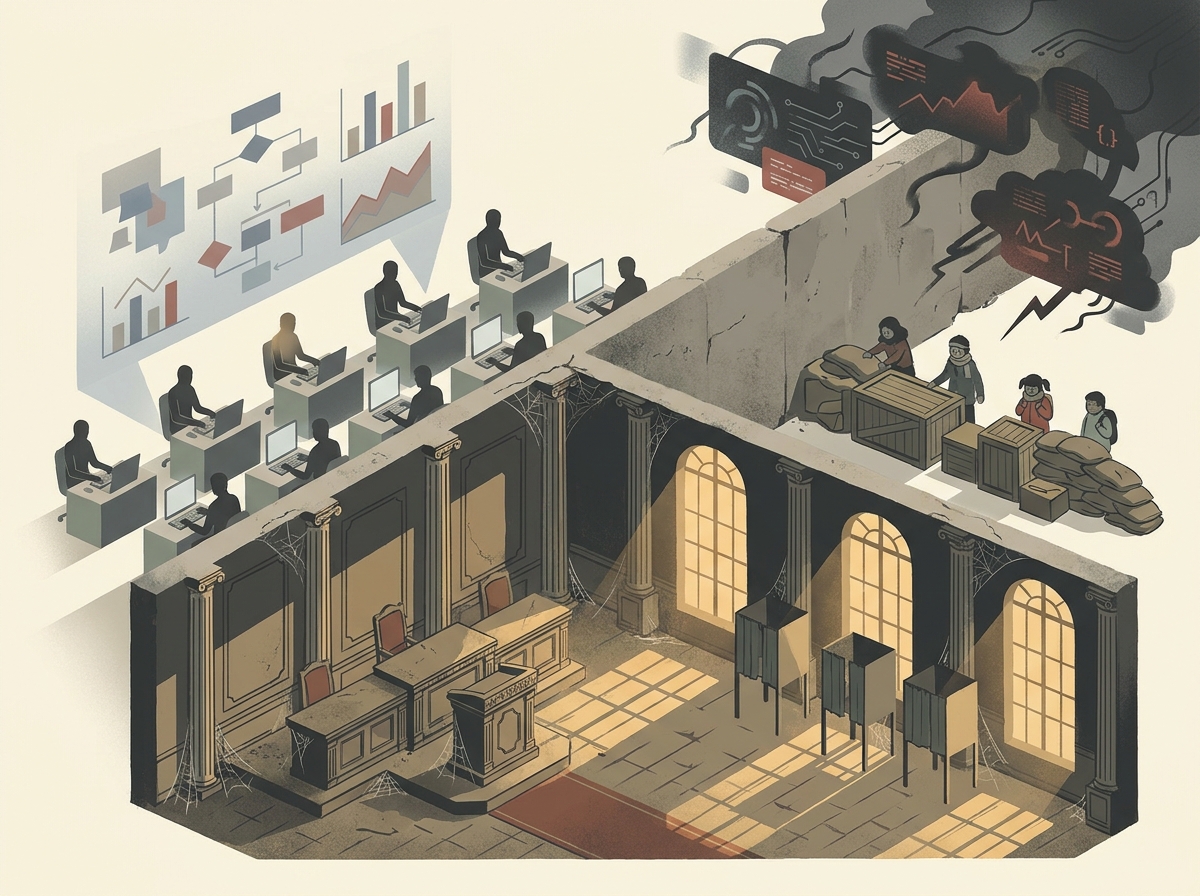
Analysis of 1,036 AI literacy sources drawn from a week of 4,890 total reveals a discourse fixated on defense — spotting fakes, catching cheats, blocking scams — while the harder civic question of how ordinary people might actually govern the systems already acting on them barely registers. The citizen-as-participant framing surfaces in only a sliver of the corpus; most sources treat literacy as threat-detection, a set of reflexes for surviving AI rather than a standing capacity for shaping it.
The Landscape
“AI literacy,” as the week’s sources use the phrase, has quietly narrowed. The dominant framing is protective and reactive: how to recognize a deepfake Deepfakes and the crisis of knowing - UNESCO, how to avoid a phishing lure Protección contra ataques de suplantación de identidad (phishing …, how to keep a chatbot from harming a teenager Common Sense Media Finds Major AI Chatbots Unsafe for Teen Mental …. These are real skills. But notice who is doing the defining. Vendors publish the safety FAQs ¿Es ChatGPT seguro para todas las edades? - OpenAI Help Center; platform-security firms publish the threat guides; the closest thing to a civic charter comes from a federal advisory body whose recommendations remain aspirational PDF United States of America RECOMMENDATIONS: Enhancing AI Literacy for the. Literacy is being scripted largely by the parties with the most to gain from citizens staying reactive.
Whose Literacy
The perspective distribution is lopsided. Expert and institutional voices — safety researchers, journalism watchdogs, security vendors — dominate, and they speak about citizens far more than with them. When RSF runs a hundred deepfakes through analysis to warn that detection is failing Cent deepfakes passés au crible : RSF alerte sur une menace croissante …, the implied reader is a professional gatekeeper, not a voter deciding what to trust before a municipal election Municipales 2026 : IA, deepfakes et désinformation, la démocratie …. Even the empirical work on how people actually use these systems — that 60% of U.S. teens have tried AI chatbots and 11.4% use them daily 60% of U.S. Teens Have Tried AI Chatbots, 11.4% Use Them Daily — frames the user as a subject to be studied and protected, rarely as an agent to be equipped.
What’s Being Taught
The thematic clusters resolve into two unequal piles. The larger one is detection and use: how to verify content AI Content Authenticity Tools: What’s Real, What’s Hype, and What …, how to resist coordinated manipulation Experts warn of threat to democracy from ‘AI bot swarms’ infesting …, how to guard a grandparent against a cloned voice AI Scams Targeting Seniors: 2026 Defense Guide | HCSK. The smaller pile — critical judgment about the systems, not just their outputs — is where the discourse thins. And where it does teach detection, it often oversells it: the accusatory infrastructure of AI-detection tools generates false positives that upend real lives, as families in Palo Alto A Palo Alto high schooler was accused of AI cheating. His family filed … and Long Island An Adelphi University student was accused of using AI to … - Newsday discovered. Teaching citizens to trust detection is itself a literacy failure when the detectors are unreliable False Positives in AI Detection: Complete Guide 2026.
What’s Missing
Almost entirely absent: literacy as leverage. The corpus rarely equips a reader to demand an audit trail, contest an automated decision, or weigh in on procurement — the governance muscles Carnegie argues we lack because no one monitors these systems over time We Need Ongoing Monitoring of AI and Political Information. Data rights, consent, and the mechanics of redress appear as afterthoughts. The Council of Europe’s framing of generative AI as a democratic question IA générative et démocratie is the road not taken by most of the week’s sources. The delta from a year of prior literacy debates is precisely this: the constraint is no longer curriculum or access — it is that the discourse still trains defenders, not participants.
Core Tensions
The phrase “AI literacy” sounds like a settled good, the civic equivalent of learning to read. But the term conceals a fight about what citizens are supposed to know, who decides, and whose interests the knowing serves. Our reading of this week’s evidence surfaces no single missing fact to supply. What it surfaces instead is contested terrain: four tensions that any honest literacy agenda has to pick sides on, and most agendas quietly pick a side without telling you.
Protection from AI versus empowerment with it. The most visible framing casts the citizen as a target to be shielded. The threats are real: deepfakes that RSF documents as a growing hazard to journalists and the public record Cent deepfakes passés au crible : RSF alerte sur une menace croissante …, AI-generated scams engineered specifically for older adults AI Scams Targeting Seniors: 2026 Defense Guide | HCSK, and chatbots that Common Sense Media found unsafe for teenagers seeking mental-health support Common Sense Media Finds Major AI Chatbots Unsafe for Teen Mental …. A protective literacy teaches wariness: spot the fake, refuse the pitch, verify before sharing. But protection framing has a cost — it positions the citizen as perpetually on defense, downstream of tools built by others, and it lets the builders off the hook. When 60% of U.S. teens have already tried AI chatbots and 11.4% use them daily 60% of U.S. Teens Have Tried AI Chatbots, 11.4% Use Them Daily, “just be careful” is not literacy; it is triage.
Consumer literacy versus citizen literacy. Watch the move made by the vendors themselves. OpenAI’s own safety guidance frames the question as whether its product is appropriate for various ages ¿Es ChatGPT seguro para todas las edades? - OpenAI Help Center — a consumer question, answerable by adjusting settings and reading the terms. Consumer literacy makes you a competent user of a product. Citizen literacy asks a different order of question: who owns the model, what does it do to the information commons, and who is accountable when it degrades shared reality? The Council of Europe frames generative AI as a matter for democratic institutions, not user preferences IA générative et démocratie. The two literacies are not complementary; the consumer frame actively crowds out the citizen frame by making the individual account the unit of analysis.
Individual competency versus collective governance. Much of the policy literature loads responsibility onto the person. The U.S. National AI Advisory Committee’s recommendations lean on individual skill-building as the mechanism of resilience PDF United States of America RECOMMENDATIONS: Enhancing AI Literacy for the. But no quantity of personal skill lets a citizen out-verify an industrial-scale problem. When experts warn of “AI bot swarms” flooding social platforms Experts warn of threat to democracy from ‘AI bot swarms’ infesting …, and the Carnegie Endowment argues we need ongoing institutional monitoring of AI in political information We Need Ongoing Monitoring of AI and Political Information, the honest conclusion is that individual literacy is necessary and radically insufficient. Framing it as sufficient is a way of not regulating.
Use versus refusal. Almost no mainstream literacy program treats not using AI as a legitimate literate choice. Yet the Brennan Center’s finding that AI both fights and fuels election disinformation Does AI Fight or Fuel Election Disinformation? - Brennan Center for Justice implies that competent citizenship sometimes means declining the tool, not mastering it.
Underneath all four tensions sits a metaphor war. Across the discourse, AI is overwhelmingly a tool (roughly 304 framings to the threat frame’s 52). The tool metaphor is comforting and disarming: a tool has no agency, so responsibility rests wholly with the wielder — exactly the assumption that produces “just be careful” literacy. The rare partner framing (7 instances) would demand something the tool frame forbids: reciprocal obligations, disclosure, a duty of care from the system toward the person, which is precisely what UNESCO invokes when it describes deepfakes as a crisis of knowing rather than a crisis of users Deepfakes and the crisis of knowing - UNESCO. The literacy citizens actually need begins here: ask which metaphor a given program assumes, and ask whom that assumption conveniently absolves.
Power & Agency Analysis
Power in AI literacy operates through definition: whoever decides what citizens “need to know” also decides what stays invisible. The framing that dominates this week’s evidence is not a description of how AI works — it is a description of who is responsible when it goes wrong, and the answer keeps sliding away from the people who build and deploy these systems. Across the corpus, AI is repeatedly cast as an autonomous actor that “spreads,” “targets,” “decides,” and “menaces,” while the humans directing it recede into passive grammar. That grammatical choice is a power move, and citizens rarely see it made.
How AI is portrayed
Watch the verbs. Deepfakes “menace” trust and confidence Deepfakes et désinformation : comment l’IA menace la confiance; bot swarms “infest” social media Experts warn of threat to democracy from ‘AI bot swarms’ infesting …; scams “target” seniors AI Scams Targeting Seniors: 2026 Defense Guide | HCSK. In each case the technology is the subject of the sentence and the human operator disappears. This matters because agency attribution is causal reasoning in disguise. When a deepfake “deceives voters,” the sentence quietly excuses the campaign that commissioned it. When an election is described as menaced by AI rather than by the people paying to flood it, the accountable party evaporates Municipales 2026 : IA, deepfakes et désinformation, la démocratie …. The Carnegie Endowment’s call for ongoing monitoring of AI political content is, read closely, an admission that no one currently owns the problem — that responsibility has been distributed until it dissolved We Need Ongoing Monitoring of AI and Political Information. For a citizen, the first literacy skill is restoring the missing subject: who deployed this, and who profits.
Who defines literacy
The definitional authority sits, overwhelmingly, with two groups: government advisory bodies and the vendors themselves. The U.S. National AI Advisory Committee’s recommendations frame literacy as workforce readiness and risk mitigation — a civic good, but one authored by experts for citizens rather than with them PDF United States of America RECOMMENDATIONS: Enhancing AI Literacy for the. Meanwhile OpenAI publishes its own guidance on whether its product is “safe for all ages,” positioning the company that profits from adoption as the authority on adoption’s risks ¿Es ChatGPT seguro para todas las edades? - OpenAI Help Center. When Microsoft explains phishing defense, it is simultaneously teaching a threat model and selling the remedy Protección contra ataques de suplantación de identidad (phishing …. The citizen’s voice — what ordinary people actually find confusing or coercive — is almost entirely absent from these framings.
What metaphors teach
Three metaphors compete, and they are not equal. The corpus leans hard on tool (over 300 instances) and much less on threat (roughly 50), with a persistent undercurrent of AI-as-oracle. The tool metaphor is reassuring and mostly false in its reassurance: it implies a neutral instrument wielded by a user, obscuring that the tool is designed, monetized, and optimized by parties whose interests are not yours. A hammer does not learn your behavior. The threat metaphor does the opposite work — it justifies surveillance and control, which is why child-monitoring apps get sold on fear even as their own logic is questioned Las apps de monitorización infantil podrían necesitar un …. The most dangerous is the oracle: treating a chatbot’s output as knowledge rather than probable-sounding text, which is precisely how AI content authenticity tools get oversold as arbiters of truth AI Content Authenticity Tools: What’s Real, What’s Hype, and What …. UNESCO names the resulting condition bluntly: a crisis not of images but of knowing Deepfakes and the crisis of knowing - UNESCO. Critical metaphor literacy means asking, every time: which metaphor is being used on me, and who benefits from my believing it?
Citizen agency
The honest answer is that individual agency is thin and collective agency is where the leverage lies. Knowing that AI detection tools generate false positives does not protect one accused student, but it arms a community to reject the tool False Positives in AI Detection: Complete Guide 2026 — as the families who filed suit after AI-cheating accusations understood A Palo Alto high schooler was accused of AI cheating. His family filed …. The Brennan Center’s finding that AI can fight disinformation as readily as fuel it is the crucial reframe: the technology is contested terrain, not fate Does AI Fight or Fuel Election Disinformation? - Brennan Center for Justice. Power returns to citizens the moment they stop asking what AI does and start asking who did it — and demand that party answer. Across 4,890 sources this week, that question remains the one the framing is built to prevent you from asking.
Failure Genealogy
Literacy failures differ from technical failures: they occur when citizens misunderstand what AI is, what it’s doing, or how to evaluate it. The system can work exactly as engineered and still leave a person worse off — deceived, surveilled, or convinced of something false — because the failure lives in the gap between what the tool does and what the user believes it does. Our analysis of this week’s 4,890 sources surfaces a recurring set of these breakdowns, and they cluster into patterns worth naming precisely.
Where understanding fails
The dominant failure is miscalibrated trust, in both directions. Over-trust shows up most visibly around synthetic media: when a majority of a population cannot reliably distinguish a fabricated video from a real one, the failure is not technical but epistemic. UNESCO frames this as a “crisis of knowing” — the corrosion of our shared capacity to establish what happened at all Deepfakes and the crisis of knowing - UNESCO. Reporters Without Borders, dissecting a hundred deepfakes, found the fabrications convincing enough to impersonate working journalists — the very people whose credibility is supposed to anchor public verification Cent deepfakes passés au crible : RSF alerte sur une menace croissante ….
Under-trust is the mirror failure — and it is quietly more costly. Its purest form is the detection tool: schools now run essays through AI detectors that flag innocent students, and the false positives are not rare edge cases but a documented, systemic problem False Positives in AI Detection: Complete Guide 2026. Families have sued over exactly this — in Palo Alto A Palo Alto high schooler was accused of AI cheating. His family filed … and at Adelphi An Adelphi University student was accused of using AI to … - Newsday — because a probabilistic guess got laundered into an accusation. Citizens who trust the detector make the same error as citizens who trust the deepfake: they mistake a confident output for a verified fact.
What assumptions mislead
Three assumptions do most of the damage. The first is that AI-generated content will look generated — that fakery announces itself. It does not, and the belief that it will is precisely what the manipulator exploits Deepfakes et désinformation : comment l’IA menace la confiance. The second is that scale is human: that the account arguing with you, or the surge of consensus in a comment thread, reflects real people. The Guardian’s reporting on “bot swarms” shows coordinated synthetic accounts manufacturing the appearance of public opinion Experts warn of threat to democracy from ‘AI bot swarms’ infesting …. The third is that a fluent answer is an accurate one — the assumption that lets an authoritative-sounding chatbot substitute for a source.
Consequences of gaps
These gaps do not distribute evenly. Seniors absorb a disproportionate share through voice-cloning and impersonation scams built to defeat exactly the trust cues older adults were taught to rely on AI Scams Targeting Seniors: 2026 Defense Guide | HCSK. Teenagers absorb another share: Common Sense Media rated major chatbots unsafe for adolescent mental-health support Common Sense Media Finds Major AI Chatbots Unsafe for Teen Mental …, even as daily teen use climbs 60% of U.S. Teens Have Tried AI Chatbots, 11.4% Use Them Daily. The collective cost is the one democracies feel last and worst: when verification collapses, the Brennan Center notes, the payoff is not any single lie but a generalized doubt that lets bad actors dismiss authentic evidence as fake Does AI Fight or Fuel Election Disinformation? - Brennan Center for Justice.
What would help
The honest answer is that no detection skill scales with the fakes. What travels further is a procedural habit — treating provenance, not appearance, as the unit of trust: who published this, traceable to what source, corroborated where? Carnegie’s argument for ongoing monitoring of AI political content concedes the deeper point We Need Ongoing Monitoring of AI and Political Information: this is not a skill you acquire once. It is maintenance against a moving target — and authenticity tools that promise to settle the question for you are, mostly, selling the reassurance rather than the capability AI Content Authenticity Tools: What’s Real, What’s Hype, and What ….
Evidence Synthesis
Synthesizing analyses across 4,890 sources this week, the evidence on AI literacy points to an uncomfortable finding: the skill that matters most for citizen participation is not knowing how to use AI but knowing when your own perception is being engineered. This goes beyond technical fluency. The literacy at stake is a defensive posture against a machinery built to exploit the fact that most of us still trust our eyes and ears.
What the evidence shows
The convergent finding across the strongest sources is that detection—by humans or by tools—is losing. UNESCO’s analysis of deepfakes describes a “crisis of knowing” in which the problem is not any single forgery but the ambient erosion of the baseline assumption that recorded media corresponds to something real Deepfakes and the crisis of knowing - UNESCO. Reporters Without Borders put a hundred deepfakes under the microscope and warned the threat to journalists is scaling faster than verification practices Cent deepfakes passés au crible : RSF alerte sur une menace croissante …. The tooling response is honest about its own limits: authenticity checkers are, in the industry’s own accounting, a mix of what works and what is marketing AI Content Authenticity Tools: What’s Real, What’s Hype, and What …. What actually builds civic resilience, per the U.S. national recommendations, is population-wide literacy treated as public infrastructure rather than a personal responsibility PDF United States of America RECOMMENDATIONS: Enhancing AI Literacy for the.
Contested terrain
Here the evidence genuinely splits. The Brennan Center refuses the tidy panic narrative, noting AI both fuels and fights election disinformation, and that the empirical record of AI swinging an election remains thin Does AI Fight or Fuel Election Disinformation? - Brennan Center for Justice. Against that measured read, the Guardian documents “bot swarms” degrading the information commons at scale Experts warn of threat to democracy from ‘AI bot swarms’ infesting …, and France’s municipal 2026 coverage treats deepfake-driven manipulation as an active democratic hazard, not a hypothetical Municipales 2026 : IA, deepfakes et désinformation, la démocratie …. “Literacy” stays contested because the two camps are measuring different things: documented vote-swinging versus ambient trust decay. Both can be right.
Across domains
Tool-specific literacy means understanding what a given system does to you, not just for you—phishing that now writes in fluent, personalized prose Protección contra ataques de suplantación de identidad (phishing …, and scam operations that clone a grandchild’s voice to target the old AI Scams Targeting Seniors: 2026 Defense Guide | HCSK. The social-aspects dimension is equity: Milenio’s reporting frames disinformation defense as a collective public-health problem, not a private cognitive one IA y desinformación: ¿Cómo detener la propagación de … - MILENIO. The Council of Europe folds all of it into a single frame—generative AI and democracy are now the same file IA générative et démocratie.
Gaps and uncertainty
What we do not know is whether literacy interventions actually change behavior under live manipulation, as opposed to raising awareness in the calm of a survey. Carnegie’s call for ongoing monitoring of AI in political information is a tacit admission that our measurements are snapshots of a moving target We Need Ongoing Monitoring of AI and Political Information. The France academic énoncé on AI in elections is similarly candid about how thin the causal evidence remains PDF Quand l’IA s’immisce dans les élections.
For citizens
The defensible takeaways: treat provenance, not plausibility, as your test—ask where a clip came from before asking whether it looks real. Assume voice and video can be faked cheaply now, and build the pause into your own reflexes, especially around urgency and money. But do not mistake personal vigilance for a solution. The evidence is unanimous that individual skill cannot outrun industrial-scale synthesis; that requires collective action—platform accountability, provenance standards, and literacy funded as infrastructure PDF United States of America RECOMMENDATIONS: Enhancing AI Literacy for the. Watch that move whenever someone tells you the fix is simply being a smarter reader.
References
- 60% of U.S. Teens Have Tried AI Chatbots, 11.4% Use Them Daily
- A Palo Alto high schooler was accused of AI cheating. His family filed …
- AI Content Authenticity Tools: What’s Real, What’s Hype, and What …
- AI Scams Targeting Seniors: 2026 Defense Guide | HCSK
- An Adelphi University student was accused of using AI to … - Newsday
- Cent deepfakes passés au crible : RSF alerte sur une menace croissante …
- Common Sense Media Finds Major AI Chatbots Unsafe for Teen Mental …
- Deepfakes and the crisis of knowing - UNESCO
- Deepfakes et désinformation : comment l’IA menace la confiance
- Does AI Fight or Fuel Election Disinformation? - Brennan Center for Justice
- Experts warn of threat to democracy from ‘AI bot swarms’ infesting …
- False Positives in AI Detection: Complete Guide 2026
- IA générative et démocratie
- IA y desinformación: ¿Cómo detener la propagación de … - MILENIO
- Las apps de monitorización infantil podrían necesitar un …
- Municipales 2026 : IA, deepfakes et désinformation, la démocratie …
- PDF Quand l’IA s’immisce dans les élections
- PDF United States of America RECOMMENDATIONS: Enhancing AI Literacy for the
- Protección contra ataques de suplantación de identidad (phishing …
- We Need Ongoing Monitoring of AI and Political Information
- ¿Es ChatGPT seguro para todas las edades? - OpenAI Help Center