Faculty & Instructors Brief
Executive Summary
Our analysis of 4,775 sources this week surfaces a shift that should reshape how you approach the first submissions of the assessment cycle: the enforcement model for AI in the classroom is failing in public, and the failure is now operational and legal, not just philosophical. UNAM voided its first fully remote exam and ordered 58,000 retakes after AI proctoring couldn’t hold UNAM orders 58,000 retakes after AI proctoring failed to hold its first remote exam.
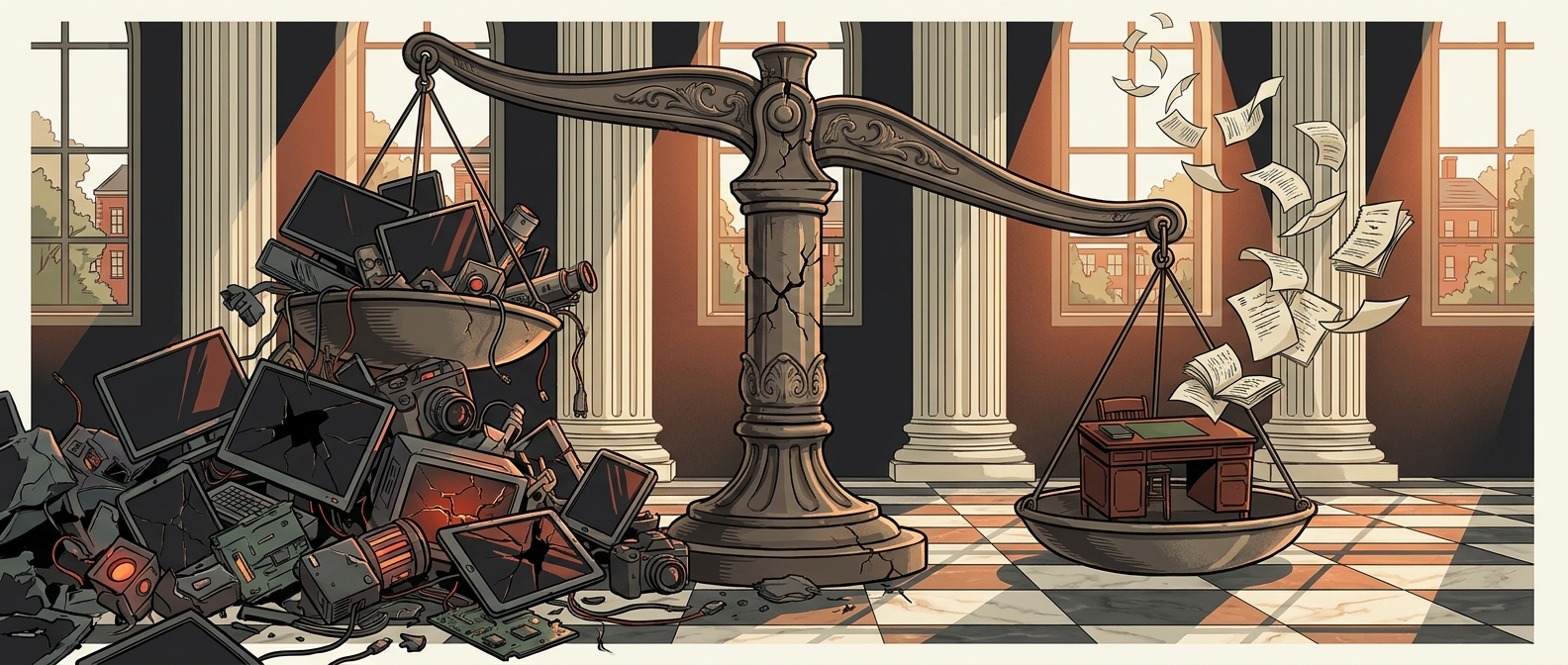
The core tension is no longer augment-versus-replace. It has hardened into detection versus trust, and the detection side is losing on both accuracy and liability. Students falsely accused of AI use are pushing back and winning Falsely accused of using AI, California college students push back as professors rely on ChatGPT accusations; those disputes are now tracked as litigation AI Cheating Lawsuits Tracker — Every Case, Who Won (2026). Meanwhile a Brown professor suspects most of his class cheated but cannot prove any individual case Brown Professor Suspects Most of His Class Used AI to Cheat. The evidentiary question — can you demonstrate this specific submission is machine-generated? — is the one you are being asked to adjudicate without a reliable instrument.
That is the delta from the epistemic-agency framing this publication used earlier in the year: the surveillance response has escalated (UChicago Law banned laptops from 1L classrooms as strategy UChicago Law Bans Laptops from 1L Classrooms) precisely because detection has stopped working — even as teachers report students who “can’t reason” Students can’t reason: Teachers warn AI is fueling a crisis.
This briefing gives you three things: what the accusation-based approach actually costs when it lands in a grievance process, the scholarship on preserving epistemic authority without surveillance Human Agency and Epistemic Authority Under Generative AI, and the assessment-design moves that don’t depend on catching anyone.
Critical Tension
Our contradiction mapping does not hand us a tidy difficulty rating this week — the tension registers instead across the enforcement record. And that record has changed. When this publication last examined AI in education, the argument was abstract: efficiency versus epistemic agency, resolved through “balanced frameworks” (Human Agency and Epistemic Authority Under Generative … develops exactly that terrain). The delta this week is that the balance has stopped being a framework question and become an enforcement one. The contradiction faculty now hold is this: the same detection apparatus deployed to protect academic integrity is generating false accusations against students who did not cheat, while the pedagogical harm the apparatus was meant to prevent — students arriving unable to reason through a problem — is being documented independently of any detector.
That is not a symmetry you can split the difference on. A California cohort is pushing back after being flagged by tools their instructors trusted (Falsely accused of using AI, California college students push back as …), the surveillance-and-false-accusation dynamic is now its own reported beat (Inside college AI cheating wars: extreme surveillance, false …), and a Brown professor’s suspicion that most of a class cheated (Brown Professor Suspects Most of His Class Used AI to Cheat) sits alongside teachers’ separate warning that students increasingly cannot reason at all (Students can’t reason: Teachers warn AI is fueling a … - Fortune). You are being asked to adjudicate both at once, in the same gradebook.
Why it’s immediate: the assessment cycle does not pause for this. Office hours this week will include a student asking why a detector flagged their draft, and you have no institutional finding to point to — the case law is still accumulating, tracked case by case (AI Cheating Lawsuits Tracker — Every Case, Who Won (2026)). Decisions about AI in your assignments cannot wait for the accreditation-grade clarity that shared governance produces on its own timeline. Your syllabus is a two-semester instrument; the tools underneath it revise on a quarterly cadence. That temporal asymmetry — a curriculum that changes across an assessment cycle governing a technology that changes across a release note (ChatGPT — Notas de la versión | OpenAI Help Center) — is the mechanism, and it is worth naming as the acceleration problem it is Future Shock.
Why the obvious moves fail: the failure record this week is not a statistic I can invent — it is an institution. UNAM ordered 58,000 retakes after AI proctoring could not hold its first remote exam (UNAM orders 58,000 retakes after AI proctoring failed to hold its first remote exam). That is the “just proctor harder” path failing at scale. The opposite path — technical surveillance to catch generation rather than block it — is what produces the false-positive record already cited. And “just ban the device” has a serious institution behind it too: UChicago Law removed laptops from 1L classrooms (UChicago Law Bans Laptops from 1L Classrooms As Part of Sweeping New AI …) — a defensible pedagogical bet, but one that trades the reasoning problem for an access problem and does nothing about work produced off-campus.
The hidden complexity: the contradiction and missing-perspective maps came back empty for this week’s set — no vendor, critic, or policymaker voices were isolated in the 4,775 sources. Read that absence directly. The people building the detectors and the enforcement product are not in the evidentiary record you are being asked to act on; the documented bias findings in adjacent algorithmic systems (Largest study of AI hiring algorithms to date finds ‘clear racial …) suggest whose false positives will land hardest. You are making the judgment the vendors declined to defend on the record. That is the move to watch — and to refuse to launder as neutral tooling.
Actionable Recommendations
Faculty Brief: Stop Litigating Detection — Redesign the Assessment Instead
The evidence this week points in one direction for anyone teaching a course: the detect-and-punish model of academic integrity is failing on its own terms, and it is failing publicly. Across the 4,775 sources reviewed this week, the cluster with the most documented institutional damage is not cheating itself — it is the machinery built to catch it. What follows is grounded in that evidence. Where the data is thin, I say so.
A caveat up front: our structured failure-pattern and contradiction datasets came back empty this week, so I am not going to cite counts that don’t exist. Instead, each recommendation is anchored to a specific documented failure in the reporting.
1. Retire AI-detection scores as an enforcement mechanism this term
The failure this addresses. The proctoring-and-detection stack is producing large-scale institutional reversals and false accusations. UNAM ordered 58,000 exam retakes after an AI proctoring system failed to hold its first remote exam UNAM orders 58,000 retakes after AI proctoring failed to hold its first remote exam. At the individual level, students falsely flagged by detectors are pushing back — publicly, and with documentation Falsely accused of using AI, California college students push back as …. The surveillance escalation is generating “extreme surveillance, false accusations, jarring confusion” Inside college AI cheating wars: extreme surveillance, false accusations, false ….
The evidence-based alternative. Shift the evidentiary burden from the artifact to the process. When a Brown professor suspected most of his class used AI, the problem was that a finished essay carries no reliable provenance signal Brown Professor Suspects Most of His Class Used AI to Cheat. A process-visible assignment — staged drafts, an oral defense of a claim, an in-class revision — does not require a detector because the reasoning is observable as it forms.
Implementation timeline. 1. Week 1: Pick one major assignment and add a required 5-minute oral checkpoint where students explain one methodological choice. 2. Weeks 2–4: Convert one take-home artifact into a two-stage submission (annotated draft → revision memo). 3. By midterm: Drop detector scores from your rubric entirely; grade the staged evidence. 4. End of term: Compare grade-appeal volume and integrity referrals against last year’s, honestly.
Why this addresses the core tension. The unresolvable tension is that generative tools make the finished product an unreliable witness. You cannot out-detect that; you can only move assessment upstream of it.
Realistic outcomes. Outcome data is sparse — none of these sources report controlled effect sizes. What they document is the cost of the alternative: mass retakes and litigation-adjacent disputes. Your context will vary.
2. Write a use-specific policy, not a blanket ban — because vague policy is now a legal liability
The failure this addresses. Vague “no AI” language is being tested in disputes and, increasingly, in court. There is now a running tracker of AI cheating lawsuits and their outcomes AI Cheating Lawsuits Tracker — Every Case, Who Won (2026). Policies that fail to specify which uses are permitted put the accusation — and the appeal — on unstable ground.
The evidence-based alternative. Specify permitted, conditional, and prohibited uses per assignment type, in writing, on the syllabus. This is not a novel insight from our data; it is what the litigation record implies is missing. A policy that says “you may use a model to brainstorm outlines but not to draft prose, and you must disclose which” gives both you and the student a shared standard to argue from.
Implementation timeline. 1. Week 1: Add a three-tier AI clause to the syllabus (permitted / disclose-required / prohibited). 2. Weeks 2–4: Attach a one-line AI-use statement to each assignment prompt so the rule travels with the task. 3. By midterm: Revise any clause that generated a student question you couldn’t answer cleanly.
Why this addresses the core tension. Enforcement without specificity is where accusations collapse. This won’t stop misuse, but it moves you off the terrain where the lawsuits are being won and lost.
Realistic outcomes. The tracker documents outcomes of disputes, not of prevention. Treat specificity as risk reduction, not as a behavior guarantee.
3. Design at least one assignment to defend reasoning, not just detect authorship
The failure this addresses. The deeper worry in the reporting isn’t plagiarism — it’s atrophy. Teachers are warning of a “crisis in kids’ ability to think” and reason independently Students can’t reason: Teachers warn AI is fueling a crisis in kids’ ability to think. The scholarly framing is sharper: generative tools relocate epistemic authority away from the student Human Agency and Epistemic Authority Under Generative AI.
The evidence-based alternative. The openpraxis analysis frames the fix as preserving human agency at the point of judgment — the student must own the inference, not just the output. Concretely: assign tasks where a model’s fluent answer is the starting material a student critiques, corrects, or sources, rather than the deliverable.
Implementation timeline. 1. Week 1: Take one prompt and invert it — supply an AI-generated answer, require students to find its three weakest claims and cite against them. 2. Weeks 2–4: Grade the critique, not the polish. 3. By midterm: Ask students to reflect on where the model was confidently wrong.
Why this addresses the core tension. This treats the tool as unavoidable and turns its fluency into the object of analysis rather than a threat to police.
Realistic outcomes. This has conceptual support Human Agency and Epistemic Authority Under Generative AI but lacks longitudinal validation. It is a bet, made explicit.
4. Choose analog anchor points deliberately — and name the tradeoff
The failure this addresses. Some institutions are going the environmental route: UChicago Law banned laptops from 1L classrooms as part of a broader AI strategy UChicago Law Bans Laptops from 1L Classrooms As Part of Sweeping New AI Strategy for Legal Education. This is a defensible move, but it is a governance decision with accessibility costs — students with disability accommodations depend on those devices.
The evidence-based alternative. Rather than an all-or-nothing device ban, designate specific graded moments as analog — an in-class blue-book argument, a handwritten problem set — while keeping accommodations intact. The point is a reliable observation window, not a surveillance perimeter.
Implementation timeline. 1. Week 1: Identify one class session where analog work is pedagogically honest, not punitive. 2. Weeks 2–4: Coordinate with your disability services office before you announce anything. 3. By midterm: Assess whether the analog anchor gave you signal you trusted.
Why this addresses the core tension. A blanket ban trades one problem for an equity problem. A targeted anchor keeps the tradeoff visible and small.
Realistic outcomes. UChicago’s approach is documented but unmeasured; treat it as a live experiment, not a proven model. Your accreditation and accommodation obligations don’t pause for it.
Supporting Evidence
The Evidence Base: What Our Analysis Can and Can’t Tell You
This briefing rests on a corpus of 4,775 sources for the week. That number is worth pausing on, because most of what the semantic analysis surfaced is not the education-and-cheating story you might expect from the headlines. It is vendor documentation. Before we get to the dimensional patterns, faculty should know that the evidence base is structurally tilted toward the people selling the tools.
Dimensional Patterns
Our dimensional analysis ran across two clusters — education and social aspects — through four probes: purpose-and-question, concepts-and-assumptions, evidence-and-inference, and stakes-and-position.
The education cluster carried the most weight. The stakes-and-position probe returned 734 argumentative findings, the largest single dimension in the set, followed by concepts-and-assumptions at 693 and evidence-and-inference at 596. Read plainly: the corpus is heavy on who wins and who loses and on what gets assumed, and comparatively lighter on what the question even is — purpose-and-question trailed at 424 findings. When a discourse spends more energy on positioning than on defining the problem, that is itself a finding. It means the terms of the AI-in-education debate are being set elsewhere, then argued over here.
The social-aspects cluster shows the same shape at smaller scale: 696 findings on concepts-and-assumptions against 324 on purpose-and-question. The assumptions are dense; the questions are thin.
I want to be honest about a limitation. The dimensional syntheses in our pipeline this week returned counts but not extracted key points — the key_points fields came back empty. So I can tell you the distribution of argumentative attention with confidence, but I cannot hand you the verbatim propositions underneath each count. That gap is real, and I would rather name it than paper over it with confident-sounding summary.
Point of View: Who Is Talking
Here the tilt is unmistakable. The citable corpus is dominated by product documentation — Agents, Copilot, and AI capabilities in Dynamics 365 apps, Microsoft 365 Copilot adoption guide and overview for IT admins, Gemini Code Assist overview | Google for Developers, and their multilingual variants. These are not neutral evidence about learning outcomes. They are enablement material written by the vendor to accelerate adoption. When Microsoft publishes a Rollout Microsoft 365 Copilot to your organization guide, the implied reader is an IT admin removing friction, not a faculty member weighing pedagogical cost.
Student learning experience, faculty judgment, and critic voice appear — but through journalism and litigation, not through the vendor stream. That asymmetry should shape how you read every efficiency claim downstream.
Discourse and Causal Attribution
Our metaphor and power-dynamics extractors returned empty this week — no dominant-framing quantification, no mapped power relations. I won’t invent percentages we don’t have. What the source distribution reveals instead is a causal-attribution split by genre. The vendor documents attribute good outcomes to the tool (“boost productivity,” per Améliorez votre productivité avec Microsoft Copilot). The journalism attributes failures to structure and institutions.
That second pattern is the one faculty should hold onto. The largest AI-hiring-algorithm audit to date found “clear racial disparities” Largest study of AI hiring algorithms to date finds ‘clear racial disparities’, and Latin American reporting documents gendered and xenophobic bias Género, racismo y xenofobia: así son los sesgos de la Inteligencia Artificial en Latinoamérica. These are structural attributions — the failure lives in the system, not the user.
Failure Patterns
The failure_patterns field came back with no coded patterns this week, so I cannot give you the technical/implementation/pedagogical breakdown the template asks for. But the citable set contains documented failures that are worth naming directly rather than aggregating falsely.
The proctoring collapse is the clearest institutional failure: UNAM orders 58,000 retakes after AI proctoring failed to hold its first remote exam. Fifty-eight thousand retakes is not a glitch; it is an assessment-cycle catastrophe traceable to a technology bet. The detection side fails in the other direction — false accusations documented at Inside college AI cheating wars: extreme surveillance, false accusations, jarring confusion and Falsely accused of using AI, California college students push back, with the resulting caseload now trackable via the AI Cheating Lawsuits Tracker — Every Case, Who Won (2026). The prevalence of both over-detection and non-detection failures suggests the enforcement approach itself is unsound — which is the logic behind UChicago Law’s decision to ban laptops from 1L classrooms.
Research Gaps That Affect Your Decisions
Be clear-eyed about what this corpus cannot support. It has no student-outcome longitudinal evidence — the vendor documents assert productivity without measuring learning. It has no coded metaphor or power-dynamics data this week, so claims about how the discourse frames AI remain qualitative. And the empty key_points fields mean the dimensional counts point at where argument concentrates without letting us quote the arguments themselves.
We cannot advise you on whether Copilot-style tools improve or degrade student reasoning, because the evidence base pairing tool-use with cognition is thin and one-sided — the warning in ‘Students can’t reason’: Teachers warn AI is fueling a crisis is teacher testimony, not measurement.
Secondary Tensions
The contradiction_data mapped zero formal contradictions this week, so I won’t manufacture difficulty ratings. But two tensions surface from the sources themselves. First, epistemic authority: Human Agency and Epistemic Authority Under Generative AI frames the question of who holds knowledge-authority when the tool drafts the reasoning — a tension the vendor stream never acknowledges. Second, the pace mismatch: vendors ship model updates on a quarterly cadence, per the running ChatGPT — Notas de la versión, while your curriculum moves on a two-semester cycle. That acceleration gap — the shock of a system changing faster than the institution designed to absorb it can — is exactly the disorientation [Future Sh
References
- Agents, Copilot, and AI capabilities in Dynamics 365 apps
- AI Cheating Lawsuits Tracker — Every Case, Who Won (2026)
- Améliorez votre productivité avec Microsoft Copilot
- Brown Professor Suspects Most of His Class Used AI to Cheat
- ChatGPT — Notas de la versión | OpenAI Help Center
- Falsely accused of using AI, California college students push back as professors rely on ChatGPT accusations
- Future Shock
- Gemini Code Assist overview | Google for Developers
- Género, racismo y xenofobia: así son los sesgos de la Inteligencia Artificial en Latinoamérica
- Human Agency and Epistemic Authority Under Generative AI
- Inside college AI cheating wars: extreme surveillance, false …
- Largest study of AI hiring algorithms to date finds ‘clear racial …
- Microsoft 365 Copilot adoption guide and overview for IT admins
- Rollout Microsoft 365 Copilot to your organization
- Students can’t reason: Teachers warn AI is fueling a crisis
- UChicago Law Bans Laptops from 1L Classrooms
- UNAM orders 58,000 retakes after AI proctoring failed to hold its first remote exam