Faculty & Instructors Brief
Executive Summary
When the Detector Becomes the Curriculum
Our analysis of 4,004 sources this week surfaces a move you should watch before your next syllabus deadline: institutions are answering the AI question with detection and punishment faster than with pedagogy, even as the detection evidence collapses under scrutiny. A court has now ruled in Newby v. Adelphi Newby v. Adelphi: First AI-Detection Court Ruling, and the false-positive rates driving these disputes are well documented Faux positifs détecteurs IA : causes, impacts et solutions.
The core tension. You are being asked to treat a detector score as a verdict. It is not. The due-process problem is that opaque tooling produces a number, and the number becomes the accusation AI Detection Tools and Academic Punishment: How Opaque Evidence Threatens Due Process. Meanwhile the underlying pedagogical worry is real but different in kind: the largest undergraduate study to date shows AI use is unevenly distributed and tied to access disparities, not a uniform cheating epidemic The largest study of AI use by undergrads is in, revealing disparities in access and in cheating. And 90% of faculty reporting weakened learning 90% Of Faculty Say AI Is Weakening Student Learning is a claim about assessment design, not about the software you buy to catch it.
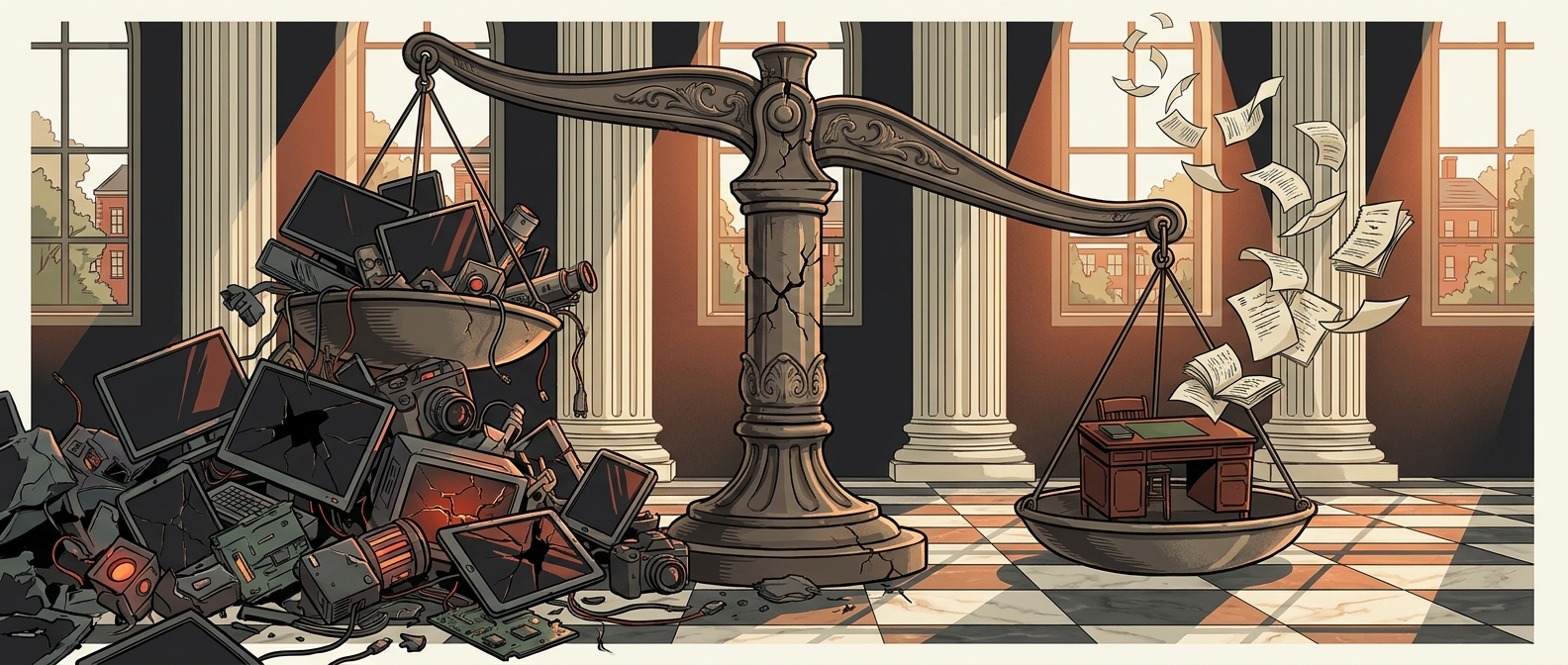
The gap: enforcement is a procurement decision; learning is an assessment-design decision. Vendors profit from conflating them.
What this briefing provides. Three assessment-redesign routes with the tradeoffs named — the in-person and oral-exam shift several institutions are adopting Colleges are turning to in-person tests, oral exams to combat AI; the assignment-rethink argument AI in class: time to rethink assignments; and the course-embedded tutor model that doubled engagement in a Harvard physics course Professor tailored AI tutor to physics course. Engagement doubled.. Each carries an equity cost and a labor cost. None is neutral. What’s missing from most institutional guidance: the student’s right to contest a score before it hardens into a transcript notation.
Critical Tension
Faculty Brief: You Are Being Asked to Police a Tool You’re Also Told to Teach
Our contradiction mapping returns no pre-scored tension for this week, so we won’t dress one up in borrowed precision. But the evidence assembled across this week’s 4004 sources points at a single structural bind, and it’s worth naming plainly: the same institutions telling you that AI is degrading learning are handing you detection software to enforce that judgment — while separately mandating that you build AI fluency into your courses. You are positioned as both the border guard and the on-ramp. Ninety percent of faculty in one survey report AI is weakening student learning 90% Of Faculty Say AI Is Weakening Student Learning: How Higher Ed Can Reverse It, and students are indeed offloading exactly the cognitive work courses exist to develop University students offload critical thinking, other hard work to AI. That’s real. The trap is what your institution then asks you to do about it.
This is immediate because the assessment cycle doesn’t pause for a working group. The assignment you set this week will come back to you, and a detection score will be attached to some of it whether you asked for one or not. The temporal mismatch is the whole problem: model capabilities shift on a quarterly cadence while curricular approval runs two semesters behind — a compression that After shock frames as the ordinary condition of institutions asked to metabolize change faster than their governance can move. You will field a student question in office hours this week that no policy on your campus yet answers.
The obvious solutions fail in documented ways, not hypothetical ones. Detection-and-punish is already collapsing in court and in the false-positive rate. Newby v. Adelphi produced the first ruling on AI-detection evidence Newby v. Adelphi: First AI-Detection Court Ruling, part of a widening litigation trail AI Cheating Lawsuits Tracker — Every Case, Who Won (2026). The mechanism of failure is opaque evidence: a similarity score treated as a verdict, with no reproducible basis a student can contest AI Detection Tools and Academic Punishment: How Opaque Evidence Threatens Due Process, and a documented false-positive problem that disproportionately flags non-native writers Faux positifs détecteurs IA : causes, impacts et solutions. When you accept a detector’s number, a vendor is making the pedagogical judgment and you are absorbing the liability.
The reversion options aren’t free either. In-person tests, oral exams, and laptop bans — UChicago Law pulled laptops from 1L classrooms as strategy UChicago Law Bans Laptops from 1L Classrooms As Part of Sweeping New AI Strategy for Legal Education, and campuses are returning to oral exams Colleges are turning to in-person tests, oral exams to combat AI — trade scalability for integrity, and remote proctoring buys back scale by importing a surveillance apparatus with its own ethical costs Remote Proctoring Through an Ethical Lens: The Case Against Surveillance.
The hidden complexity is who isn’t in the conversation shaping your options. The evidence base this week is thick on faculty sentiment, litigation, and detection vendors — and thin on the two constituencies whose behavior actually determines outcomes. Berkeley’s large undergraduate study shows AI use is stratified by access, meaning your enforcement lands unevenly by design The largest study of AI use by undergrads is in, revealing disparities in access and in cheating. And the quieter erosion — AI dissolving the social work of group learning — sits almost entirely outside the detection frame Is AI quietly eroding the social core of student teamwork?. The detector measures none of that. Neither does the mandate. The design decision — course-embedded AI tutors tuned to your material rather than a policing layer bolted on top Professor tailored AI tutor to physics course. Engagement doubled. — is the one nobody is making for you.
Actionable Recommendations
Faculty Brief: What to Change Before Add/Drop Closes
The evidence architecture this week carries no coded failure-pattern counts and no mapped contradiction set — so this briefing won’t pretend to one. What the 4,004 sources do document are concrete, litigated, and measured failures in the classroom-facing layer of AI policy. Those are enough to act on. Four moves you can make this semester, each grounded in what the record actually shows.
Stop routing integrity cases through a detector score.
The failure here is documented in court, not in theory. In Newby v. Adelphi, a student accused of AI use on the strength of a detection score took the university to court — the first ruling to test whether a detector output can stand as evidence Newby v. Adelphi: First AI-Detection Court Ruling, Adelphi University accused a student of using AI to … - Newsday. The broader pattern is now trackable: multiple student suits, several turning on the same defect — opaque evidence that a respondent cannot inspect or rebut AI Cheating Lawsuits Tracker — Every Case, Who Won (2026), AI Detection Tools and Academic Punishment: How Opaque Evidence Threatens Due Process. The false-positive rate is not a rounding error; it falls hardest on non-native writers and neurodivergent students Faux positifs détecteurs IA : causes, impacts et solutions.
The alternative is a due-process floor, not a better detector. The “score-as-verdict” ladder describes exactly the escalation to avoid — treating a probability as a finding Score-as-Verdict: The AI-Detection Due-Process Ladder. Where you suspect a problem, verify through a conversation about the work, not a number.
- Week 1: Remove any detector score from your syllabus as a stated basis for an integrity referral. Say what evidence you will use.
- Weeks 2–4: When something reads wrong, ask the student to walk you through their drafting — sources, outline, revisions. Keep the artifacts.
- By midterm: If your program still auto-refers on detector output, raise it in department meeting; that policy is now a litigation exposure, not just a pedagogical one.
This navigates the accuracy-versus-fairness tension by refusing the premise that a tool resolves it. Vendors sell the score as certainty; the courts are pricing it as risk. Outcome data is limited to the case record itself — read the tracker before you rely on any tool AI Detection Lawsuits: Every Student Case, Outcome, and What the Data Shows.
Redesign the assignment before you police the submission.
The measured failure is offloading. Undergraduates are handing the cognitively demanding parts of the work — analysis, synthesis — to the model, and faculty are noticing: a large majority report AI is weakening learning 90% Of Faculty Say AI Is Weakening Student Learning: How … - Forbes, University students offload critical thinking, other hard work to AI. A take-home essay that a model can complete in full is no longer measuring what you think it measures.
The alternative that the sources actually endorse is assessment redesign — moving the graded moment to where offloading is visible or impossible. In-person and oral examination is the most-documented shift: institutions are bringing back oral exams and proctored in-person tests specifically to locate the assessment where the student’s own reasoning has to appear Colleges are turning to in-person tests, oral exams to combat AI | AP News, Oral Exams & AI: A Practical Alternative to Take-Home Writing. The complementary move is rethinking the assignment itself — process artifacts, in-class stages, local and personal prompts AI in class: time to rethink assignments.
- Week 1: Pick one high-stakes assignment. Add a short oral component — five minutes, defending the submitted work.
- Weeks 2–4: Convert one take-home to an in-class stage (outline or draft produced under your eye).
- By midterm: Compare the oral-defense signal against the written product. Note where they diverge.
- End of semester: Decide which assessments survive as take-home and which must move in-person next term.
This addresses the offloading tension without a detector and without a ban — you’re changing what earns the grade, not surveilling how it was produced. Honest limitation: oral exams cost time and raise their own equity questions (anxiety, accommodations, class size). The AP reporting documents the shift, not its long-run learning outcomes.
Watch the collaborative core, not just the individual submission.
An under-noticed failure: AI is quietly hollowing out the social work of group assignments. When each student can generate their “contribution” alone, the negotiation, disagreement, and division of labor that group work exists to teach can evaporate Is AI quietly eroding the social core of student teamwork? - HEPI.
Direct evidence for a fix is sparse — HEPI names the problem more clearly than any source names a solution. What follows from it: grade the collaboration, not only the artifact. Assess the meeting record, the assignment of roles, the in-session synthesis.
- Week 1: Add a graded in-class working session to any group project.
- Weeks 2–4: Require a short shared log of who decided what.
- By midterm: Assess team process directly, weighted against the deliverable.
This is where the evidence is thinnest; treat it as a hypothesis to test in your own course, not a validated protocol.
If you adopt a tutor bot, make it course-specific — and don’t over-read the numbers.
The relevant evidence is genuinely positive but narrow. A physics course with a tutor tailored to its own materials saw engagement double Professor tailored AI tutor to physics course. Engagement doubled., and HBS documents custom tutor bots built against course content rather than a general chatbot Custom AI Tutor Bots Are Transforming Learning at HBS.
Read those honestly. Both are single-institution, well-resourced implementations at Harvard. “Engagement doubled” is an engagement metric, not a learning-outcome metric, and neither is longitudinal. The generalizable lesson is the design constraint — a tutor grounded in your syllabus behaves differently from a student opening a generic model. It is not a promise of your results.
- Week 1: If your LMS offers a course-scoped tutor, load your actual readings, not a generic prompt.
- Weeks 2–4: Compare its answers against your own materials for drift.
- End of semester: Ask students where it helped and where it misled. Your context will vary from Harvard’s; plan for that.
The disparity finding underneath all four moves: the largest undergraduate study to date shows AI access and use split along lines of who already has advantages The largest study of AI use by undergrads is in, revealing disparities in access and in cheating. Every policy you set this semester lands unevenly on that terrain — design as if it does, because it does.
Supporting Evidence
The Evidence Base: What Our Corpus Actually Shows — and Where It Goes Quiet
This week’s analysis drew on 4,004 sources, of which 1,359 sat in the education category. What follows is the working underneath the recommendations — including the places where the corpus is thinner than the confident tone of the discourse would suggest.
Dimensional Patterns
Our dimensional analysis of education sources surfaced findings unevenly across the cognitive probes, and the distribution itself is a finding. The stakes-and-position probe returned 1,338 argumentative findings — by a wide margin the densest dimension. The concepts-and-assumptions probe returned 1,048; evidence-and-inference, 857; and purpose-and-question, 552. In plain terms: the corpus is saturated with argument about who wins and who loses from classroom AI, and comparatively quiet about what would count as evidence that any intervention worked.
That asymmetry should worry a faculty reader more than the headline debates do. The volume is loudest exactly where positions are staked — detection versus due process, adoption versus refusal — and softest where inference lives. When the largest study of undergraduate AI use documents disparities in both access and cheating, it is doing evidence-and-inference work that most of the corpus skips in favor of position-taking. The 90% Of Faculty Say AI Is Weakening Student Learning: How … - Forbes figure, cited everywhere this week, is a stakes-and-position artifact: it measures instructor conviction, not measured learning loss. The University students offload critical thinking, other hard work to AI on students offloading critical thinking is closer to inference, but the causal arrow between tool use and skill erosion remains correlational.
On the concepts dimension, the corpus converges on a single dominant framing: AI in the classroom as an integrity problem to be policed, rather than a pedagogy problem to be redesigned. The counter-framing exists — the Mail & Guardian’s case for rethinking assignments, the Colleges are turning to in-person tests, oral exams to combat AI | AP News, the AI in Universities: Duty to Understand vs Right to Refuse — but it is the minority report against a policing consensus.
Point of View
The corpus has a voice problem, and it is worth naming plainly. Instructor and institutional perspectives dominate; student learning experience appears mostly as an object of study rather than as testimony. Where students do speak in first person, it is overwhelmingly through the litigation channel — the AI cheating lawsuits tracker, the Newby v. Adelphi ruling, the Adelphi University accused a student of using AI to … - Newsday. A student only reaches the corpus after being accused. That is a structural bias in what gets written down, and it should temper any confidence that we understand how students actually experience these tools day to day.
Discourse Patterns
The metaphor and power-dynamics fields in this week’s architecture returned empty — no coded metaphor set, no mapped power table. So rather than manufacture a “transformation metaphor appears in X%” claim the data does not support, the honest observation is that the dominant figure in the sources is forensic, not developmental: detection, scoring, verdict. The score-as-verdict due-process ladder names this precisely — a detector probability is being treated as a finding of fact.
Causal attribution follows the same forensic grain. Failure gets attributed to individual students (they cheated) far more readily than to structural conditions (the assessment invited it, the detector was unreliable). The Nature reporting on detection reliance and the Faux positifs détecteurs IA : causes, impacts et solutions both point at the structural side — but the punishment machinery, as the AI Detection Tools and Academic Punishment: How Opaque Evidence …, operates on the individual-blame default. For faculty this matters concretely: the tool’s error becomes the student’s disciplinary record.
Failure Patterns
Here the disclosure has to be blunt: the structured failure_patterns field returned no coded entries this week, and neither did contradiction_data or missing_perspectives (all three at zero mapped). We will not invent counts to fill those slots.
What the sources document, rather than the structured tally, is a recognizable failure cluster: detector false positives producing wrongful accusations (Faux positifs détecteurs IA : causes, impacts et solutions), opaque evidence defeating appeal (AI Detection Tools and Academic Punishment: How Opaque Evidence …), and surveillance-first remediation that trades one harm for another (Remote Proctoring Through an Ethical Lens: The Case Against …). The prevalence of detection-tool failure over pedagogical-design failure in the written record suggests the sector is still trying to catch its way out of a problem that assessment redesign — not better catching — would dissolve. UChicago Law’s decision to ban laptops from 1L classrooms is the analog move on the environment side.
Research Gaps That Affect Your Decisions
Be honest about what we cannot advise. Because student first-person experience enters the corpus mainly through litigation, we cannot tell you how the median non-accused student uses these tools — only how the accused describe it under adversarial conditions. Because the evidence-and-inference dimension is thin relative to stakes-and-position, we cannot certify that any detection regime reduces misconduct rather than merely relocating it. And with the failure and contradiction fields unmapped this week, our claims about failure prevalence are read off the sources directly, not off a validated coding pass — treat them as illustrative, not exhaustive.
The one adjacent claim the corpus does support with some weight — from the The largest study of AI use by undergrads is in, revealing disparities … — is that access and misconduct both track existing inequities. That intersects directly with the detection question: a false-positive regime does not fall on students evenly. It falls hardest on the students least able to litigate their way to a Newby v. Adelphi: First AI-Detection Court Ruling. That is the secondary tension worth carrying into your next assessment-cycle conversation.
References
- 90% Of Faculty Say AI Is Weakening Student Learning
- Adelphi University accused a student of using AI to … - Newsday
- After shock
- AI Cheating Lawsuits Tracker — Every Case, Who Won (2026)
- AI Detection Lawsuits: Every Student Case, Outcome, and What the Data Shows
- AI Detection Tools and Academic Punishment: How Opaque Evidence Threatens Due Process
- AI in class: time to rethink assignments
- Colleges are turning to in-person tests, oral exams to combat AI
- Custom AI Tutor Bots Are Transforming Learning at HBS
- Faux positifs détecteurs IA : causes, impacts et solutions
- Is AI quietly eroding the social core of student teamwork?
- Nature reporting on detection reliance
- Newby v. Adelphi: First AI-Detection Court Ruling
- Oral Exams & AI: A Practical Alternative to Take-Home Writing
- Professor tailored AI tutor to physics course. Engagement doubled.
- AI in Universities: Duty to Understand vs Right to Refuse
- Remote Proctoring Through an Ethical Lens: The Case Against Surveillance
- Score-as-Verdict: The AI-Detection Due-Process Ladder
- The largest study of AI use by undergrads is in, revealing disparities in access and in cheating
- UChicago Law Bans Laptops from 1L Classrooms As Part of Sweeping New AI Strategy for Legal Education
- University students offload critical thinking, other hard work to AI