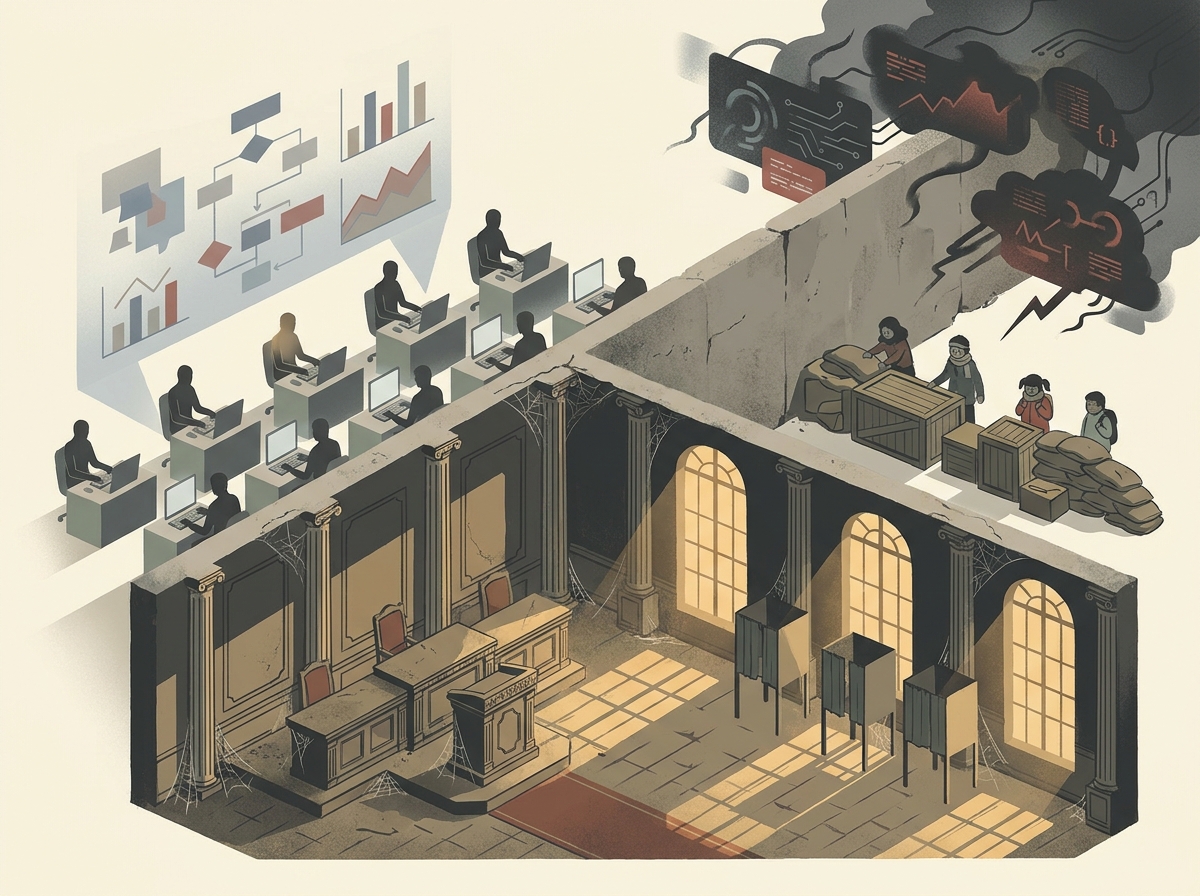
AI Literacy for Citizen Participation Report
Analysis of 4,201 sources this week, of which 956 touched AI literacy, reveals a discourse organized almost entirely around stakes and concepts—who wins, who loses, what the words mean—while the question that ought to anchor any literacy worth the name barely registers. Across the argumentative findings, the probe closest to citizen-as-participant (“what follows, and from whose position”) returned a single result against 916 for stakes-and-position and 812 for concepts-and-assumptions. The citizen as an agent who acts, refuses, votes, and consents appears in well under one percent of the analyzed material. Most sources treat literacy as something done to a population—a curriculum to be delivered, a skill to be certified, a vulnerability to be patched.
The Landscape
“AI literacy” in current discourse means, overwhelmingly, competence: the ability to operate the tools and recognize their outputs. The most circulated frameworks formalize this. The review draft Empowering Learners for the Age of AI organizes literacy around understanding, using, evaluating, and creating with AI—a sensible taxonomy that nonetheless centers the individual learner’s capability rather than the citizen’s standing inside systems that act on them. Adjacent work elevates “prompt engineering as a new 21st century skill,” which quietly redefines literacy as fluency in vendor interfaces. The definers here are instructive: framework consortia, journals, and—at the operational edge—the platforms themselves. When Google publishes Search Generative AI performance reports and Microsoft documents data, privacy, and security for Copilot, they are not merely informing; they are setting the terms on which “understanding AI” is conducted, with the product as the syllabus.
Whose Literacy
The voices teaching literacy are largely institutional—policy bodies, frameworks, vendors—while the people meant to acquire it appear as objects of study. The Ipsos-EPITA Observatoire des usages de l’IA par les étudiants surveys behavior; it does not hand the surveyed a vote. Genuinely civic framings exist but sit at the margins: Communautique’s proposal to imagine a citizen dialogue on AI in public services and Derechos Digitales’ Latin American considerations on AI in education treat people as participants in governance rather than recipients of training. Watch the asymmetry: experts produce, citizens consume, and the EU’s effort to meet the AI Act’s literacy obligations risks compliance-by-checkbox unless someone insists the obligated parties are powerful institutions, not anxious individuals.
What’s Being Taught
The thematic clusters split cleanly between use and defense. On the use side: tool inventories like Peru’s roundup of free AIs, prompt skills, productivity. On the defense side—and this is where the genuinely civic content lives—the material is about recognizing what is being done to you. AARP teaches readers to detect AI-generated scams; French outlets explain how voice-cloning fraud works in three seconds; UNESCO frames deepfakes as a crisis of knowledge. A scoping review on generative AI and misinformation and the SSRC synthesis on the persuasive risks of AI misinformation sharpen the threat model. Protection, notably, gets taught as personal hygiene rather than collective right.
What’s Missing
What the discourse almost never teaches is power. The competency that would let a citizen contest an AI decision—or organize against one—is largely absent. Amnesty’s Algorithmic Accountability Toolkit is the exception that exposes the rule. The genuinely civic stakes are documented elsewhere and rarely fed back into literacy: China’s plan to predict political risk with AI, the prospect of LLM-supercharged mass surveillance, and the AI-and-democracy intersections mapped by Carnegie. Missing too are the populations most surveilled and least consulted—a literacy that names harms but withholds the means to resist them.
Core Tensions
The phrase “AI literacy” sounds like a deficit to be corrected — a thing citizens lack and institutions will supply. But strip the jargon and watch what the term is actually doing: it bundles together at least six incompatible demands and presents them as one curriculum. Our scan of this week’s 4201 sources surfaced no clean consensus on what a citizen should know. What it surfaced instead is contested terrain, where the disagreement is not about facts but about purpose. The most fundamental fault line: should literacy protect citizens from AI, or empower them to wield it? These are not the same project, and the difference determines who gets taught what.
Protection from versus empowerment with. The protective frame dominates the consumer-facing literature, and for good reason. Voice-cloning fraud now needs three seconds of audio to impersonate a relative Cloner votre voix en 3 secondes : comment fonctionne l’arnaque …, and consumer-protection guides now treat AI-generated scams as a standing condition of daily life Estafas y fraudes generados con IA: ¿Cómo detectarlos? - AARP. Protective literacy teaches vigilance — spot the fake, verify the caller. But vigilance is a defensive crouch. It tells citizens to fear the technology without ever telling them how it works or who profits from its deployment. The empowerment frame, visible in frameworks like Empowering Learners for the Age of AI, promises agency — but agency easily collapses into mere fluency with vendor products, which is a different thing from understanding them.
Consumer literacy versus citizen literacy. This is where the protective framing quietly betrays its limits. Teaching someone to detect a deepfake audio scam Voix clonées et deepfakes audio : fraudes et protection en 2026 makes them a safer consumer. It does nothing to equip them as a citizen confronting AI deployed by the state. China’s system for predicting who might pose a “political risk” China Aims A.I. at Predicting Who Could Pose a Political Risk and the documented capacity of large language models to supercharge bulk surveillance How LLMs could supercharge mass surveillance in the US are not problems a vigilant consumer can solve by checking a caller’s voice. Citizen literacy requires understanding power, not just product — the difference between knowing how to use a tool and knowing how it is being used on you.
Individual competency versus collective governance. The literacy discourse loads responsibility onto the individual: learn to prompt well Frontiers | Prompt engineering as a new 21st century skill, learn to verify, learn to protect your data. But Amnesty’s algorithmic accountability work Algorithmic Accountability Toolkit - Amnesty International and Quebec’s experiments in citizen deliberation over public-sector AI Imaginer un dialogue citoyen sur l’IA dans les services publics point the other way: the decisions that matter most are collective, made before any individual encounters the system. No amount of personal competency lets a citizen opt out of a deployed government model. The EU’s move to embed literacy obligations in its AI Act Cumplir los objetivos de alfabetización en inteligencia artificial gestures at this — but a legal mandate to be “literate” still individualizes a structural problem.
The metaphor does the arguing. Across the corpus, AI is named a tool roughly 304 times, a threat 52 times, a partner just 7. This is not neutral vocabulary. The tool metaphor implies a user fully in control — agency flows one way, responsibility lands on whoever holds the handle. It makes “literacy” mean skill. The threat metaphor implies a hazard to be defended against — literacy becomes defense. Both obscure what the rare “partner” framing would force into view: that these systems act, shape, and persuade, and that the persuasion is documented The Persuasive Risks of Generative AI Misinformation. A partner is something you negotiate with and can be manipulated by — a framing that asks about the system’s agency, not just yours.
Here is the move to watch: whoever gets to define “AI literacy” gets to decide which of these tensions disappears. UNESCO frames deepfakes as a crisis of knowledge itself Les deepfakes et la crise du savoir - UNESCO — and a knowledge crisis cannot be resolved by teaching individuals to be more careful shoppers. The Carnegie mapping of AI and democracy AI and Democracy: Mapping the Intersections makes the stake explicit: literacy framed as consumer self-defense leaves the democratic questions — who builds, who deploys, who is accountable — entirely untouched. Citizens can test any literacy program against a single question: does it teach me to protect myself, or to govern the thing? The first is useful. Only the second is citizenship.
Power & Agency Analysis
Power in AI literacy operates through definition: who decides what citizens “need to know” shapes what remains invisible. The dominant move in this week’s material is grammatical before it is political. AI systems are written as actors — they “predict,” “detect,” “decide,” “flag” — while the institutions deploying them recede into the passive voice. When the New York Times reports that China Aims A.I. at Predicting Who Could Pose a Political Risk, the headline itself performs the substitution: the AI predicts, not the security apparatus that built it, fed it, and acts on its outputs. This framing is not neutral. It teaches citizens to address their fear or gratitude to a machine rather than to the people holding the machine.
How AI is portrayed
Notice how often agency floats free of any human hand. School surveillance vendors sell systems that “catch” threats, yet when students are called to the office — and even arrested — for AI misreadings of their messages, the error is attributed to the tool’s limitations, not to the administrators who chose to trust it. The same grammar runs through fraud coverage: voice-cloning scams that clone your voice in three seconds are described as if the technology itself were the predator, when the predator is a person operating it. For citizens, the lesson embedded in this attribution pattern is corrosive: it trains you to negotiate with weather, not with adversaries. You cannot hold weather accountable. You can hold a company, an agency, or a scammer accountable — but only if the sentence names them.
Who defines literacy
Definitions of “AI literacy” are being written largely by the parties with the most to gain from a particular shaping of your attention. Google now offers Search Generative AI performance reports, and Microsoft documents Data, Privacy, and Security for Microsoft 365 Copilot — both useful, both also exercises in setting the terms by which you are permitted to evaluate their products. Against this, the formal frameworks at least gesture toward a civic conception: the draft Empowering Learners for the Age of AI and the EU’s effort to meet the AI literacy objectives of the AI Act treat the citizen, not the consumer, as the unit. The gap between those two definitions — literacy as informed use versus literacy as the capacity to contest — is where power hides. Civic experiments like Communautique’s citizen dialogue on AI in public services matter precisely because they let the public, rather than the vendor, set the agenda.
What metaphors teach
The reigning metaphor is the tool — neutral, obedient, picked up and set down at will. It dominates because it flatters everyone: the seller (our product merely serves you) and the buyer (I remain in control). But the tool metaphor obscures the systems that watch you back. There is no “tool” framing that honestly describes how LLMs could supercharge mass surveillance, because a hammer does not read every nail it has ever struck. The competing metaphor — threat — does different work: it justifies counter-power. When UNESCO frames deepfakes as a crisis of knowledge, or the Carnegie Endowment maps AI and democracy’s intersections, the threat language licenses regulation, audit, and refusal. Critical metaphor literacy means asking, each time: which metaphor is being used, and whose action does it authorize?
Citizen agency
Your real power is smaller than the marketing implies and larger than the fatalism allows. Individually, knowing that AI-generated scams and persuasive misinformation work by exploiting trust — not technical naïveté, as the persuasive risks synthesis documents — is genuine protection. Collectively, the leverage is greater: Amnesty’s Algorithmic Accountability Toolkit exists because deployed systems can be audited, named, and challenged. The first act of agency is grammatical. Refuse the sentence in which the AI decides. Insert the human who chose it. Drawn from this week’s 4201 sources, the pattern is consistent: power survives wherever the actor goes unnamed.
Failure Genealogy
Literacy failures differ from technical failures: they occur when citizens misunderstand what AI is, what it’s doing, or how to evaluate it. The model can be working exactly as designed and the person in front of it still loses—because the loss lives in the gap between the system’s actual behavior and the user’s mental picture of it. Our analysis of this week’s evidence documents five recurring places where that gap opens.
Where understanding fails
The first failure is calibration—the dial between over-trust and under-trust, almost never set correctly. Over-trust shows up when people treat a fluent answer as a verified one; a scoping review of generative AI and misinformation finds that the persuasiveness of synthetic content rides on production quality, not accuracy, so the smoother the output the more uncritically it gets absorbed Generative AI and misinformation: a scoping review of the role of …. Under-trust is the mirror image: a blanket cynicism that “you can’t believe anything anymore,” which UNESCO names as the deeper damage of deepfakes—not that any single fake deceives, but that their existence corrodes the baseline confidence required to know anything at all Les deepfakes et la crise du savoir - UNESCO.
The second is detection. The intuition that people can spot AI-generated images, voices, or text by looking harder is mostly false and getting falser. AARP’s fraud researchers document scams where the synthetic element is precisely what makes the appeal land Estafas y fraudes generados con IA: ¿Cómo detectarlos? - AARP, and audio cloning now needs roughly three seconds of a real voice to impersonate a family member convincingly Cloner votre voix en 3 secondes : comment fonctionne l’arnaque …. Detection-as-skill is a literacy dead end; the skill that survives is verification through channels the forger doesn’t control.
What assumptions mislead
Beneath these failures sit two assumptions citizens take for granted. The first is that an AI tool is a passive instrument—something you use, not something that uses you. Microsoft’s own documentation for Copilot describes the data flows, retention, and grounding behavior that most users never read Data, Privacy, and Security for Microsoft 365 Copilot; the assumption of passivity is what makes unwitting data disclosure feel like nothing happened. The second is that scale neutralizes intent—that a system processing millions of records is too big to be aimed at any one person. The reporting on how large language models could supercharge bulk surveillance dismantles exactly that comfort: scale is what makes individuated targeting cheap How LLMs could supercharge mass surveillance in the US, and China’s program to flag individuals as political risks shows the aim made explicit China Aims A.I. at Predicting Who Could Pose a Political Risk.
Consequences of gaps
The costs are not evenly distributed. When school monitoring systems flag students and trigger police involvement over misread text, the harm falls on the surveilled, not the vendor who sold the false positive Students have been called to the office — and even arrested — for AI …. At the collective level, Carnegie’s mapping of AI and democracy traces how degraded shared facts erode the conditions for self-government AI and Democracy: Mapping the Intersections - Carnegie Endowment for …. The person who misunderstands rarely pays the full bill; the public does.
What would help
The honest answer is that no amount of individual vigilance closes a gap engineered to widen. The synthesis evidence on misinformation countermeasures finds that prebunking and source-verification habits help at the margin but cannot outrun production volume The Persuasive Risks of Generative AI Misinformation and …. What a realistic literacy offers is not detection superpowers but a posture: assume fluency is not accuracy, assume the tool is also a collector, and verify consequential claims through channels you trust. Amnesty’s accountability toolkit makes the structural point that detection failures are best addressed upstream, by holding deployers answerable—not downstream, by asking citizens to win an arms race they were never equipped to enter Algorithmic Accountability Toolkit - Amnesty International.
Evidence Synthesis
Synthesizing 956 analyses of AI literacy from this week’s 4,201 sources, the evidence points to a finding our prior pieces have circled but never named: literacy for citizens is not the same competence as literacy for workers or students. This goes beyond technical skill or even misinformation defense — it is the capacity to remain a participating member of a polity when the institutions around you are quietly being rewired by systems you cannot see.
What the Evidence Shows
The convergent finding across sources is that effective AI literacy is contextual judgment, not button-pressing. The most developed framework on offer, the Empowering Learners for the Age of AI draft, organizes competence around evaluating outputs and understanding systems rather than operating interfaces — a deliberate move away from the “prompt engineering as 21st-century skill” framing that treats literacy as a marketable technique Frontiers | Prompt engineering as a new 21st century skill. On the civic side, the strongest evidence concerns deliberation: Quebec’s structured dialogue citoyen on AI in public services demonstrates that ordinary people, given access to how systems actually make decisions, produce coherent governance preferences — literacy as a collective practice, not a private accomplishment. The EU’s effort to operationalize literacy obligations under the AI Act points the same direction, treating it as an enforceable public duty Cumplir los objetivos de alfabetización en inteligencia artificial. Amnesty’s Algorithmic Accountability Toolkit closes the loop: knowing a system exists is the precondition for contesting it.
Contested Terrain
Where evidence conflicts is on whether literacy works at all against the threat it is most often invoked to counter. The scoping review on generative AI and misinformation finds the research base thinner than the policy enthusiasm, and the SSRC synthesis on the persuasive risks of generative AI is blunt that countermeasures — including media literacy — show modest, uneven effects. UNESCO frames deepfakes as a crisis of knowledge itself, which raises an uncomfortable possibility: if authenticity becomes unverifiable in principle, no amount of individual discernment closes the gap. Literacy remains contested because some of its proponents sell it as a substitute for regulation it cannot replace.
Across Domains
Tool-specific literacy matters because the tools are not neutral. Microsoft’s own privacy documentation for 365 Copilot and Google’s Search Generative AI performance reports reveal how much of what a citizen “reads” is already a vendor-shaped surface. The social-aspects dimension is sharper still: literacy is an equity issue when the same systems used to inform are used to monitor — China aiming AI at predicting who could pose a political risk, and LLMs poised to supercharge bulk surveillance in democracies too. Carnegie’s mapping of AI and democracy and Georgetown’s AI & Elections work both treat citizen understanding as infrastructure, not enrichment.
Gaps and Uncertainty
What we don’t know is whether literacy scales across the divides that matter. Access in Lima looks nothing like access in Brussels Las 15 mejores IAs gratuitas para usar desde Perú, and Latin American scholars warn the frameworks are imported wholesale Consideraciones sobre el uso de la inteligencia artificial. We have almost no longitudinal evidence that any of this durably changes behavior.
For Citizens
The defensible takeaways are narrow but real. Individually: assume any AI-mediated text is vendor-shaped, and verify provenance before trust — the discipline that catches voice-cloning fraud Cloner votre voix en 3 secondes and AI scams Estafas y fraudes generados con IA. Collectively: the evidence is clear that individual vigilance is necessary and insufficient. Disclosure mandates, accountability toolkits, and citizen deliberation do what private discernment cannot — and they are the part you can vote for.
References
- AI & Elections
- AI-and-democracy intersections
- Algorithmic Accountability Toolkit
- called to the office — and even arrested — for AI
- considerations on AI in education
- data, privacy, and security for Copilot
- deepfakes as a crisis of knowledge
- detect AI-generated scams
- Empowering Learners for the Age of AI
- free AIs
- imagine a citizen dialogue on AI in public services
- LLM-supercharged mass surveillance
- meet the AI Act’s literacy obligations
- Observatoire des usages de l’IA par les étudiants
- persuasive risks of AI misinformation
- predict political risk with AI
- prompt engineering as a new 21st century skill
- scoping review on generative AI and misinformation
- Search Generative AI performance reports
- voice-cloning fraud
- Voix clonées et deepfakes audio : fraudes et protection en 2026