AI Literacy for Citizen Participation Report
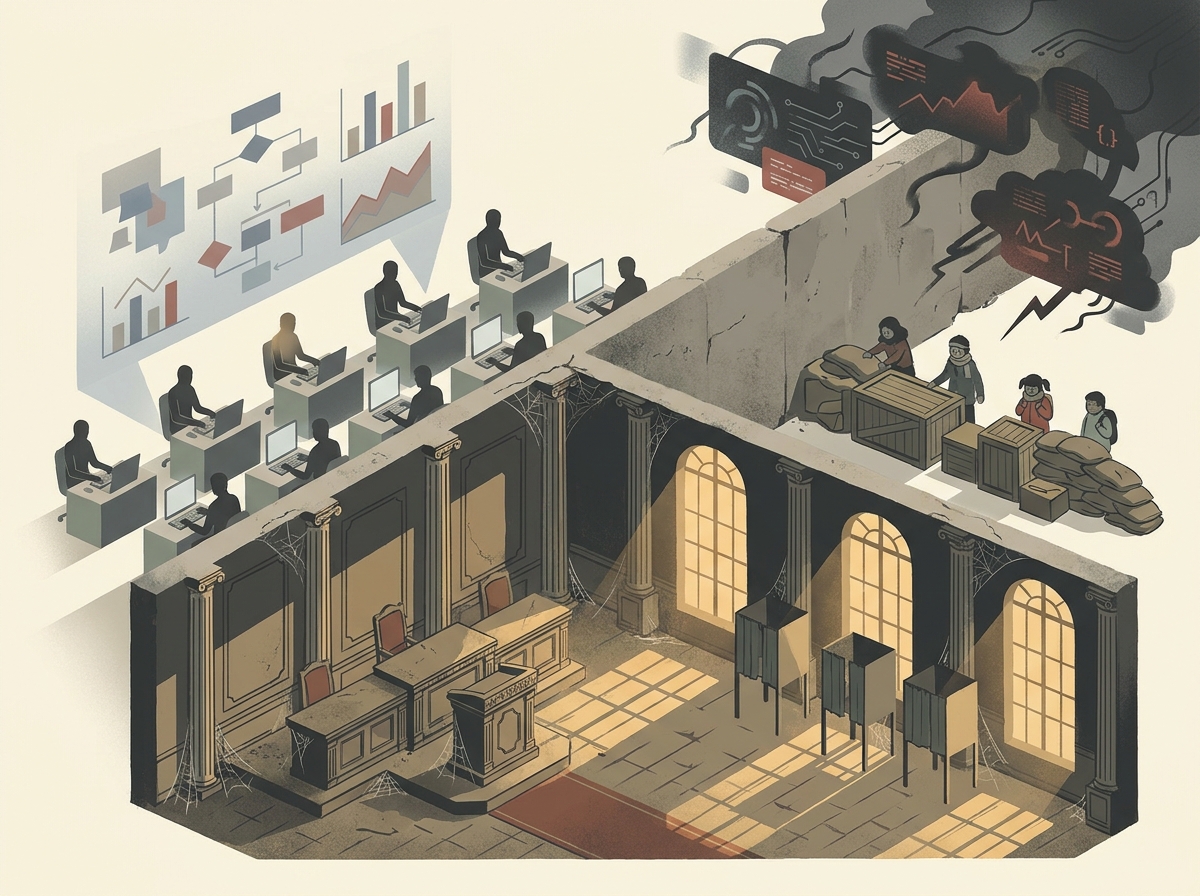
Analysis of 888 AI literacy sources this week (out of 4,171 total) reveals a discourse fixated on classroom management of student behavior while the citizen — the adult who votes, banks, applies for benefits, watches political ads, and has AI used on them by employers and governments — appears as a recognizable subject in a small minority of pieces. The citizen-as-participant framing, by a generous count that includes deliberation, civic deepfake awareness, and consumer-protection angles, surfaces in roughly one in eight sources. The dominant frame is pedagogical-institutional: literacy as something schools dispense to people who are still being formed, rather than a competence adults need yesterday.
1. The Landscape
“AI literacy” in this week’s corpus is largely defined by people whose day job is to train other people. Education ministries, university centers, and ed-tech vendors set the vocabulary; consultancies and security firms borrow it. The Renaissance Numérique report on deploying AI literacy in France PDF RAPPORT OCTOBRE 2025 Déployer une littératie en IA pour une is one of the few documents that begins from the citizen rather than the curriculum, and it reads as a corrective precisely because the surrounding discourse defaults to schools. The marginalized framing — literacy as protection against being acted upon — survives in fragments: UNESCO on the epistemic damage of deepfakes Les deepfakes et la crise du savoir - UNESCO, a Mexican press guide on detecting synthetic content Guía para periodistas sobre cómo detectar contenido generado por IA, and Carnegie’s mapping of AI’s footprint on democratic institutions AI and Democracy: Mapping the Intersections. These are the exceptions, not the centre of gravity.
2. Whose Literacy
The voices doing the defining are overwhelmingly institutional: vendors, ministries, foundations, and academics. Citizens appear as subjects of study or objects of intervention — surveyed for “practices,” sorted into “divides” Generative AI Practices, Literacy, and Divides, surveilled through school-issued laptops How AI monitors school Chromebooks and what it means for privacy, or potentially folded into LLM-powered government dragnets How LLMs could supercharge mass surveillance in the US — but rarely as authors of what literacy should mean. The asymmetry matters: when IBM frames literacy through its security portfolio IBM Brings Its Most Advanced AI-Powered Security Portfolio to Clients, the implicit competent actor is the enterprise, not the person whose data is being defended or sold.
3. What’s Being Taught
The thematic clusters tilt heavily toward use over protection. Prompt engineering has been promoted to the status of “a new 21st century skill” Frontiers | Prompt engineering as a new 21st century skill, which neatly converts a vendor-specific interface quirk into a civic virtue. Detection literacy — recognizing synthetic media, understanding hallucination as a category of inaccuracy New sources of inaccuracy? A conceptual framework for studying AI hallucinations, tracking the political deepfake landscape We Looked at 78 Election Deepfakes — runs a distant second. Technical fluency is treated as the affirmative agenda; the defensive curriculum (consent, refusal, redress) is treated as remedial.
4. What’s Missing
Three absences stand out. First, literacy of being-acted-upon: how to recognize that a benefits decision, a hiring screen, or a content moderation outcome was produced by a model, and what recourse exists. Second, infrastructural literacy: the web is being rebuilt for machine consumers, not human ones The Web Is Being Made Accessible for AI, Not People, a structural shift no curriculum names. Third, deliberative literacy: research on AI-augmented deliberation Realizing the Potential Gains of AI-Enabled Deliberative Democracy exists, but the corresponding citizen-side competence — how to participate when the room contains an algorithm — has no textbook. The discourse trains people to prompt; it does not train them to push back.
Core Tensions
Core Tensions
The phrase “AI literacy” performs a sleight of hand. It sounds like a deficit — something citizens lack and institutions can supply — when in fact it names a contested terrain about what people should be permitted to know, refuse, or demand. Four tensions structure that terrain, and none of them resolve into a curriculum.
Technical skill versus critical understanding. The dominant literacy on offer is operational: learn to prompt, learn to verify, learn to integrate. A growing body of research treats prompt engineering itself as a foundational 21st-century competency Frontiers | Prompt engineering as a new 21st century skill, and the framing has spread fast enough that a recent arXiv survey of generative AI practices documents stark divides not in whether people use these tools but in how skillfully they extract value from them Generative AI Practices, Literacy, and Divides. The trouble is that fluency with a system is not the same as judgment about it. A citizen who can write a clean prompt has been trained to optimize within the tool’s logic; a citizen who understands why the tool hallucinates, and who profits from its hallucinations, is doing something else entirely. Harvard’s Misinformation Review has proposed a conceptual framework that treats AI-generated inaccuracy not as a glitch to be prompted around but as a structural feature of probabilistic systems New sources of inaccuracy? A conceptual framework for studying AI …. The skill-first framing buries that structural critique under productivity tips.
Individual competency versus collective governance. Most literacy programs target the lone user: detect the deepfake, verify the source, sharpen your prompt. But the Knight Columbia analysis of 78 election deepfakes found that political misinformation is largely not an AI problem at all — it is a distribution problem, a platform problem, a trust problem We Looked at 78 Election Deepfakes. Political Misinformation Is Not an …. Loading individuals with detection duties while platforms continue to amplify whatever moves is a policy choice dressed as pedagogy. Twenty US states have begun regulating synthetic political media How 20 States Are Now Regulating Deepfakes—and What It Means for Elections, and UNESCO has framed deepfakes as a crisis of knowledge rather than of perception Les deepfakes et la crise du savoir - UNESCO — both arguments that the work cannot be downloaded onto the individual. Carnegie’s mapping of AI and democracy points the same direction: the literacy that matters for citizenship is institutional, not personal AI and Democracy: Mapping the Intersections - Carnegie Endowment for ….
Use versus refusal. Almost every public literacy effort assumes that the citizen’s task is to use AI better. The possibility of refusing — of declining to feed a model, of declining to be modeled — barely enters the syllabus. It should. MIT Technology Review’s reporting on how large language models could supercharge bulk surveillance describes a near future in which any text a citizen produces becomes parseable at scale How LLMs could supercharge mass surveillance in the US. AP’s investigation of Gaggle, GoGuardian and Securly shows the surveillance template already running inside US school districts How AI monitors school Chromebooks and what it means for privacy …. A literacy worth the name has to include the right to opt out, and the political vocabulary to demand that right.
Consumer literacy versus citizen literacy. Here is where the dominant metaphors do their quiet work. AI is overwhelmingly framed as a tool — neutral, instrumental, picked up and put down at will — and occasionally as a threat. Both framings position the human as consumer: someone who selects, deploys, or guards against a product. The rarer framing of AI as partner or as civic infrastructure would require something the consumer model does not: democratic input into design. Carnegie’s recent work on AI-enabled deliberative democracy gestures at what that might look like — citizens shaping the systems that shape them, not just learning to live with vendor defaults Realizing the Potential Gains of AI-Enabled Deliberative …. France’s Renaissance Numérique has argued for treating AI literacy as a precondition of democratic life rather than a workforce upgrade, a reframing that scoping reviews of generative AI and misinformation increasingly echo Generative AI and misinformation: a scoping review of the role of ….
The tensions are not problems to be smoothed. They are the substance of the literacy itself.
Power & Agency
Power & Agency Analysis
Power in AI literacy operates through definition: whoever decides what citizens “need to know” also decides what stays invisible. Scan this week’s evidence and a pattern emerges — AI systems are overwhelmingly described as actors that do things (decide, detect, generate, monitor, recommend), while the humans operating them recede into passive voice or disappear entirely. A surveillance vendor’s product “flags concerning content.” A deepfake “spreads.” An agent “completes the task.” Read enough of this prose and you start to feel like the weather has opinions. That grammatical drift is the first power move citizens need to see, because it determines who gets blamed when things go wrong and who gets thanked when they go right.
How AI is portrayed
Consider how agency is distributed in the week’s reporting. When MIT Technology Review describes how large language models could “supercharge mass surveillance” by reading and summarizing billions of intercepted communications, the model is the subject of the verb How LLMs could supercharge mass surveillance in the US; the agencies procuring, deploying, and acting on those summaries are grammatical bystanders. The same pattern shows up in school monitoring systems where AI “monitors” Chromebooks — the districts choosing to install Gaggle, GoGuardian, and Securly, and the parents never told, become a passive backdrop How AI monitors school Chromebooks and what it means for privacy …. The Knight Columbia analysis of 78 election deepfakes cuts directly against this framing by insisting that political misinformation is fundamentally a political problem with human authors and human audiences, not a technological force of nature We Looked at 78 Election Deepfakes. Political Misinformation Is Not an …. When citizens absorb the autonomous-actor framing, they prepare to defend themselves against a machine. When they absorb the human-actor framing, they prepare to hold someone accountable.
Who defines literacy
The definitional power is concentrated in three constituencies, and citizens are in none of them. Vendors define literacy as competence with their products — IBM frames its security portfolio rollout as the literacy citizens didn’t know they needed IBM Brings Its Most Advanced AI-Powered Security Portfolio to Clients, and is Strengthened by Ongoing Project Glasswing Work. Academic researchers define it as a measurable construct, currently tilting toward “prompt engineering” as the new civic skill Frontiers | Prompt engineering as a new 21st century skill — a definition that, conveniently, treats fluency with commercial chatbots as the bar. Governments and intergovernmental bodies define it as defense against epistemic collapse Les deepfakes et la crise du savoir - UNESCO. Missing from all three: anyone asking citizens what they want to be literate about. The largest survey of student AI use to date documents stark access gaps but still measures literacy in terms researchers chose The largest study of AI use by undergrads is in, revealing disparities in access — and in cheating.
What metaphors teach
The dominant metaphor remains “tool” — used vastly more often than “threat” or “oracle” in this week’s corpus — and it teaches a specific lesson: the system is neutral, responsibility lives with the user. That framing is doing real work. It is what allows a Common Sense Media report to discuss children’s chatbot use as a parenting challenge rather than a product-design one PDF 2024 The Dawn of the AI Era - Common Sense Media. It is what permits a misinformation review to catalog “AI hallucinations” as system properties without dwelling on who shipped systems that hallucinate at scale New sources of inaccuracy? A conceptual framework for studying AI …. The “threat” metaphor, used sparingly but pointedly around generative video Google’s Veo 3 Can Make Deepfakes of Conflict, Riots, More - TIME, does the opposite work: it justifies state regulatory power, as in the patchwork of twenty state-level deepfake laws now on the books How 20 States Are Now Regulating Deepfakes—and What It Means for Elections. Citizens fluent in metaphor can read which lever each framing is reaching for: “tool” reaches for personal responsibility, “threat” reaches for state power, and neither reaches for the vendor.
Citizen agency
So what can a citizen actually do? The honest answer is: less individually than the literacy literature implies, more collectively than it admits. Individual vigilance against deepfakes is overrated; the Knight Columbia data shows ordinary political lying still does most of the damage We Looked at 78 Election Deepfakes. Political Misinformation Is Not an …. Collective leverage — procurement rules, surveillance disclosure mandates, deliberative processes that actually use AI to widen rather than narrow public input Realizing the Potential Gains of AI-Enabled Deliberative … — is where citizen power compounds. The Carnegie mapping of AI and democracy is blunt about this: the consequential decisions are being made at the level of institutions, not individuals AI and Democracy: Mapping the Intersections - Carnegie Endowment for …. Literacy that stops at the user has already conceded the field. Literacy that names the actor — vendor, agency, legislator — keeps the field open.
Failure Genealogy
Literacy failures differ from technical failures: they occur when citizens misunderstand what AI is, what it’s doing, or how to evaluate it. The week’s evidence sorts these breakdowns into a small number of recurring patterns — over-trust, detection blindness, unwitting disclosure, and the failure to refuse — each with its own genealogy and its own cost.
Where understanding fails
The most striking finding from recent misinformation research is that the failure point is usually not the deepfake itself. The Knight Columbia review of 78 election deepfakes concluded that political misinformation “is not an AI problem” so much as a problem of motivated belief and distributional reach We Looked at 78 Election Deepfakes. Political Misinformation Is Not an …. Citizens who already distrust an institution accept fabricated evidence against it; citizens who trust it dismiss authentic evidence as fake. The literacy gap is not “can you spot the artifact” — synthetic video from systems like Google’s Veo 3 is now visually clean enough that artifact-spotting is a losing game Google’s Veo 3 Can Make Deepfakes of Conflict, Riots, More - TIME — it is “do you ask where this came from before you forward it.” Detection guides written for working journalists have shifted accordingly, foregrounding provenance and chain-of-custody over pixel forensics Guía para periodistas sobre cómo detectar contenido generado por IA. The asymmetry is brutal: the skills civil society needs to keep up with synthetic media are being professionalized at exactly the moment ordinary citizens are being told they should personally evaluate every clip.
A parallel failure runs in the opposite direction. Over-trust shows up not as “I believed a fake” but as “I let the system answer for me.” A scoping review of generative AI and misinformation documents how confident-sounding outputs short-circuit verification behaviour that the same readers would apply to a Wikipedia entry or a tabloid Generative AI and misinformation: a scoping review of the role of …. UNESCO frames the same pattern as a wider crisis of knowing — the difficulty is no longer accessing information but adjudicating it Les deepfakes et la crise du savoir - UNESCO.
What assumptions mislead
Three assumptions do most of the damage. First, that AI outputs are retrievals from a database rather than statistical generations — a conceptual error that makes hallucinations feel like glitches rather than the system working as designed New sources of inaccuracy? A conceptual framework for studying AI …. Second, that interacting with a free consumer chatbot is private; a recent practice survey shows users routinely disclose health, financial, and relationship information they would not type into a search bar Generative AI Practices, Literacy, and Divides. Third, that AI-mediated content is bounded to the moment of viewing — when in fact the same architectures support bulk inference over personal records at population scale How LLMs could supercharge mass surveillance in the US.
Consequences of gaps
The costs land unevenly. Citizens who disclose to chatbots underwrite training corpora and surveillance infrastructure they cannot inspect How LLMs could supercharge mass surveillance in the US. Voters who cannot triage synthetic political content concede the agenda to whoever floods the channel first — a dynamic that twenty US states have now tried to address through deepfake statutes of varying coherence How 20 States Are Now Regulating Deepfakes—and What It Means for Elections. And the deliberative-democracy literature is now openly worried that AI-augmented citizen forums, if deployed without literacy support, will simply launder vendor framings as public consensus Realizing the Potential Gains of AI-Enabled Deliberative ….
What would help
A literacy that prevented these failures would not be a detection checklist. It would teach provenance reflexes (where did this come from, who profits from my believing it), disclosure economics (what am I paying with when the tool is free), and refusal as a civic skill — the right and habit of saying no to a system whose terms you cannot see. None of this is sufficient against industrial-scale synthetic media or platform asymmetries. But the alternative — outsourcing judgment to whichever interface arrives first — is the failure mode already in progress.
Evidence Synthesis
Evidence Synthesis
Synthesizing roughly two dozen recent analyses spanning misinformation research, deliberative democracy experiments, accessibility audits, and surveillance reporting, the evidence on AI literacy for citizen participation points to a single uncomfortable finding: the bottleneck is not citizen ignorance of how chatbots work, but citizen leverage over the systems already deciding what they see, hear, and can contest. This goes beyond technical skill. The literacy that matters is the capacity to recognize when an AI system is operating on you — in a feed, a benefits decision, a police dossier, a deepfaked robocall — and to know what institutional handle exists to push back.
What evidence shows
Convergence across the strongest sources is striking. The Knight Columbia analysis of 78 election deepfakes found that most political misinformation that moved voters required no AI at all — cheap edits and decontextualized clips did the work We Looked at 78 Election Deepfakes. UNESCO reaches the complementary conclusion: the epistemic damage of synthetic media is less about specific fakes than about generalized doubt, the “liar’s dividend” that lets any inconvenient recording be dismissed Les deepfakes et la crise du savoir. A scoping review in AI & Society corroborates: detection literacy alone underperforms; what works is provenance habits, lateral reading, and source triangulation Generative AI and misinformation. The Harvard Misinformation Review framework on hallucinations reframes the problem further — inaccuracy is structural to generative systems, not a bug literate users can prompt away New sources of inaccuracy?. On the participatory side, Carnegie’s deliberative-democracy work shows AI can genuinely scale citizen consultation when designed as scaffolding for human deliberation rather than substitute for it Realizing the Potential Gains of AI-Enabled Deliberative Democracy.
Contested terrain
The disagreements are real. Prompt-engineering advocates treat fluency with models as a foundational civic skill Prompt engineering as a new 21st century skill; critics counter that elevating prompting normalizes the tools as infrastructure citizens must accommodate rather than govern. The Berkeley undergraduate study documents widening access and competence gaps that any “just learn to prompt” gospel papers over The largest study of AI use by undergrads. Twenty US states now regulate election deepfakes with sharply different definitions of harm How 20 States Are Now Regulating Deepfakes, so “literate” in one jurisdiction means knowing rights that do not exist in the next.
Across domains
Tool-specific literacy now means recognizing model affordances: Veo 3’s capacity to fabricate riot footage on demand changes what a citizen should assume about any unsourced video Google’s Veo 3 Can Make Deepfakes. The social-aspects dimension is sharper still: LLM-powered bulk data analysis collapses the cost of mass surveillance How LLMs could supercharge mass surveillance, and the web itself is being restructured for machine consumers rather than human ones The Web Is Being Made Accessible for AI, Not People. Carnegie’s broader mapping shows democracy is touched at every layer — information, deliberation, administration, contestation AI and Democracy: Mapping the Intersections. Practical detection guidance for non-specialists exists Guía para periodistas sobre cómo detectar contenido generado por IA, but its effectiveness presumes the institutional channels — newsrooms, regulators, courts — citizens can route findings into.
Gaps and uncertainty
We do not have causal evidence that any AI-literacy curriculum changes voting, civic trust, or vulnerability to manipulation at scale. Common Sense’s Dawn of the AI Era survey maps adoption, not effect PDF 2024 The Dawn of the AI Era. Renaissance Numérique’s literacy roadmap is candid that population-level outcomes remain unmeasured RAPPORT OCTOBRE 2025. Studies of generative-AI divides describe stratification clearly but cannot yet tell us which interventions close it Generative AI Practices, Literacy, and Divides.
For citizens
Three takeaways earn the evidence. First, individually: practice lateral reading and source triangulation before you practice prompting; the payoff is larger and the skill transfers. Second, collectively: the consequential fights are over procurement, disclosure, and provenance standards — civic literacy means knowing which agency, legislator, or court holds the lever. Third, refuse the framing that surveillance creep or synthetic media is your personal vigilance problem. The evidence is consistent: literacy is necessary, and nowhere close to sufficient.
References
- AI and Democracy: Mapping the Intersections
- Frontiers | Prompt engineering as a new 21st century skill
- Generative AI and misinformation: a scoping review of the role of …
- Generative AI Practices, Literacy, and Divides
- Google’s Veo 3 Can Make Deepfakes of Conflict, Riots, More - TIME
- Guía para periodistas sobre cómo detectar contenido generado por IA
- How 20 States Are Now Regulating Deepfakes—and What It Means for Elections
- How AI monitors school Chromebooks and what it means for privacy
- How LLMs could supercharge mass surveillance in the US
- IBM Brings Its Most Advanced AI-Powered Security Portfolio to Clients
- Les deepfakes et la crise du savoir - UNESCO
- New sources of inaccuracy? A conceptual framework for studying AI hallucinations
- PDF 2024 The Dawn of the AI Era - Common Sense Media
- PDF RAPPORT OCTOBRE 2025 Déployer une littératie en IA pour une
- Realizing the Potential Gains of AI-Enabled Deliberative Democracy
- The largest study of AI use by undergrads is in, revealing disparities in access — and in cheating
- The Web Is Being Made Accessible for AI, Not People
- We Looked at 78 Election Deepfakes