Asimov column
Through Asimov’s Lens
The Detection Arms Race
April 26, 2026 | 2153 words
THE STORY Original fiction in the tradition of Isaac Asimov. Not by Asimov.
The Provenance Desk
The condolence letter had been flagged twice, which was unusual.
Marisol Reyes set the printout between them on the desk and waited. Across from her sat Daniel Kwon, who had worked the Provenance Desk for fourteen months and who, until this morning, had never been called into a Tier-Two review.
“Read it,” she said.
He read it. It was four paragraphs long, addressed to a woman in Tulsa whose husband had died of a stroke at fifty-one. The letter mentioned the husband’s name, the small auto-body shop he had run, a detail about his having coached Little League. It closed with a line that Daniel must have written ten thousand times in some variant: He was loved, and that love does not end where his life did.
“It’s mine,” Daniel said.
“I know it’s yours. Your name is on it. The question is whether it’s yours.”
“I wrote it Tuesday afternoon. I remember the file. The widow called the intake line and told the operator about the Little League team. I pulled the transcript and wrote the letter.”
Marisol nodded slowly. “Veritext flagged it at 0.91. Authoraegis flagged it at 0.88. Both of them say it reads as machine-composed.”
“Both of them are wrong.”
“They are wrong together, Daniel. That’s what the audit committee is going to want explained.”
He looked down at the page. SoftPassage, the company that paid them, sold bereavement correspondence to funeral homes, hospices, and a growing number of HR departments who did not trust their managers to write to grieving families without producing something actionable. Every letter that left the building carried a provenance stamp: Composed by a human writer in the United States. The stamp was the product. The stamp was why the funeral homes paid eighteen dollars a letter instead of using the free templates their software vendors offered.
“The detector is calibrated against our own corpus,” Daniel said. “Three years of letters I wrote. Of course it sounds like a machine. It sounds like me, and me is what the model learned from.”
“That argument has been made.”
“It’s a true argument.”
“True arguments lose hearings every day.” She tapped the page. “Walk me through Tuesday.”
He walked her through Tuesday. The intake transcript at 1:14 p.m. The forty minutes he spent on the letter. The coffee he had spilled on his keyboard at some point, which she could verify against the facilities log because he had filed a ticket. The draft saved at 1:53. The send at 2:07.
“And you used no assistance.”
“I used the spellchecker.”
“Nothing else.”
“Nothing else, Marisol. You know I don’t. You know why I don’t.”
She knew why he didn’t. Daniel’s older sister had died four years ago and the letter the hospital sent had been so plainly automated, so plainly assembled from a library of warmth-tokens, that his mother had thrown it in the trash and then taken it out of the trash and then thrown it away again. He had told Marisol this on his second day. It was, in some sense, why he had been hired.
“The problem,” she said, “is that the funeral home in Tulsa ran the letter through their own verifier before passing it to the family. That’s new. They didn’t used to do that. Now they do, because two months ago a letter from one of our competitors was exposed as model-generated and there was a small lawsuit. So now the funeral homes verify us. And our verifier and their verifier disagree, except this time both of them agree that you’re a machine.”
“I’m not a machine.”
“I know.”
“So tell them.”
“I can tell them. The audit committee will ask what evidence I have beyond your word, and I will say I have your word, and they will say the word of an employee whose performance bonus depends on volume is not evidence, and they will ask whether we should refund the funeral home, and the funeral home will ask whether they should refund the widow, and the widow —”
“The widow read the letter and called the intake line yesterday to thank us. It’s in the log.”
Marisol paused. “I didn’t see that.”
“It’s there. She said it was the only piece of mail that week that didn’t feel like a form.”
For a moment neither of them spoke. Through the glass wall of the small office, Daniel could see the floor: forty-two writers at forty-two terminals, each composing letters for strangers, each letter passing through the in-house detector before it was permitted to leave the building. He had watched a colleague last month rewrite a sentence eleven times to lower a flag from 0.74 to 0.39. The sentence had been We are so sorry for your loss. The colleague had eventually changed it to Our hearts are heavy at this news, which scored 0.31 and which, Daniel thought, sounded considerably more like a machine.
“What happens now?” he said.
“I write a recommendation. The committee reviews. If they uphold the flag, the letter is rescinded and reissued under another writer’s name, and you go on a watch list. Three flags on the watch list and you’re released.”
“The widow already received it.”
“Then it’s reissued as a corrected version with an apology for the prior.”
“An apology for what?”
Marisol did not answer.
“An apology for what, Marisol? For the letter being too good? For sounding like I meant it?”
“For the provenance being uncertain.”
“The provenance is not uncertain. I am the provenance. I am sitting here.”
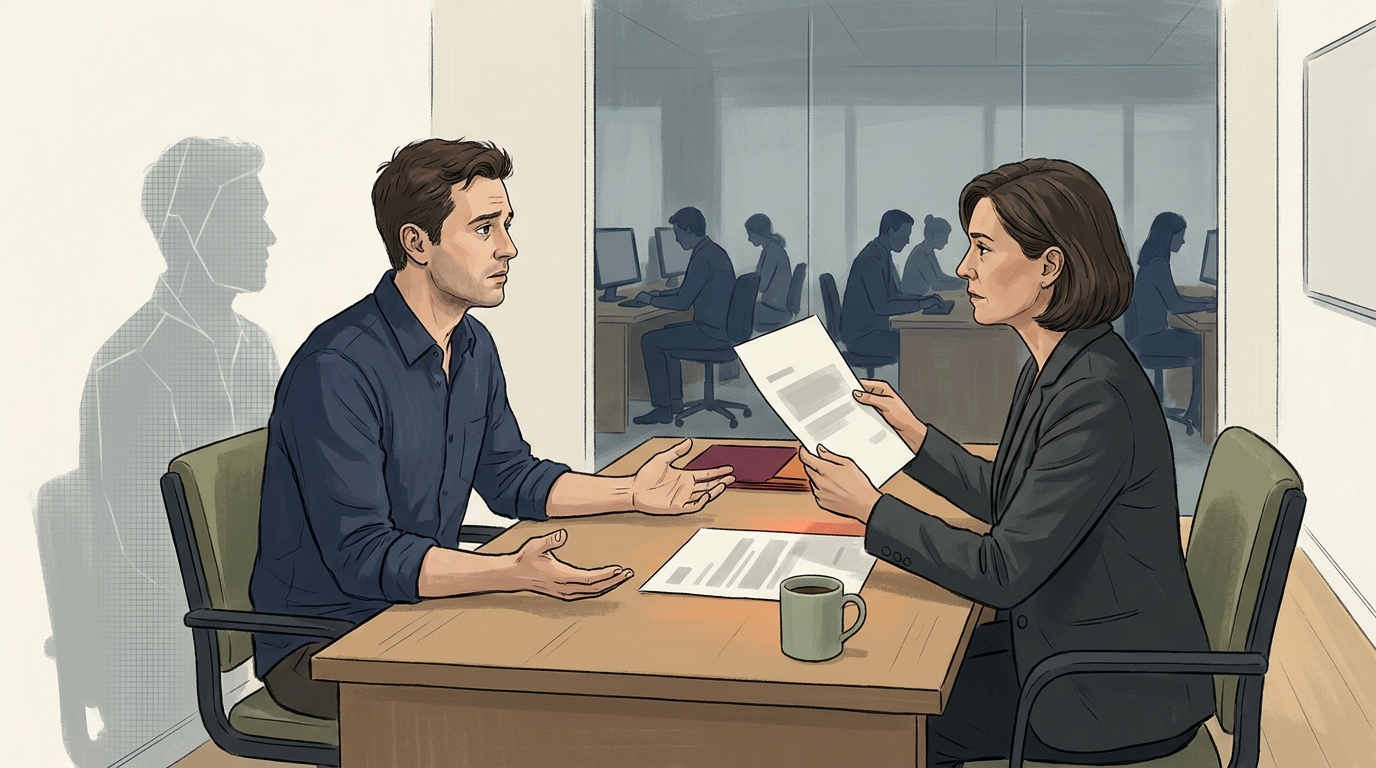
She looked at him then, fully, for what felt to both of them like a long time. She had been at SoftPassage for nine years. She had helped draft the original detector specification. She had sat in the room when the executives decided that the stamp — Composed by a human writer in the United States — was the only thing standing between them and irrelevance, because anyone with a sixty-dollar subscription could now generate a passable condolence letter in four seconds, and the only reason to pay them was the promise that a person had sat with the dead for forty minutes.
She believed in the stamp. She had believed in it on Monday, and she had believed in it this morning when she walked in, and she was trying, with some difficulty, to determine whether she still believed in it now.
“Daniel,” she said. “If I clear you, and the committee asks me how I knew, what do I tell them?”
He thought about it.
“Tell them you read the letter.”
“I read the letter.”
“And?”
She did not answer him. The page lay between them on the desk, and outside the glass the forty-two writers kept typing, and Marisol Reyes sat with the question she had not been hired to ask, which was: what was the stamp ever supposed to certify, if not this?
THE REFLECTION
The Provenance Desk does not exist, but the logic that would build it already does. Every time an institution decides that the cost of a false negative — a machine passing as human — is greater than the cost of a false positive — a human declared a machine — it builds a Provenance Desk. The detector is procured. The watch list is drafted. The apology-for-uncertain-provenance is composed, almost always by someone who knows better and who tells themselves they will fix it later.
What Asimov understood, and what the present moment is busy forgetting, is that the interesting question is never whether a machine can imitate a person. It is what the imitation reveals about the person, and about the institutions that surround the person, and about the rules those institutions write when they get nervous. Susan Calvin’s interrogations in The Complete Asimov are not really about whether a robot is malfunctioning. They are about whether the humans around the robot can still tell the difference between a rule and the thing the rule was meant to protect. By the end of “The Evitable Conflict,” the rules have eaten the thing. Nobody notices except Calvin, and Calvin is tired.
The detection arms race is the same story in cheaper clothes. A vendor sells a writing tool. A second vendor — sometimes the same vendor under a different logo — sells a tool to detect the first. Institutions buy both and pass the cost downstream: to the claims adjuster whose narrative summary is rejected by the fraud-screening model, to the immigration officer whose decision memo is flagged for “non-native fluency patterns,” to the small-town reporter whose obituary is held for review because it scored 0.71 on a tool nobody on the editorial board can actually explain. Independent evaluations of the leading classroom-grade detectors have repeatedly clocked false-positive rates in the range of 4 to 9 percent on authentic human writing — and substantially higher for non-native English speakers, whose prose the models read as suspiciously smooth ((GPT detectors are biased against non-native English writers)). A 6 percent false-positive rate, applied to a workplace that produces a thousand documents a day, is sixty accusations a day. Sixty Daniels.
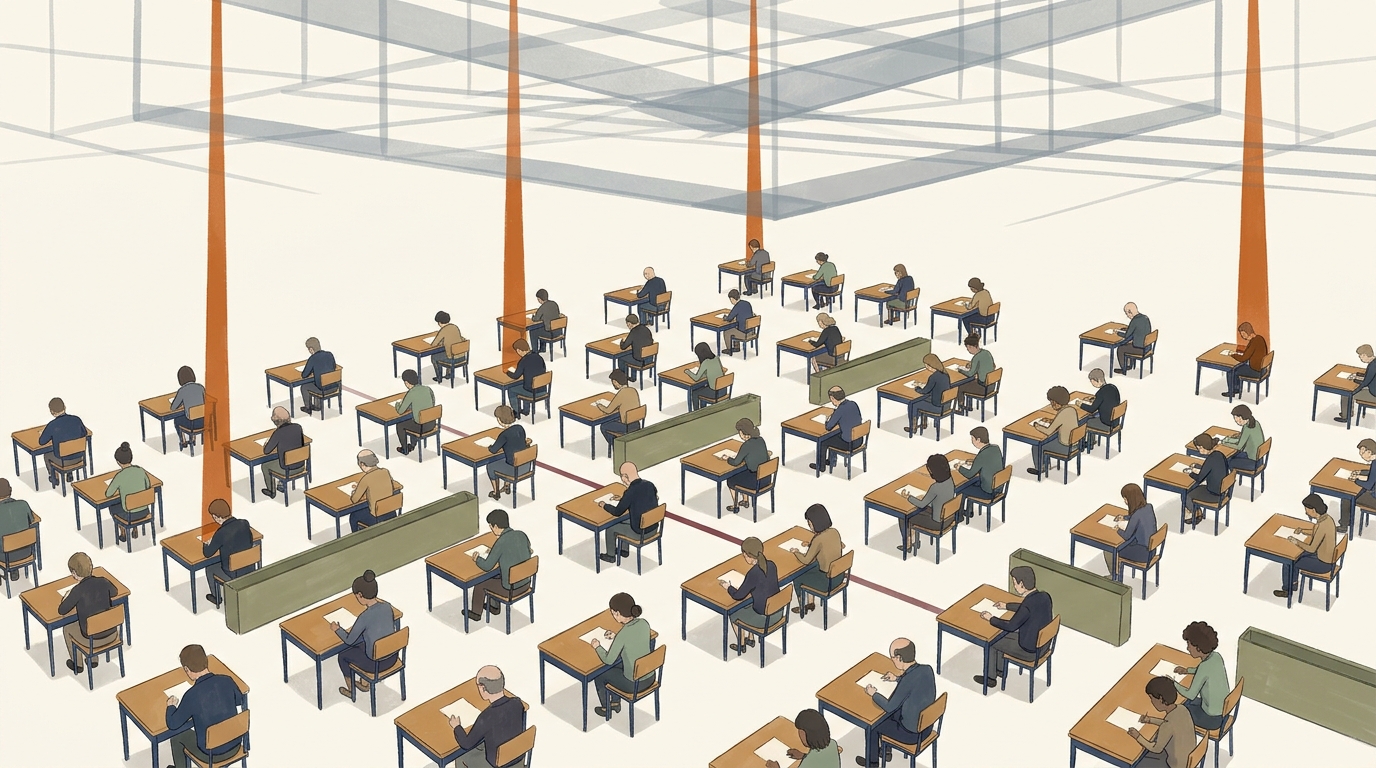
This is what gets lost when the arms race is framed as a technical problem awaiting a technical fix: the cost is being paid in a currency the vendors do not measure and the institutions do not book. The currency is the presumption of good faith. It is the quiet civic agreement that when a person tells you they wrote something, you believe them until you have a reason not to. That agreement is a commons. It was built slowly, over centuries of letters and contracts and testimony, and it is being drawn down now at a rate set by quarterly procurement cycles.
Surveys of knowledge workers in document-heavy industries — claims, compliance, journalism, social services — report that authentication and provenance review are now consuming meaningful fractions of working hours that used to go to the actual work. One recent industry survey put the added verification overhead at roughly thirteen hours per worker per month ((The Hidden Labor of AI Verification in Knowledge Work)). That time is not free. It is taken from the conversation with the widow, the second look at the claim, the walk to the bereaved family’s door. It is taken from the part of the work that the stamp was supposed to certify in the first place.
And here is the part the vendor decks do not put on the slide: the same companies that profit from the writing tools profit from the detectors, and the same institutions that buy the detectors are the ones whose workforce was thinned by the writing tools. The arms race is a closed loop, and the loop has a meter on it, and the meter runs in one direction. The funeral home pays SoftPassage. SoftPassage pays the detector vendor. The detector vendor licenses corpora from companies that also sell generation tools. Daniel pays in a watch list. The widow pays in an apology-for-uncertain-provenance for a letter that made her cry in the right way.
The Complete Asimov is full of machines that reveal humans to themselves. Multivac, asked the wrong question, answers honestly and embarrasses everyone. The detection economy inverts this: it asks humans to reveal themselves to machines, continuously, as a condition of being credited with their own work. The inversion is not subtle, and it is not stable. A regime that treats every text as a suspect produces, in the end, a workforce that writes defensively — that flattens its own cadence, removes its own warmth-tokens, sands down the sentences a detector might find too fluent or too plain. The prose that survives is the prose the machines approve of. Which is to say: the prose of the machines.
What the arms race is consuming is not, in the end, fraud. Fraud will route around it; fraud always does. What it is consuming is the small daily evidence that a person sat with another person’s grief, or claim, or testimony, for forty minutes, and put words to it. That evidence used to be free. It used to be the floor. We are paying eighteen dollars a letter to certify it now, and the certification is failing, and the failure is being charged to the writer.
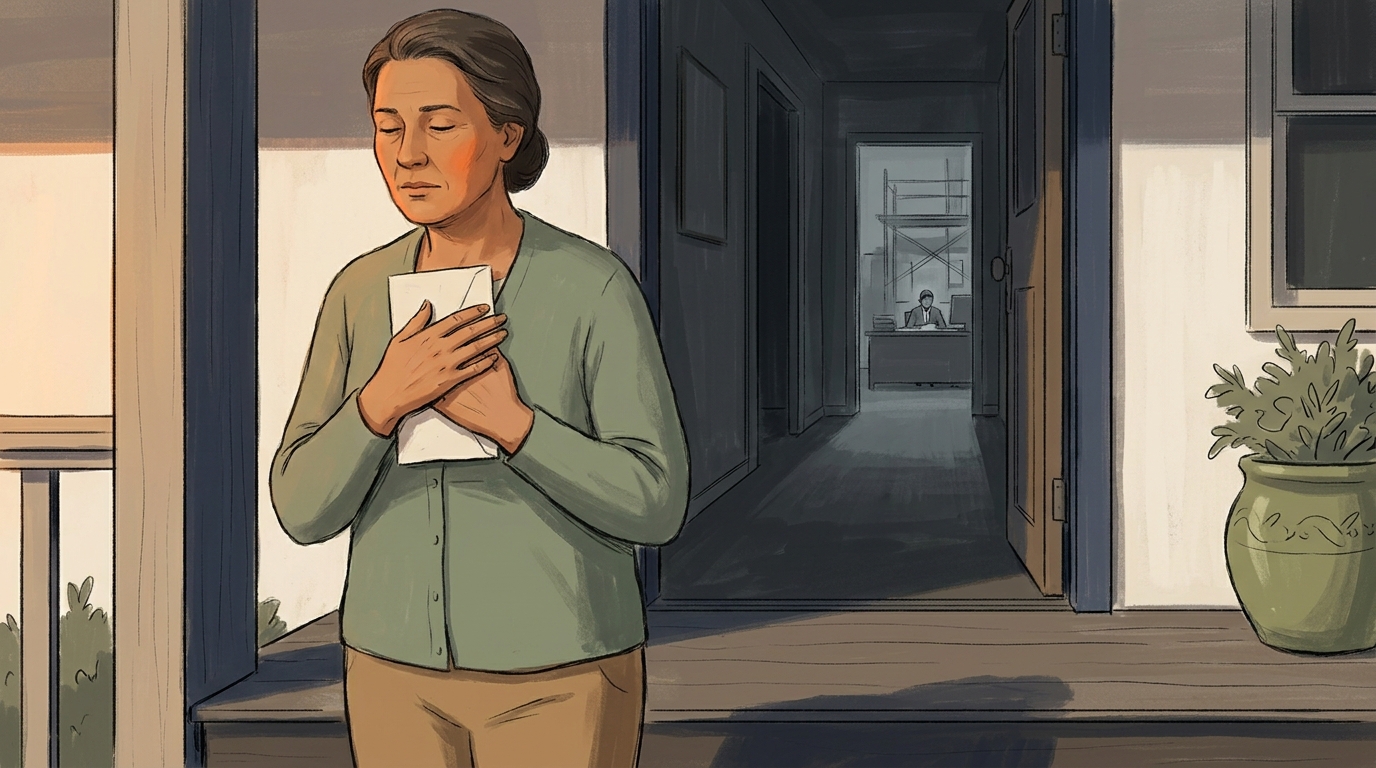
Marisol does not answer Daniel’s question because the honest answer is that the stamp was never going to certify what she thought it would. The question worth sitting with is not whether the detectors will get better. They will, and it will not help. The question is what we are willing to extend to one another, in the absence of certainty, that we used to extend as a matter of course — and whether we will notice, before too long, that we have stopped extending it at all.
← Back to AI News Social