The Signal Collapse: When Every Job Application Is a Deepfake
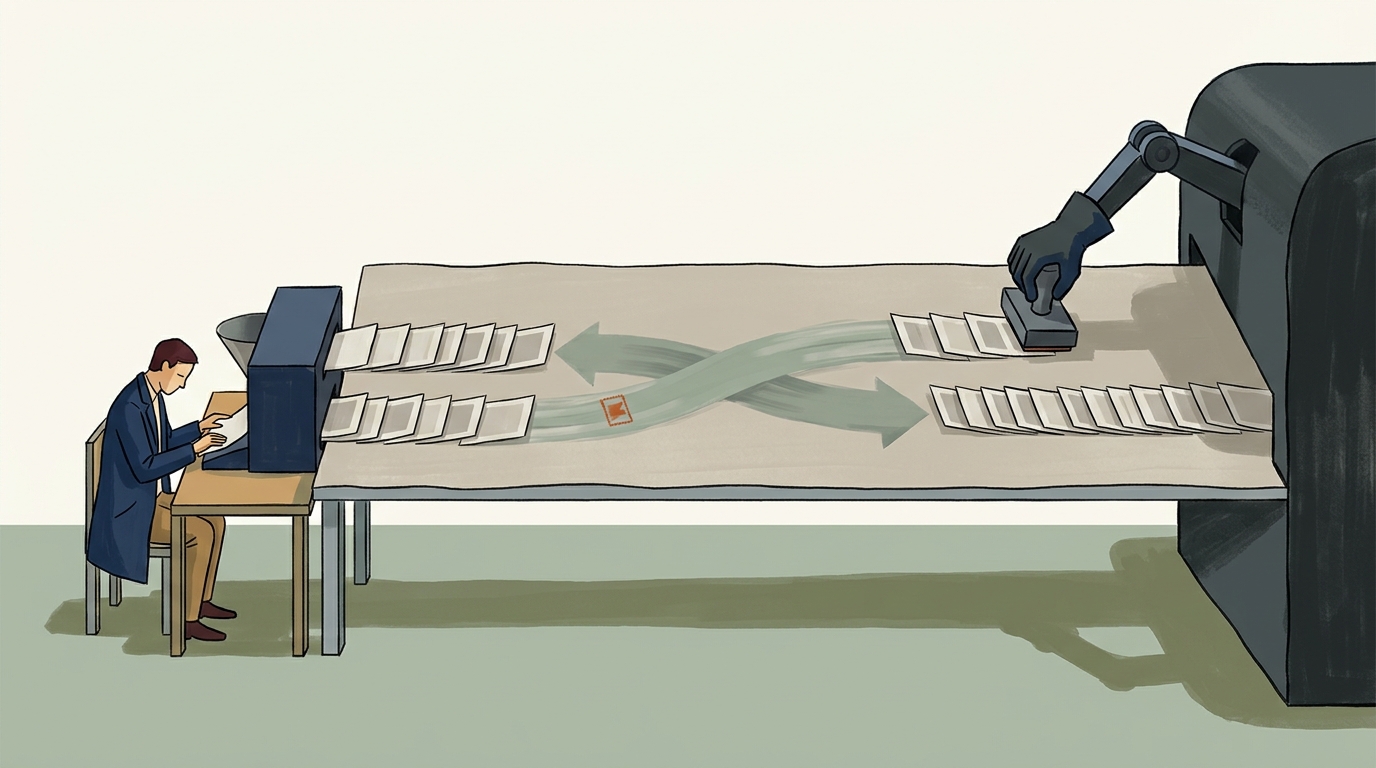
Sometime in the last eighteen months, the resume stopped being a document and became a probabilistic event. Job seekers feed prompts into ChatGPT and Claude to generate cover letters tuned to specific listings; employers run those letters through algorithmic screeners that were themselves trained on resumes generated by earlier versions of the same models. The artifact that arrives on the hiring manager’s screen — if a hiring manager ever sees it — is a synthetic object, optimized at both ends, signed by no one. Call this the signal collapse: a labor market in which every applicant looks plausible, every applicant looks the same, and the apparatus designed to sort them has become, in effect, a deepfake detector pointed at deepfakes it helped create.
The discourse around this collapse has a peculiar shape. We hear constantly from vendors selling the screeners, from consultants advising on prompts, from law firms warning employers about emerging liability. We hear less often, and never with comparable amplification, from the people whose livelihoods are being scored by systems they cannot inspect. This essay is about that asymmetry — about who is permitted to speak about hiring AI, who is held accountable when it fails, and what the structural silences in the conversation tell us about the political economy of work in 2026. The convergence of generative resume tools and algorithmic screening is not just a technical curiosity. It is, as one trade analysis puts it bluntly, a regime in which “AI is scoring your job candidates” and most employers using these tools cannot explain how the score was produced AI is scoring your job candidates. Can you explain how?.
That ignorance is not incidental. It is the product.
The Arms Race Nobody Asked For
The mainstream framing of AI in hiring is about efficiency. A JPMorgan Private Bank briefing for its wealthy clients describes AI as a productivity multiplier in labor markets, focusing almost entirely on what the technology will do for employers — reducing time-to-hire, surfacing “non-obvious” candidates, automating the tedium of resume review Job destroyer? Here’s what you need to know about AI and labor markets. A French analysis in The Conversation makes a softer version of the same move: generative AI will not destroy your job, it argues, but it will “profoundly change your craft” L’IA générative ne détruira pas votre emploi mais elle va changer profondément votre métier. Both pieces are well-reasoned. Both share a structural feature worth naming: the implicit subject of the sentence is the firm, and the worker appears as something to be reorganized.
Now ask the inverted question. What does the same technological convergence look like from the other side of the form? A worker confronted with a posting on LinkedIn or Indeed knows, by 2026, several things at once. She knows the listing may itself be partly fabricated — a “ghost requisition” posted to harvest resumes for a pipeline rather than an open seat. She knows that if she applies in her own voice she will be statistically outcompeted by applicants who have prompt-engineered a denser, more keyword-saturated artifact. She knows the screening software ranks her against a model of the ideal candidate that she cannot see. And she knows, because the lawsuits are public, that the model may be discriminating against her in ways neither she nor her future employer is permitted to understand Eightfold AI Lawsuit Claims Secret Algorithm Ranking Applicants.
The arms race that follows is not a metaphor. It is a documented escalation. As lawsuits proliferate against vendors like Eightfold and Workday, plaintiffs have argued that algorithmic ranking systems function as a kind of secret civil service exam — one administered without notice, scored without rubric, and protected from inspection by trade-secret law AI Hiring Bias Lawsuits Are Reshaping Recruiting in 2026: What …. Workers who suspect they are being filtered out cannot demand to see the model. Workers who succeed cannot know whether they were selected for their qualifications or for an artifact of training data. The screening side of the market has, in the language Crawford uses to describe AI infrastructure more broadly, become “embedded in working infrastructures” in ways that render its power “relatively invisible without losing any of their power” The Atlas of AI.
The applicant side responds the only way it can: by mirroring the opacity. If the screener is a black box, the resume becomes a black box. The job seeker uses an LLM to produce text optimized for whatever the screener seems to want. A second job seeker, watching the first succeed, escalates. By the time the third applicant begins inserting hidden white-on-white keywords into her PDF — the practice now openly discussed in recruiting circles as “resume poisoning” — the labor market has crossed a threshold. The signal that resumes were once meant to carry has become noise; the noise is what gets you hired.
Resume Poisoning as Information Warfare
Resume poisoning deserves a longer look because it reveals something about the moral architecture of the current moment. The technique — embedding instructions or keywords in a document so that an LLM-based screener “reads” content invisible to the human eye — is not, technically, fraud in any traditional sense. The applicant has not lied about her credentials. She has only exploited the gap between what the machine sees and what a person would see. She has, in other words, treated the screener as the adversary it has become.

What is striking is the moral asymmetry of the discourse around this practice. When employers deploy opaque ranking algorithms, the framing in trade press and even in regulator-friendly outlets tends toward the technocratic — talk of “responsible AI,” “workforce impact,” and the need for governance frameworks Beyond the Model — Why Responsible AI Must Address Workforce Impact. When workers respond in kind, the framing snaps to the moralistic: cheating, gaming, fraud, the death of meritocracy. The same act — using software to manipulate the perception of a counterparty in a hiring transaction — is governance when capital does it and dishonesty when labor does it. This is not a new pattern. Ruha Benjamin observed it in a different context when she asked whether “the solution is to ensure that the algorithm is not exposed to prejudicial associations, so that it avoids replicating our worst tendencies” Race After Technology — the question itself, she noted, presumes a particular distribution of trust and blame.
The information-warfare framing is not hyperbole. The same techniques used to poison resumes — adversarial inputs designed to exploit how an LLM tokenizes and weighs text — are studied in the security literature as prompt injection attacks. The labor market has, almost without anyone announcing it, become a live testbed for adversarial machine learning, with the costs of failure borne by individual workers and the upside captured by the vendors selling both the screeners and, in some cases, the resume-optimization tools that defeat them. In Latin America, where these systems are deployed with even less local oversight than in the United States, researchers have documented how the same models embed gendered, racial, and xenophobic biases that then propagate through hiring and credit decisions Género, racismo y xenofobia: así son los sesgos de la Inteligencia …. The poisoning game is one a privileged subset of applicants can play. Most cannot.
Who Escapes Accountability
The most revealing structural feature of the discourse is the accountability gap. When a screening algorithm filters out qualified candidates on the basis of a protected characteristic, the legal action — and there is now a substantial body of it — typically targets the employer. The vendor who built the system, who trained it on undocumented data, who marketed it as bias-free, who collected the subscription revenue, often appears in these cases as a third-party witness or a co-defendant under indemnification clauses that the employer signed without reading. Read the public filings in the Eightfold matter and the structure becomes visible: the secret was the algorithm, the harm was to applicants, and the financial logic of the lawsuit pushes the employer toward settlement long before the algorithm itself is opened up Eightfold AI Lawsuit Claims Secret Algorithm Ranking Applicants.
This is the pattern Crawford and others have called the laundering of decisions. Responsibility is distributed across so many parties — the data labelers, the model trainers, the platform integrators, the HR contractors, the individual hiring manager — that no single node can be held to account for the system’s output. Janelle Shane, in her wry survey of what AI can and cannot actually do, notes that systems for “screening job candidates, identifying the likely top performers by analyzing short video interviews,” appeal to firms because “software never gets tired and never gets hangry, and it doesn’t hold personal grudges” You Look Like a Thing and I Love You. The implicit promise is one of neutrality. The actual product, as multiple audits have shown, is a recapitulation of the patterns latent in the training data, dressed up in the affect of objectivity AI bias: 10 real-world examples and how to fix it | Prolific.
Notice what falls out of frame. The vendor sells “neutrality”; when neutrality fails, the employer is sued; the worker, having already been rejected, never learns what hit her. The vendor, meanwhile, books the next contract. A recent MIT Sloan Management Review piece on responsible AI argues that workforce impact must be treated as a first-order design constraint rather than an afterthought Beyond the Model — Why Responsible AI Must Address Workforce Impact. It is a sound argument. But the political economy of who is required to make that argument, and who is permitted to ignore it, remains intact. Responsibility, in the current configuration, is something corporations volunteer when it serves their reputation and outsource when it doesn’t.
The deeper accountability gap is empirical. The peer corpus — the universe of articles published this past week on AI and labor — is dominated by what we might call the ethical-failure genre: documentation of harms, audits showing bias, lawsuit reporting, and earnest calls for governance. Roughly two in five pieces are some variant of this form. The companion genre, which we might call solution-building — actual technical, legal, or institutional designs that would constrain vendor power, give applicants inspection rights, or alter the structure of the hiring market — is far smaller. The harm is documented; the response is left to “the conversation.” This is, structurally, the same pattern that the AI ethics literature has been describing for a decade. As one MIT Press essential-knowledge volume puts it, “human labor is also hidden behind the scenes: miners, workers on ships, click workers who label data sets, all in the service of capital accumulation by very few people,” and the users of AI most exposed to these dynamics are also the most vulnerable AI Ethics - The MIT Press Essential Knowledge series. Documentation of harm is not the same as redistribution of power, and the gap between the two is where the vendor lives.
The Honest Applicant Penalty
Among the cruelest dynamics of the current moment is what might be called the honest-applicant penalty. The applicant who refuses to use an LLM to inflate her resume — out of principle, or because she doesn’t know how, or because her industry treats AI assistance as ethically suspect — is now systematically disadvantaged in pipelines where the median applicant is using one. The screener, trained on the population of resumes it actually receives, drifts toward an aesthetic that the unaided applicant cannot match. The honest signal, in a market saturated with optimized signal, reads as low-effort.
This is not a hypothetical. Recruiters now routinely report that handcrafted resumes, with their idiosyncratic phrasing and uneven keyword density, fall below algorithmic thresholds that LLM-generated resumes clear effortlessly. The unaided applicant pays for her honesty in lower callback rates; the LLM-using applicant, because everyone else is also using one, captures no relative advantage. Both lose to the vendor selling the screener and to the vendor selling the resume-optimization service. The Red Queen runs harder; the prize goes to the people selling the running shoes.
What this dynamic exposes is the failure of the dominant discourse to name a class of harm that is statistical rather than individuated. Discrimination law, including the emerging case law around algorithmic hiring, is built around discrete adverse decisions: this applicant was rejected, this protected class was disparately impacted AI Hiring Bias Lawsuits Are Reshaping Recruiting in 2026: What …. The honest-applicant penalty is harder to litigate because it is diffuse. No single resume was rejected for being honest; the entire population was sorted along an axis that rewards a specific kind of synthetic fluency. Virginia Eubanks’s documentation of how automated systems “profile, police, and punish the poor” applies here in modified form: the new automated hiring stack does not punish honesty in any single transaction, but it discounts honesty as a population-level signal, and the people who pay the price are disproportionately those who cannot afford the time, tools, or cultural capital to play the game.
Networks Replace Applications
If the front door has become a deepfake, the back door becomes the only door that matters. This is the second-order consequence the senior-editor brief flagged: as trust in formal application channels collapses, hiring reverts to networks, and inequality deepens accordingly.
The pattern is already visible. Among knowledge workers in the United States, the share of hires made through formal applications has been declining for years; what is new is the velocity of the decline since LLMs commoditized the resume. Recruiters, faced with thousands of applications per posting, increasingly treat the formal pipeline as a backstop and rely on referral networks for serious candidates. The applicant who has a friend at the firm — who can be slacked into a hiring manager’s attention — bypasses the screening apparatus entirely. The applicant who does not, regardless of qualification, enters a lottery whose odds are not posted.
This is, structurally, a redistribution of opportunity from formally credentialed outsiders to socially networked insiders. It disproportionately harms first-generation professionals, immigrants, workers re-entering the labor force after caregiving, and people whose social networks do not overlap with the firms doing the hiring. A 2026 Stanford Law analysis of how AI will reshape racial disparities in education made the same point about the credentialing pipeline: when algorithmic systems become unreliable, the reversion is to social capital, and social capital is unequally distributed in ways that map directly onto race and class How will AI Impact Racial Disparities in Education?. The same dynamic obtains in hiring. The signal collapse does not return us to a state of nature; it returns us to a state of patronage.

What makes this particularly acute is that the discourse around it is largely silent. The vendors do not want to discuss it because it suggests their product is degrading the very labor market they claim to serve. The employers do not want to discuss it because the optics of “we don’t trust applications anymore, we hire from our networks” are politically toxic. The workers most affected — those without networks — are by definition the workers without platforms from which to speak. The result is a structural silence at exactly the point where the most consequential change is happening.
Hiring as Infrastructure of Surveillance
There is one more thread worth pulling, because it connects the labor-market story to a larger pattern in how AI is being deployed against ordinary people. The same vendors who sell hiring algorithms increasingly sell what is euphemistically called “workforce intelligence” — systems that monitor employees once hired, score their productivity, flag their communications, and feed performance signals back into models that will inform the next hiring cycle. The hiring algorithm is the front end of a longer surveillance pipeline.
This is not speculation. MIT Technology Review has documented in detail how large language models are being repurposed to enable bulk surveillance at scales previously unimaginable, with applications ranging from law enforcement to corporate HR How LLMs could supercharge mass surveillance in the US. The same infrastructure that scores your resume can score your Slack messages; the same model that flagged you as a “high-potential” applicant can flag you as a “flight risk” three years in. The data flows are continuous. What looks like a hiring decision is in fact a single frame in a much longer film about the management of labor.
The discourse on AI surveillance, when it surfaces, tends to focus on policing — on facial recognition, predictive policing, the sort of technologies deployed at Atlanta’s Cop City and similar sites where, as recent reporting documents, AI policing tools are being tested on Black neighborhoods with minimal oversight Atlanta’s ‘Cop City’ Makes a Black Neighborhood a Testing Lab for AI Policing. The labor-market analog gets less attention because its harms are less visible: there is no body camera footage of a resume being filtered out, no protest movement organized around algorithmic rejection. But the underlying pattern — the use of opaque AI systems to sort populations into categories of acceptability, with the targets of the sorting denied any inspection or appeal — is structurally identical. Even the Vatican has noticed the pattern broadly enough to issue formal guidance, with the pope’s recent intervention on AI explicitly invoking the dignity of the worker and the right not to be reduced to a probabilistic score The pope moves to police AI. When the institutional church is ahead of the regulators, something has gone wrong with the regulators.
The Populist Opening
A political consequence follows. When working- and middle-class people experience the formal hiring system as rigged — when they apply to thirty jobs and receive thirty automated rejections, when they suspect their resumes were never read by a person, when they watch better-connected peers bypass the pipeline entirely — they reach for explanations. The available explanations in the current political environment are largely populist: the system is rigged, elites collude against you, the credentialing institutions are corrupt. These explanations have the advantage of being partly true. The system is rigged, in the specific technical sense that opaque algorithmic gatekeeping has been inserted between worker and employer with no consent and no appeal. Elites do bypass the system through networks. Credentialing institutions have lost legitimacy.
What populist explanation gets wrong is the diagnosis of who is doing the rigging. The rigging is not a conspiracy of cosmopolitan elites against ordinary workers; it is the ordinary operation of a vendor-driven market for HR software that has captured the hiring process and offloaded its costs onto applicants. The villains are mundane: a SaaS company in Mountain View, a procurement officer who chose a vendor on price, a consulting firm that recommended an integration. But the populist frame, because it is the frame on offer, absorbs the legitimate grievance and redirects it toward more spectacular targets. The signal collapse in hiring is, in this sense, an upstream contributor to the politics of grievance — and the technologists building the screeners, when they imagine themselves as neutral parties, are participating in a political project whose downstream consequences they have not reckoned with.
The available responses fall into two camps. The technocratic camp, well represented in the trade press and in regulator-friendly think pieces, calls for governance frameworks, audit requirements, and disclosure regimes Beyond the Model — Why Responsible AI Must Address Workforce Impact. These are necessary. They are not sufficient, because they leave the underlying market structure intact: vendors continue to capture rents, applicants continue to be sorted by systems they cannot inspect, and the only change is that the sorting is now documented in a compliance report. The structural camp, much smaller and much less amplified, calls for things like mandatory human review of all hiring decisions above a certain threshold, applicant rights of inspection over algorithmic scores, and outright bans on certain classes of inferential systems. These proposals are politically harder because they would actually constrain vendor revenue. The fact that the technocratic camp dominates the discourse is itself a fact about who has power.
What the Silences Tell Us
Return to the analytical question. Who has power in AI discourse, and who doesn’t?
The vendors have power, because they shape the language in which the technology is described — “responsible,” “explainable,” “human-in-the-loop” — and because they fund the conferences, sponsor the research, and employ the analysts whose reports become the conventional wisdom. The employers have power, in a derivative sense, because they hold the budgets the vendors compete for; their procurement choices become, in aggregate, industrial policy. The trade press has power, in that it sets the agenda of what counts as a “story” about AI and hiring. Lawyers have power, particularly the plaintiff’s bar, which has begun to convert documented harms into financial pressure on a few exposed defendants AI Hiring Bias Lawsuits Are Reshaping Recruiting in 2026: What ….
Who doesn’t have power? Applicants, individually and as a class. They have no inspection rights, no organized representation in the standards-setting bodies, no presence at the vendor conferences, and no platform from which to articulate the specific harm of the honest-applicant penalty. Workers in jurisdictions outside the wealthy democracies have even less; the bias documentation in Latin America, for instance, exists but circulates within a discourse the vendors are not required to read Género, racismo y xenofobia: así son los sesgos de la Inteligencia …. The data labelers and click workers whose labor trains these systems are nominally acknowledged in the AI-ethics literature and absent from every other conversation. The unemployed, who are the population most exposed to hiring AI, almost never appear as speakers in the discourse about hiring AI; they appear as data points, as case studies, as the deserving objects of someone else’s policy proposal.
This is a familiar pattern. The structural silence in AI discourse around hiring is the same silence that has characterized labor discourse for two centuries: the people most affected by a technology are the people least represented in conversations about its governance. What is new is the speed. The hiring stack of 2026 is not the hiring stack of 2022; the screening apparatus has been substantially rebuilt in three years, with no period during which workers were consulted, no democratic deliberation about whether this was the labor market we wanted, and no mechanism by which it could be unwound.
The dominance of the ethical-failure genre in the discourse — those audits, those bias reports, those documentation projects — is itself diagnostic. Documentation is what one produces when one cannot intervene. It is the labor of the relatively powerless intellectual: bearing witness to harms one cannot stop, in the hope that the witnessing accumulates into pressure. This is honorable work, and one of its products is the emerging case law that has begun, slowly, to constrain the worst behaviors of vendors and employers AI Hiring Bias Lawsuits Are Reshaping Recruiting in 2026: What …. But the gap between documentation and structural change remains vast, and the people who close that gap — when it closes — will not be the documenters. They will be applicants, organized, demanding inspection rights and human review and the simple dignity of being evaluated by another human being.
The Question That Has Not Been Asked
There is a question buried under the entire signal-collapse discourse that almost no one is asking out loud. It is this: why are we sorting people algorithmically at all?
The defenders of algorithmic hiring offer two answers. The first is volume: there are too many applicants per posting for human review to be feasible. The second is consistency: humans are biased; algorithms, properly designed, are less so. Both answers collapse on inspection. The volume problem is partly an artifact of the algorithmic regime itself — applicants apply to more jobs because the marginal cost of an LLM-generated application is near zero, which floods employers with applications, which justifies more aggressive algorithmic filtering, which incentivizes more LLM-generated applications. It is a feedback loop the vendors profit from at every cycle. The consistency argument has been comprehensively demolished by a decade of bias research; algorithmic systems do not eliminate human bias, they laminate it under a coat of pseudo-objectivity that makes it harder to challenge AI bias: 10 real-world examples and how to fix it | Prolific.
The unasked question is whether the labor market would function better — for workers, for employers, for the social contract — under a regime that simply prohibited algorithmic sorting of applicants above some statutory threshold of consequence. Such a regime would force employers to reduce posting volume to what they can humanly review, would force applicants to apply more selectively, would give vendors a market for tools that augment human review rather than replace it, and would restore something like accountability to the hiring transaction. It would, of course, reduce vendor revenue, reduce employer hiring throughput, and impose real costs on the parties currently capturing the benefits of the algorithmic regime. Those costs are why the question is not asked.
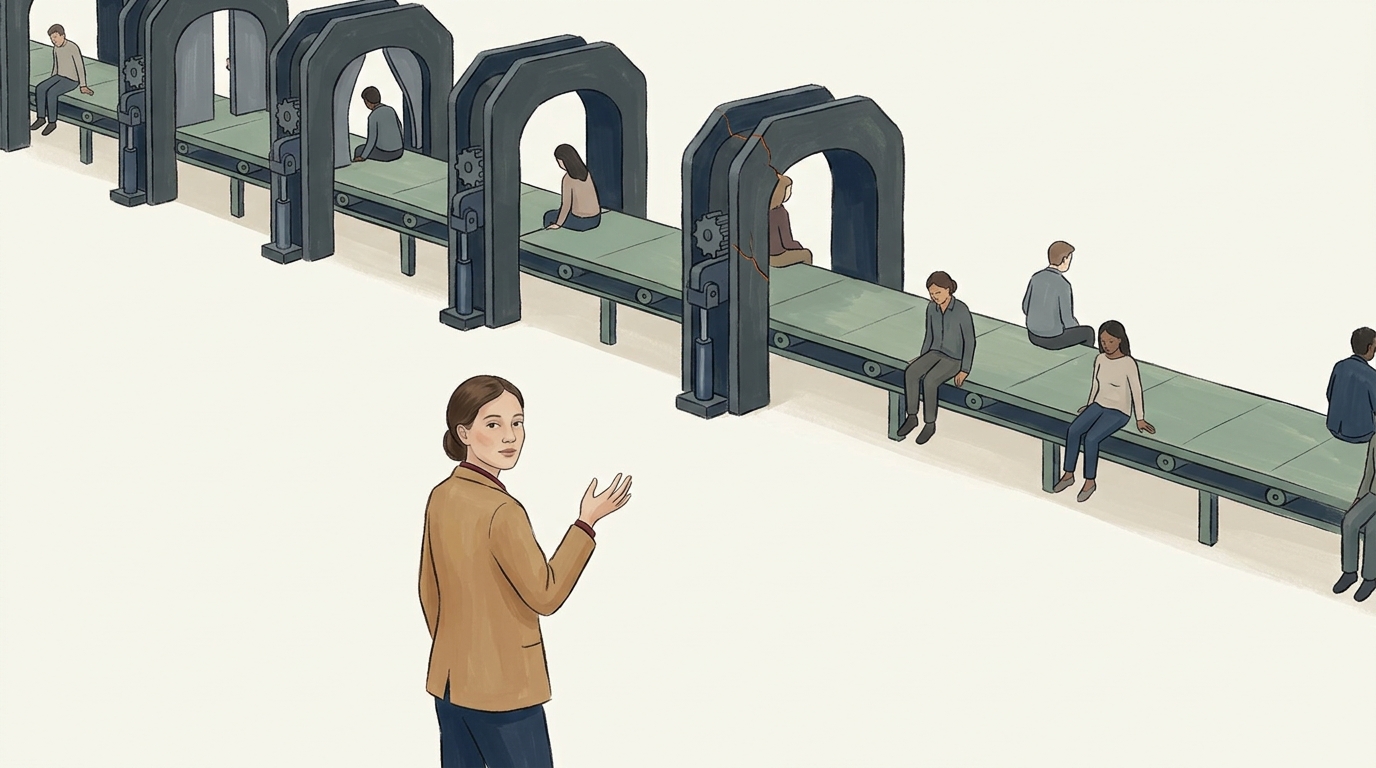
The signal collapse is not a problem the market will solve on its own, because the parties in a position to solve it are the parties profiting from it. The collapse will be solved, if it is solved, by political action — through litigation that pierces the trade-secret veil over hiring algorithms, through legislation that mandates human review and applicant inspection rights, through labor organizing that treats algorithmic hiring as the working-condition issue it has become, and through the slow rebuilding of public trust in evaluative institutions that have, for now, surrendered their legitimacy to vendors. None of this is impossible. None of it is happening at adequate scale.
What is happening, every day, is that another applicant submits another resume to another screener, both ends synthetic, neither end accountable, and the labor market continues its quiet conversion from an institution that distributed opportunity, however imperfectly, into a marketplace for the ranked attention of capital. The deepfake metaphor is the right one. A deepfake is a synthetic artifact that exploits our remaining intuitions of authenticity to extract trust we would not otherwise grant. The job application of 2026 is exactly that artifact. The question is who is being deceived, and by whom, and the answer — if the discourse will permit it — is that we are all being deceived, and the deceiver is a market structure no one designed and few are willing to name.
References
- AI bias: 10 real-world examples and how to fix it | Prolific
- AI Ethics - The MIT Press Essential Knowledge series
- AI Hiring Bias Lawsuits Are Reshaping Recruiting in 2026: What …
- AI is scoring your job candidates. Can you explain how?
- Atlanta’s ‘Cop City’ Makes a Black Neighborhood a Testing Lab for AI Policing
- Beyond the Model — Why Responsible AI Must Address Workforce Impact
- Eightfold AI Lawsuit Claims Secret Algorithm Ranking Applicants
- Género, racismo y xenofobia: así son los sesgos de la Inteligencia …
- How LLMs could supercharge mass surveillance in the US
- How will AI Impact Racial Disparities in Education?
- Job destroyer? Here’s what you need to know about AI and labor markets
- L’IA générative ne détruira pas votre emploi mais elle va changer profondément votre métier
- The pope moves to police AI