The Arms Race for the Resume: From Screening Software to Resume Generators and Back
Somewhere right now, a language model is writing a cover letter that another language model will reject. Neither model has met the human in question, and the human, increasingly, is the least active participant in the transaction. The applicant pays a subscription to a resume generator that promises to “beat the bots.” The employer pays a different subscription to an applicant tracking system that promises to “catch AI-generated content.” Both vendors are telling the truth about what their software does. Neither is telling the truth about what the software is for.
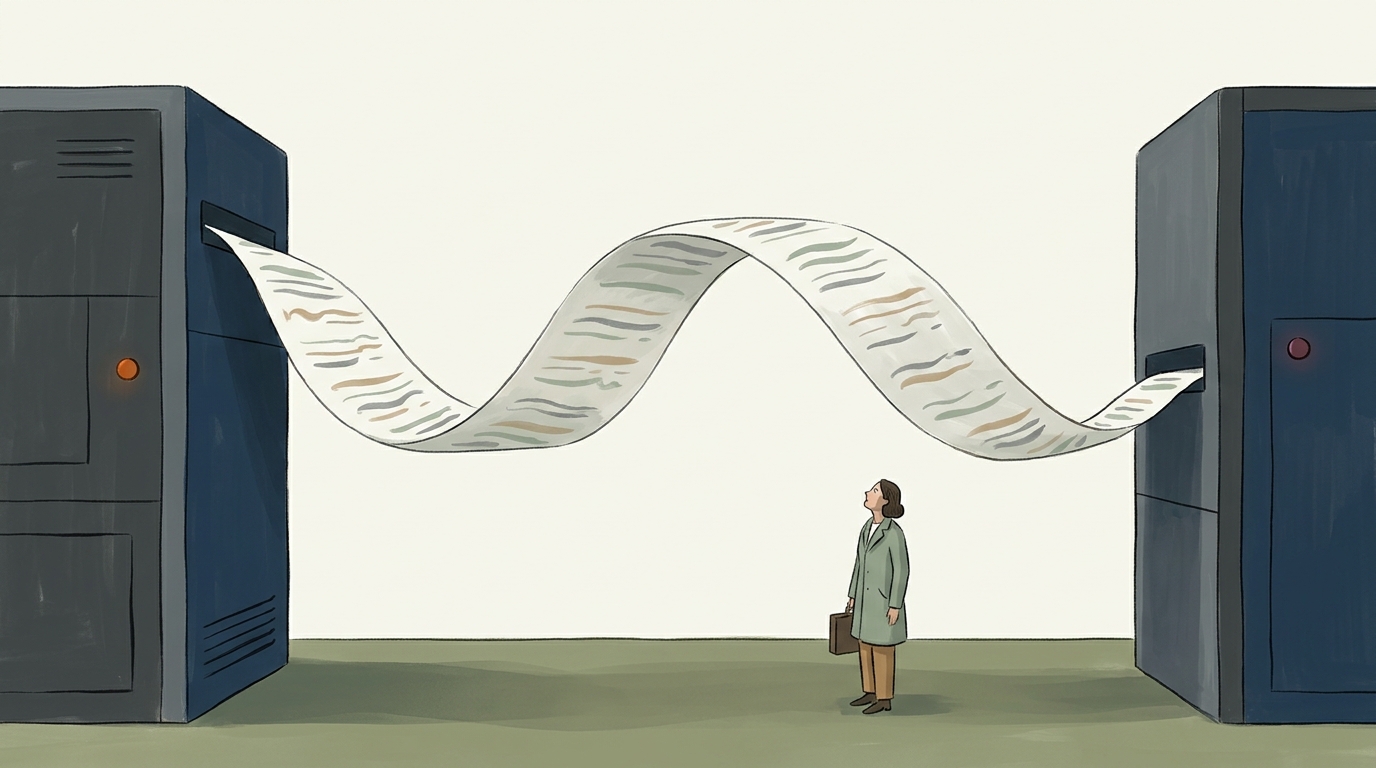
The recruitment technology stack has entered a recursive arms race in which the tools have become the primary agents shaping the labor market’s informational landscape. Resume generators optimize for the parsers; the parsers evolve to flag the generators; new generators emerge that mimic the patterns the parsers were trained to ignore. The Stanford team that produces the field’s annual census of AI capability and deployment has documented a generational leap in the fluency of these systems, with the latest report tracking sharp jumps in benchmark performance across reasoning and language tasks Rapport Stanford AI Index 2026 : Que disent les données …. What that fluency has produced, in the labor market, is not better matching between people and jobs. It is a closed loop in which language models talk past humans to other language models, with the humans on either end paying the toll.
This essay treats the AI hiring stack the way a careful mechanic treats an engine that is running too hot: it asks what the parts actually do, what they are claimed to do, and where the gap between those two descriptions has the worst consequences. The vendor literature for these tools is generous with verbs like “intelligent,” “personalized,” and “optimized.” The research literature, where it exists, is more cautious. The reader who has been told that AI will “transform hiring” deserves to know what that transformation looks like at the level of the artifact — the resume, the parser, the score, the rejection letter — rather than at the level of the marketing deck.
What Resume Generators Are Actually Doing
A resume generator built on a large language model is not, despite the marketing copy, “writing a resume for you.” It is producing the most statistically probable continuation of the prompt you have given it, conditioned on a corpus that includes hundreds of thousands of resumes scraped from the open web and from licensed datasets. The architecture documents that vendors publish for their enterprise products make this fairly explicit if you read them at the level of the data pipeline rather than the slogans How does Microsoft 365 Copilot work? | Microsoft Learn. The model retrieves relevant context, weighs it against its training distribution, and emits the next token. It does this very fast and very cheaply. It does not “understand” your career.
The consequence is a peculiar uniformity. Janelle Shane’s catalog of machine learning’s small disasters notes that systems trained to evaluate or imitate job candidates struggle catastrophically with anything that requires “human-level language skills, with the ability to handle memes, jokes, sarcasm, references to current events, cultural sensitivity, and more” You Look Like a Thing and I Love You — which is to say, with anything that distinguishes one human being’s career from another’s. What the generator is good at is the median resume: the polished, achievement-bulleted, action-verb-saturated document that looks competent and reads as though it could belong to almost anyone in the relevant field. This is not a bug of the technology. It is the technology’s mathematical center of gravity.
There is a further wrinkle. OpenAI’s own researchers have now conceded that hallucination — the confident production of false claims — is not an engineering defect that better training will eliminate but a mathematical consequence of how these systems generate text OpenAI admits AI hallucinations are mathematically inevitable, not just …. For a resume generator, this means the question is not whether the tool will sometimes invent a credential, a job title, or a metric, but how often, and whether the user will catch it. Berkeley’s Center for Entrepreneurship and Technology has framed the same problem from the receiving end: the consumer of a hallucinated text faces a brand-safety and trust problem that scales with deployment Why Hallucinations Matter: Misinformation, Brand Safety and …. The consumer, in this case, is a recruiter, who must decide whether the candidate exaggerated, lied, or merely accepted whatever the model produced.
The vendor positioning around these limits is instructive. OpenAI’s enterprise documentation for its educational tier describes a product whose guardrails and admin controls are sold as a feature to institutional buyers ChatGPT Edu at OpenAI - OpenAI Help Center. That is reasonable as a corporate posture. But the same model architecture, with thinner guardrails, is what powers the consumer-facing resume generators that an unemployed worker reaches for at one in the morning. The technology stack is identical. The supervision is not.
The Adversarial Turn at the Tracking System
If the generator is producing the median resume, the tracking system is, increasingly, trying to detect that median. Applicant tracking systems have been around for two decades, but their function has shifted in the last three years from keyword matching to something closer to adversarial machine learning. The newer ATS modules apply classifiers trained on labeled corpora of human-written and AI-generated text, looking for the statistical signatures — burstiness, perplexity, lexical predictability — that distinguish one from the other. Vendors describe this as “authenticity verification.” It is more accurately described as a guess.
The guess fails in two ways. First, it produces false negatives: a resume polished but not generated by ChatGPT often passes through, while a resume written entirely by hand by a non-native English speaker who relied on Grammarly may not. Second, and more consequentially, it produces false positives against the people whose prose was always going to look “machine-like” to a classifier trained on a particular slice of the human corpus. Ruha Benjamin’s work on what she calls the New Jim Code anticipates this dynamic: the assumption that algorithmic mediation can launder out human bias collapses when the algorithm is itself trained on the residue of that bias Race After Technology. A classifier that flags neurodivergent writing patterns, English-as-a-second-language constructions, or simply unusually formal prose as “AI-generated” is not neutral arbitration. It is the same screening problem moved one layer down the stack.
Kate Crawford has documented how the recurring pattern of bias in AI hiring is rarely “an inadequate underlying dataset or a poorly designed algorithm” alone, and pointed to insider accounts — most notoriously from Amazon — in which systems trained on historical hiring data simply automated existing exclusions The Atlas of AI - Power, Politics, and the Planetary Costs. The adversarial-detection turn does not solve this. It compounds it. Now there are two classifiers in the pipeline: one trained on what historically counted as a “good” candidate, and one trained on what historically counted as “human” prose. Both inherit the demographic skew of their training data. Both are sold as objective.
The vendor response, when this is pointed out, is to recommend more training data and better adversarial robustness, which is to say, more of the same. The research community’s response has been more circumspect. Anthropic’s recent work on how AI assistance shapes skill formation in adjacent domains found that heavy reliance on model-generated output can subtly degrade the user’s own capacity to produce that output independently How AI assistance impacts the formation of coding skills. The study was about coding, not resume writing, but the mechanism transfers cleanly. A workforce that has outsourced its self-presentation to a generator for three years is a workforce that can no longer reliably write its own resume — which raises the price of the generator and locks in the dependence the parser is, in turn, trying to detect.

The Autopoietic Loop
The word for a system that produces and reproduces itself, sustaining its own boundaries, is autopoietic. The hiring stack is becoming exactly that. The same foundation models that power the resume generators power the screening tools, the chatbots that conduct first-round “interviews,” the summarizers that condense candidate dossiers for hiring managers, and the dashboards that report on the whole pipeline. Microsoft’s enterprise-facing Copilot dashboard, for instance, is explicitly designed to give organizations metrics on how their workforce is using the company’s AI tools across productivity workflows Connect to the Microsoft Copilot Dashboard for …. The tools watch the workers; the workers feed the tools; the tools report on the watching. The hiring application of this stack is one branch of a larger pattern.
What this means concretely is that a resume submitted in 2026 may be drafted by GPT-class model A, parsed and scored by GPT-class model B, summarized for the recruiter by GPT-class model C, and matched against a job description that GPT-class model D wrote for the hiring manager last week. Each of these models has been trained on overlapping slices of the same web-scale corpus. Each has the same statistical preferences for fluent, hedged, generic prose. Each has the same blind spots. The “decision” that emerges from this pipeline is not the considered judgment of any human; it is the consensus of a committee of language models that mostly agree with each other because they are mostly the same model.

The vendor literature is candid about the ambition. Microsoft’s enterprise positioning material walks buyers through a decision tree about which Copilot product fits which organizational role, on the assumption that AI assistance will be present at every layer of the workflow Decide which Copilot is right for you | Microsoft Learn. The training infrastructure for getting employees fluent in these tools — Microsoft Copilot Academy, the various educator-facing modules — is sold as a complement to the deployment, not as an afterthought Microsoft Copilot Academy | Microsoft Learn. This is not a neutral observation about the future of work. It is a commercial commitment that the future will look like this whether or not it should.
Crawford’s broader argument applies here with particular force: the AI industry’s economics depend on a continuous expansion of the surface area on which AI is deemed necessary The Atlas of AI - Power, Politics, and the Planetary Costs. Hiring is an unusually attractive surface. It is high-volume, low-stakes-per-decision, and historically expensive to do well. It is also a domain where the costs of error are externalized — borne by rejected candidates, not by the employer or the vendor. The autopoietic loop, in other words, is not an accident of the technology. It is the technology’s most profitable configuration.
The Detectability Trap
The arms race has a particular asymmetry that deserves naming. The generators are trained to produce text that mimics the human corpus; the detectors are trained to identify text that diverges from the human corpus; both are trained on the same corpus. This is not a stable equilibrium. Each round of generator improvement narrows the gap between AI prose and human prose, which forces the detectors to look at increasingly subtle features, which produces increasingly arbitrary classifications.
The phenomenon is visible elsewhere in the AI tooling ecosystem. The Fortune piece on the unsettling appearance of “perfect homework” in classrooms — and the institutional turn toward oral examinations as a workaround — captures the same dynamic in another sector The Gen Z stare meets the mysterious perfect homework … - Fortune. When written artifacts can no longer be authenticated as human, the verification function migrates to live performance. The hiring analog of the oral exam is the in-person interview, the take-home assignment with a tight deadline, the live coding screen — methods that hiring managers were sold on automating away, now being reluctantly reinstated as the only artifacts that cannot be model-generated.
This is not progress. It is reversion. The promise of AI hiring tools was that they would compress the recruiting cycle by automating the early stages. What is happening instead is that the early stages have become unverifiable, which means the verification burden has shifted to the later stages, which means the cycle is not compressed at all. The candidate now produces a generated resume that the employer cannot trust, sits through an algorithmic screen that the candidate cannot understand, and arrives at the in-person interview where, for the first time in the process, anyone is actually evaluating anyone. The intermediate machinery has added cost without adding signal.
The detection products that promise to fix this problem inherit the same mathematical limits as the generators they detect. If hallucination is mathematically inevitable in generative models — as OpenAI’s own admission concedes OpenAI admits AI hallucinations are mathematically inevitable, not just … — then so is misclassification in detection models. There is no ground truth for “this resume was written by a human.” There is only a probability score, calibrated against a training set, applied to a candidate who may or may not resemble the population on which the calibration was performed. A vendor selling certainty here is selling something the underlying mathematics does not deliver.
What the Coding Tools Have Already Shown Us
The clearest preview of where the resume arms race is heading is the parallel arms race in software engineering, which began earlier and has accumulated more evidence. Code generation tools have been integrated into developer workflows for half a decade, and the pattern of dependence, capability shift, and detection failure is now well documented.
GitHub Copilot’s product evolution is instructive. The tool started as an in-editor autocomplete and now generates whole functions, suggests code reviews, and writes its own tests GitHub Copilot in VS Code. The official guidance for using it responsibly walks developers through a stack of practices for verifying that the model has not introduced subtle errors Uso responsable de la revisión de código de GitHub Copilot. The training documentation for unit-test generation explicitly encourages developers to use the model to write the tests that would catch the model’s own errors Generating unit tests - GitHub Docs. This is the same recursive structure as the resume arms race: a tool generates, a tool verifies, and the human is asked to trust both.
The verification problem has become serious enough that Microsoft’s Visual Studio team has published detailed guidance on how to drive Copilot through a test-generation workflow that is supposed to catch what the generation step missed Generate and run unit tests using GitHub Copilot testing - Visual …. The implicit acknowledgment in this guidance is that the generator alone cannot be trusted, and that the test-writing function — which used to be a developer’s most explicit demonstration of understanding the problem — is now an automated check on an automated artifact Writing tests with GitHub Copilot. Every layer of this pipeline is sold as a productivity gain. Each layer is also a layer at which the human can no longer easily intervene.
Anthropic’s research on the skill-formation effects of these tools is one of the few empirical pieces in the public record that addresses the long-term consequence honestly: prolonged use of AI assistance correlates with measurable changes in how users approach and retain the underlying skill How AI assistance impacts the formation of coding skills. The implication is not that the tools are useless. It is that the dependence is real and that the workforce produced by ten years of these tools will be a different workforce than the one that started using them. The hiring stack should be read in the same light. Every additional layer of AI mediation in the recruitment pipeline is also a layer of skill atrophy in the people moving through it — both candidates and recruiters.
Lock-In and the Mirage of Open Standards
The structural endpoint of the arms race is platform consolidation. The generators that produce resumes most fluent in the parser’s preferred dialect will be those produced by the same vendors that sell the parsers. The parsers most accurate at flagging “inauthentic” candidates will be those trained on the largest corpora of generated text, which is to say, the corpora produced by the dominant generators. The vendors who own both ends of this loop — and a few do — will accumulate a structural advantage that is very difficult to dislodge.
This dynamic is visible in the educational tier of the same vendors’ offerings. The free-for-students access to GitHub Copilot, the educator-discounted access to Copilot Pro, the institutional licensing of ChatGPT Edu — all follow a familiar pattern from earlier waves of platform technology Access GitHub Copilot for free as a student. Get the user young, get the user fluent in your stack, get the user dependent on your stack, and the eventual enterprise contract is downstream of a cohort effect that took five years to mature Plans for GitHub Copilot. The hiring tools are not yet at this level of vertical integration, but the trajectory is clear: the same companies are building the resume drafters, the productivity assistants in which work history accumulates, and the screening dashboards by which that history is read.
The proposed alternative — an open standard for verifiable digital resumes, perhaps with cryptographic signatures attesting that a particular credential was issued by a particular institution — is technically straightforward and politically improbable. The vendors with the most to gain from such a standard are the smallest. The vendors with the most to lose are the largest. JSON-LD-based credential schemas exist; they have existed for years; they are not adopted at scale because adoption would dissolve the proprietary parser’s competitive advantage. This is the same pattern Crawford identifies elsewhere in the AI economy, in which the public good of interoperability loses, every time, to the private good of platform lock-in The Atlas of AI - Power, Politics, and the Planetary Costs.

A reader who has watched this play out in adjacent industries — health records, learning management systems, identity providers — should not expect hiring to be the exception. The arms race is profitable for the arms dealers. It is expensive for the people whose careers depend on it. The claim that “the market will sort this out” assumes that the market is composed of buyers and sellers with comparable information. In the hiring stack, the buyers are employers with HR budgets, the sellers are platform vendors with marketing teams, and the candidates — whose resumes are the actual product being processed — are not party to the negotiation at all.
What a Careful Adopter Should Actually Know
The reader asked at the outset what the careful adopter should take from all this. The honest answer is shorter than the vendor literature would suggest.
First, the gap between what these tools claim and what they do is not random; it follows a predictable pattern. Marketing claims emphasize personalization, intelligence, and time savings. Architecture documents describe statistical retrieval, probability-weighted generation, and structured pipelines How does Microsoft 365 Copilot work? | Microsoft Learn. The two descriptions are not contradictory, but they are not equivalent either. Personalization in the marketing sense means “the output is shaped to your input.” Personalization in the technical sense means “your input is one of millions of conditioning signals on a model whose dominant prior is the median of its training corpus.” A careful adopter holds both descriptions in mind and asks, of any specific claim, which one is being relied upon.
Second, the dominant framing of these tools as neutral utilities — workflow accelerators, productivity boosters, screening efficiencies — obscures the fact that they are agents in the labor market. They do not just process information about the labor market; they reshape the information that the labor market is composed of. Stanford’s annual census documents the scale of this reshaping in adoption rates and capability benchmarks Rapport Stanford AI Index 2026 : Que disent les données …. The reshaping is not the side effect. It is the product.
Third, the failures of these tools are not transient. Hallucination is mathematically inevitable OpenAI admits AI hallucinations are mathematically inevitable, not just …. Bias inherited from training data is structural, not a tuning problem Race After Technology. Dependence-induced skill drift is documented in the closest analogous domain How AI assistance impacts the formation of coding skills. A vendor pitch that promises to solve any of these by next quarter is not engaging with the underlying mathematics. It is engaging with the procurement cycle.
Fourth, the verification function is migrating, and the careful adopter — whether candidate, recruiter, or institution — should pay attention to where it is going. When written artifacts cannot be trusted, organizations turn to live, in-person, real-time evaluation. The oral exam returning to the classroom The Gen Z stare meets the mysterious perfect homework … - Fortune is the same phenomenon as the in-person interview returning to the hiring funnel. This is not a failure of AI. It is the AI tooling pricing itself out of the upstream verification market by making upstream verification impossible.
Finally, and most importantly, the right question to ask of any AI hiring tool is not “does it work?” but “what does it do to the people it processes?” The vendor literature answers the first question. The second question is the one that matters, and the answer, on current evidence, is uncomfortable. The tools centralize the labor market’s informational substrate in the hands of a few platform vendors. They produce false positives against people whose prose patterns diverge from the corpus median. They induce dependence in users who lose, over time, the capacity to self-present without them. They sell certainty about a process — sorting humans into jobs — that is, on the underlying mathematics, irreducibly uncertain.
The arms race for the resume will continue, because the incentives to continue it are aligned for everyone except the people whose resumes are being processed. A reader who finishes this essay and decides to use one of these tools anyway should at least do so with the same wariness one would bring to any other instrument that promises to think on one’s behalf. The model is not your advocate. The parser is not your judge. They are commercial products in a market that has been very carefully arranged so that you, the human at the center of the transaction, are the part that pays.
References
- Access GitHub Copilot for free as a student
- ChatGPT Edu at OpenAI - OpenAI Help Center
- Connect to the Microsoft Copilot Dashboard for …
- Decide which Copilot is right for you | Microsoft Learn
- Generate and run unit tests using GitHub Copilot testing - Visual …
- Generating unit tests - GitHub Docs
- GitHub Copilot in VS Code
- How AI assistance impacts the formation of coding skills
- How does Microsoft 365 Copilot work? | Microsoft Learn
- Microsoft Copilot Academy | Microsoft Learn
- OpenAI admits AI hallucinations are mathematically inevitable, not just …
- Plans for GitHub Copilot
- Race After Technology
- Rapport Stanford AI Index 2026 : Que disent les données …
- The Gen Z stare meets the mysterious perfect homework … - Fortune
- Uso responsable de la revisión de código de GitHub Copilot
- Why Hallucinations Matter: Misinformation, Brand Safety and …
- Writing tests with GitHub Copilot