The Literacy of Doubt: Teaching Critical Judgment in a Post-Credential Job Market
The resume on the hiring manager’s screen is articulate, well-structured, free of typos, and tonally calibrated to the job description. It lists three quantified achievements per role, uses the right verbs, and signals a culture fit. It may also have been written, in whole or in part, by a language model that has never met the candidate. The hiring manager — a real person with a queue of seventy applications and a meeting at three — cannot tell. Neither, frankly, can the candidate’s references, who will be asked to confirm impressions formed during a fluent, well-rehearsed Zoom interview that the candidate prepared for using the same model. This is the ghost resume problem, and it is not a problem about cheating. It is a problem about reading.
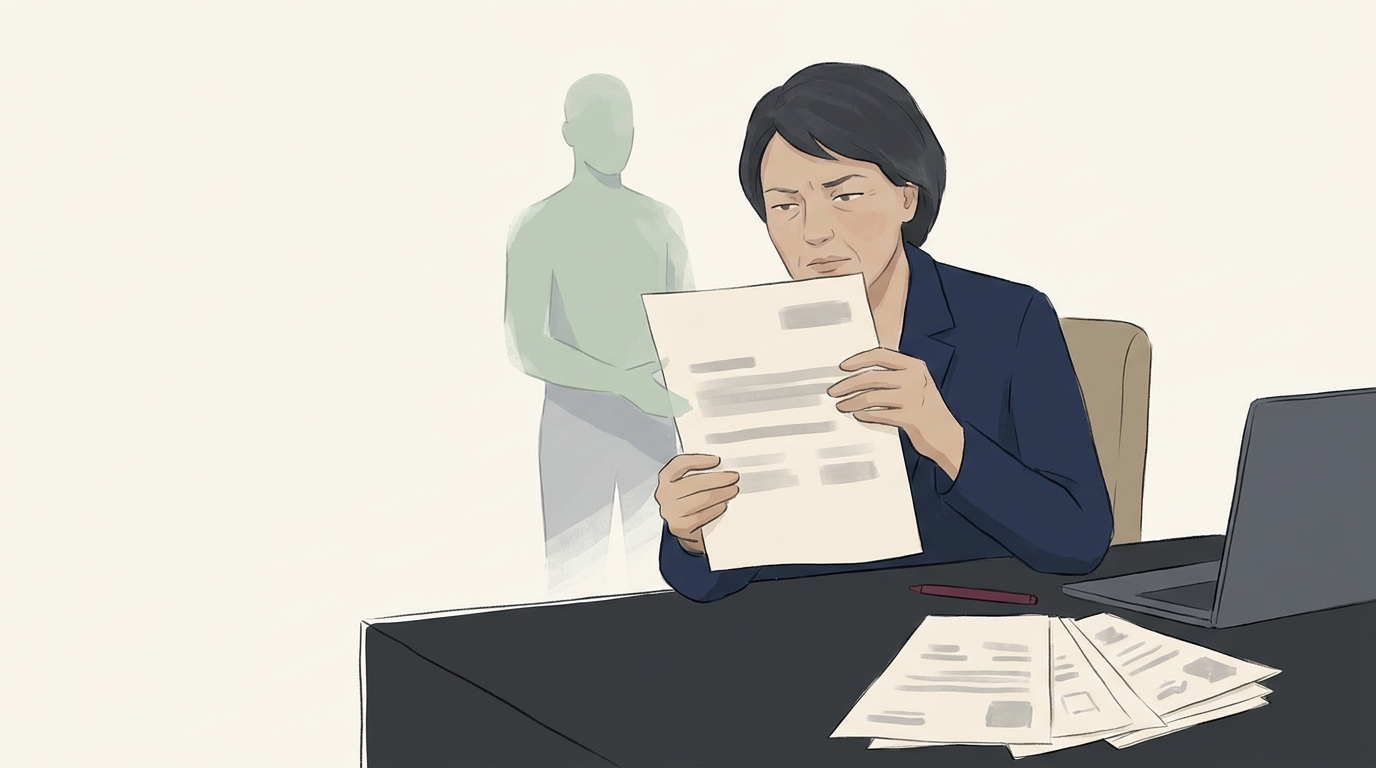
For most of the post-war century, professional literacy meant the ability to produce credible self-presentation: to write a resume, draft a cover letter, hold a conversation in the register expected of one’s field. The credential — degree, certification, prior title — anchored these performances to something verifiable. The labor market is now sliding off that anchor. When the U.S. Department of Labor released its first formal definition of “AI literacy” for the workforce, the framing already conceded the point: literacy was no longer about authoring documents but about navigating a field of documents whose authorship is uncertain, whose claims are optimized, and whose tone has been smoothed by a system trained to produce exactly the impression a reader expects The DOL Just Defined AI Literacy For The Workforce. What’s Next? - Forbes. What looks like a productivity story is in fact an epistemic one. The center of gravity in professional communication has moved from writing to judging.
This essay maps that shift. It argues that the dominant frameworks for AI literacy — the ones being adopted by labor ministries, school systems, and corporate trainers — still mostly teach people how to use AI tools, when the urgent civic and professional skill is how to read AI’s outputs and the human-AI hybrids that surround them. The gap matters. A workforce trained to prompt but not to doubt is a workforce that will be more easily managed, more easily sorted, and more easily deceived — by employers, by vendors, and by each other.
The Two Literacies, and Why They Aren’t the Same
Walk through the public materials of any major AI literacy initiative and you will find two definitions awkwardly bundled together. The first is operational: a literate person can use AI tools effectively. They can write a prompt, refine an output, integrate a model into a workflow. The second is critical: a literate person can evaluate AI’s outputs, recognize its failure modes, and judge when its use is appropriate. Vendors prefer the first definition because it sells seats; ministries prefer it because it produces measurable training metrics. The second is harder to teach, harder to credential, and harder to monetize.
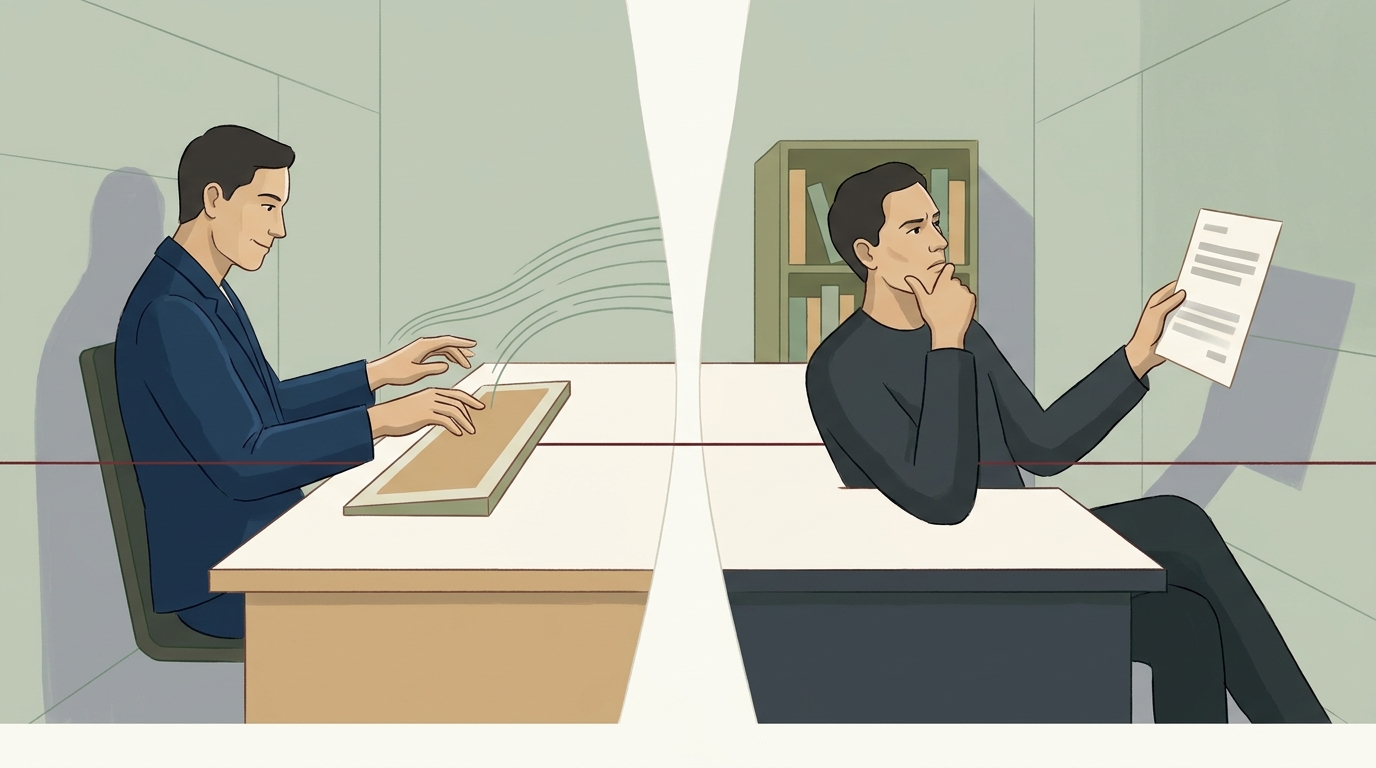
Microsoft’s training pathways, for example, organize the field around responsible use — students learn to deploy AI in classrooms, professionals learn to integrate it into pipelines Responsible use of artificial intelligence in education. The architecture of the curriculum assumes the AI is a tool you operate, with ethics and safety bolted on as guardrails AI adoption for Microsoft and Azure - Cloud Adoption Framework. Even content-safety products — designed precisely to detect AI-generated harm — are framed as services you call from inside an application, not as habits of mind a citizen carries from one situation to another What is Azure AI Content Safety? - Azure AI services. The assumption is that critical judgment can be outsourced to a classifier.
The competing tradition, more common in UNESCO and civil-society documents, refuses that outsourcing. UNESCO’s Think Critically, Click Wisely framework lists, as the first competency, the ability to recognize what is and is not an AI artifact, and acknowledges directly the difficulty of doing so UNESCO Think Critically Click Wisely. Its companion document for teachers stresses that AI outputs are stochastic — the same input produces different outputs — and therefore cannot be trusted in the way a textbook can AI competency framework for teachers - UNESCO. This is a different epistemology. Tools you operate; judgments you make. The difference shows up immediately when you ask what a “literate” person should be able to refuse.
The AI Literacy Framework circulating among curriculum designers tries to bridge the two, organizing competencies around understanding, evaluating, and creating with AI Empowering Learners for the Age of AI. But in practice the bridge sags toward the production side. It is easier to write a rubric for “student can produce a working prompt” than for “worker can recognize when the polished email in their inbox was generated to manipulate them.” The first is a skill; the second is a disposition that has to be practiced against live, adversarial material.
Provenance Was Always the Point
Begin from the ghost resume, and the conceptual muddle clears. The reason the document is a problem is not that AI helped write it — humans have been helped by ghostwriters, career coaches, and template libraries for decades. The problem is that the AI’s help is invisible and unbounded. A career coach edits; a model generates. A template fills in; a model fabricates plausible specificity. The professional document arrives without a chain of custody.
This is the sense in which “literacy” most needs to be reframed. The journalists who write detection guides have figured this out faster than the educators. The Global Investigative Journalism Network’s primer on identifying AI-generated content reads as a checklist of provenance heuristics — inconsistencies in time, place, and detail; the absence of friction in narrative; the suspicious smoothness of language Guía para periodistas sobre cómo detectar contenido generado por IA. The verification playbooks for hallucinated text instruct readers to triangulate every claim against an external source, on the assumption that fluency is no longer evidence of accuracy La Verificación de Alucinación en 60 Segundos: Manual de Verificación. The empirical literature on hallucination rates is now substantial enough that a reader who treats model output as merely “sometimes wrong” is being naïve about how confidently wrong it is Las alucinaciones de la IA: evidencia empírica.
What the journalist already knows, the hiring manager and the voter and the parent are still learning: that evaluation in an AI-saturated environment is no longer about content alone. It is about the trail. Where did this document come from? Whose words pass through it? What was the model trained to optimize? UNESCO’s framing of the deepfake crisis as a “crisis of knowing” gets the diagnosis right — what we have lost is not the ability to be persuaded by texts, but the ability to take their surface as evidence of their origin Deepfakes and the crisis of knowing - UNESCO. Once the surface decouples from the source, every document becomes an inference problem.
The professional implication is sharper than it looks. A resume has always been a performance, but it was a performance authored by a person whose limits — vocabulary, self-knowledge, available examples — bounded what the document could plausibly claim. Strip those limits, and the resume becomes a kind of fluent emptiness: every candidate sounds like a strong candidate, every cover letter is competently written, every LinkedIn summary is “results-driven.” The signal collapses. The reader, asked to make a hiring decision in this collapsed signal environment, needs a literacy that earlier generations of readers did not need: the literacy of doubt.
The Smoothness Tell
Critical evaluation of AI-generated professional text has, by now, a small canon of tells. Overly optimized language — the paragraph that ticks every keyword in the job description without naming a single human collaborator. Inconsistent specifics — the candidate who claims “led a team of seven” in one bullet and “managed cross-functional groups of twelve to fifteen” two lines later, as though the model resampled the number. The absence of the kind of texture only lived experience produces: a project that failed and was rescued, a colleague named, a small detail about the building or the budget that no template would predict. Educators in the journalism tradition catalog these patterns rigorously Éduquer contre la désinformation amplifiée par l’IA et l’hypertrucage; media educators in Finland have made an entire civic curriculum out of teaching citizens to read the seam where the synthetic meets the real Après des décennies d’éducation aux médias, la Finlande forme les élèves à repérer les deepfakes.
The same competencies, ported into a hiring context, change the meaning of the hiring conversation. An interview is no longer a confirmation of the resume; it is a probe of whether the person on the other end of the camera can produce, under live pressure, the textured specifics their document promised. A reference check is no longer a courtesy call; it is a chain-of-custody inspection. A writing sample, if requested, has to be produced under conditions that make provenance legible — not because the candidate is suspect, but because the document alone can no longer carry the evidentiary weight it once did. None of this means the candidate is dishonest. It means that the relationship between the document and the person it represents has loosened, and the reader has to do work that used to be done by the form itself.
There is a real risk, of course, that this devolves into pattern-matching paranoia. Readers can over-detect; they can mistake non-native English fluency for AI smoothness, or punish candidates whose careful editing happens to resemble a model’s prose. Detection without humility becomes its own injustice. The point of teaching evaluation is not to produce confident detectors but to produce readers who can hold the question open — who can say, this document is plausible and its provenance is unclear, and who design their hiring practices to elicit additional, harder-to-fake evidence.
What the Frameworks Don’t Cover
The current generation of AI literacy frameworks has a blind spot at exactly this point: the social and economic dynamics that determine whose ghost resume is read charitably and whose is read with suspicion. The Kapor Foundation’s Responsible AI guide is unusually direct about this — when bias is encoded into systems that mediate hiring, the burden of proof lands unevenly, and a “neutral” detection regime tends to fall hardest on candidates who already had less margin Responsible AI - Kapor Foundation. A workforce literacy that teaches readers to spot AI smoothness without also teaching them to interrogate their own confidence about who “sounds authentic” will replicate the inequities of the credentialing system it claims to replace.
The DOL’s workforce framing tries to split the difference, locating AI literacy somewhere between digital fluency and critical thinking, but the tilt of the document is toward labor-market readiness — what employers want a worker to be able to do — rather than toward the worker’s capacity to read the labor market itself The DOL Just Defined AI Literacy For The Workforce. What’s Next? - Forbes. This is the older shape of “literacy as employability”: a curriculum designed by the parties hiring, for the parties being hired. It assumes that the asymmetries of the hiring conversation are settled. They are not. When employers screen with AI, applicants apply with AI, and references are verified by AI — as they increasingly are — the question of which parties most need critical literacy gets worth asking again. The applicant who cannot read an automated rejection email skeptically is the one most exposed.
This is where the philosophical literature on AI ethics has more to offer than its reputation suggests. The argument made in the MIT Press’s AI Ethics — that “doing AI” must come to include ethics not as an add-on but as constitutive of the practice — generalizes outward to readers as well as builders AI Ethics - The MIT Press Essential Knowledge series. To live as a reader in an AI-saturated economy is to need an ethics, not just a skill set: a practiced sense of what kinds of doubts are worth holding, what kinds of trust are worth extending, and what social arrangements would make those judgments easier or harder to sustain. A literacy that addresses only the second question — what skill set — is a literacy that has agreed in advance to whatever social arrangements the platform companies provide.
The Field Beyond the Resume
If the ghost resume forces a literacy of doubt, that literacy cannot stop at the resume. The same epistemic conditions hold for cover letters, LinkedIn profiles, performance reviews, customer testimonials, internal memos, the drafts circulating in any organization where someone has discovered that the model writes faster than they do. They hold for the press release announcing a layoff and the candidate statement attached to a ballot. They hold, increasingly, for the text on the screen in front of a child trying to do their homework. Children’s susceptibility to AI-generated content turns out to be measurably high, with younger readers especially likely to treat a fluent answer as a correct one Children’s susceptibility to content generated by artificial intelligence. Brookings’s mapping of “Generation AI” — the first cohort whose pre-school years are saturated by these systems — makes clear that critical literacy is no longer a competency one acquires before entering the workforce; it is a competency one needs before learning to read Generation AI starts early: A guide to technologies already shaping young children’s lives.
The same logic extends upward into the political economy of information. UNESCO has been blunt that AI’s contribution to disinformation is now structural rather than incidental — a feature of how the information environment is being reshaped, not a bug to be patched Inteligencia artificial y desinformación - UNESCO. European broadcasters report that AI-generated content is showing up in the disinformation feeds more often, with mixed results from the labeling regimes that were supposed to make provenance visible Des contenus générés par IA sources de plus en plus recurrentes de désinformation. Reportage from conflict zones documents a category of harm — deepfakes used as instruments of algorithmic war — that is qualitatively different from the older information disorders Deadly deepfakes: A survival guide for the age of algorithmic war. The literacy a citizen needs to cast a vote, the literacy a worker needs to evaluate a job, and the literacy a parent needs to sit with their child at a screen are converging on the same skill: reading texts of uncertain provenance with appropriate doubt.
This convergence is what makes AI literacy a load-bearing capacity for everything else. A society whose citizens cannot evaluate the documents they encounter is a society in which credentials, contracts, and consent decline together. The labor market’s particular version of this problem — the ghost resume — is just the most professionally legible instance of a general condition. Conferences cataloging deepfake-driven disinformation now routinely treat the workforce question and the public-sphere question as the same question, because the underlying epistemic vulnerability is the same Deepfakes, Disinformation, and AI Content Are Taking. What is at stake in teaching a hiring manager to read a resume skeptically is also what is at stake in teaching a voter to read a video skeptically. The skills travel, or none of them work.
Who Defines Literacy, and Whose Counts
The question every literacy framework should be asked, before any of its competencies are evaluated, is who wrote it and who benefits from its definition winning. The post-war push for adult literacy in many countries was a contested political project; the question of whether literacy meant “able to sign one’s name on a ballot,” “able to read scripture,” or “able to read the conditions of one’s labor critically” was answered differently by different actors with different stakes. The current push for AI literacy is no different. The DOL’s definition, once codified, will shape billions of dollars of training subsidies and certification frameworks The DOL Just Defined AI Literacy For The Workforce. What’s Next? - Forbes. The vendors’ definitions shape the curricula their certification programs reach. UNESCO’s definitions shape what ministries of education in low- and middle-income countries take as the international standard Les deepfakes et la crise du savoir - UNESCO.
The metaliteracy tradition, which treats literacy as an active and continually negotiated practice rather than a fixed skill set, has been arguing for some time that the design of the network itself is part of what readers are learning to read MetaLiteracyIACW. When commercial platforms structure the information environment in which all reading takes place, asking citizens to evaluate AI outputs without also asking them to evaluate the platforms is a partial literacy at best. The ghost resume sits inside an applicant tracking system whose ranking logic is opaque; the LinkedIn profile sits inside a feed whose ordering optimizes for engagement; the AI tutor sits inside a product whose business model is, increasingly, surveillance.
The surveillance dimension is not incidental to the literacy question — it shapes what kinds of doubt are even possible. Schools and workplaces using AI counselors and AI surveillance produce an environment in which the reader is also being read Schools are using AI counselors to track students’ mental health; the false-positive rates of school surveillance systems have already produced documented harms School AI surveillance like Gaggle can lead to false alarms, arrests. The infrastructure that promises to help readers navigate AI is the same infrastructure recording how they navigate it Unmasking EdTech’s Surveillance Infrastructure in the Age of AI. A literacy curriculum that does not treat this as one of its central problems — that defines AI literacy without addressing who watches the reader — is teaching a literacy designed to fit the watcher’s convenience.
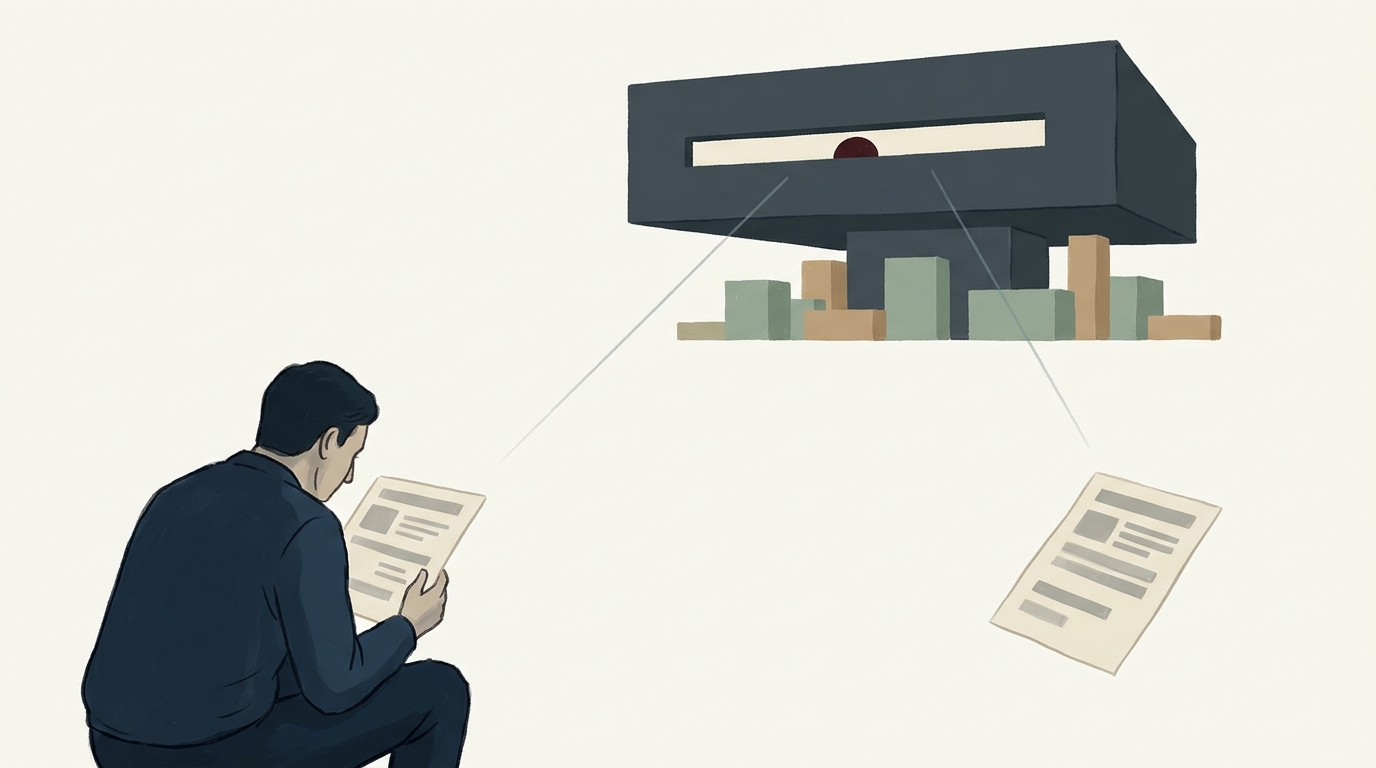
This is the deepest gap in the current frameworks. Most of them define AI literacy as a relationship between a reader and a text. The actual relationship is triangular: reader, text, and the platform that mediates both. A worker who has been trained to evaluate AI outputs but has not been trained to evaluate the system that ranks their job applications has a literacy with a hole in it precisely where their interests are most exposed. A parent who can spot a deepfake in a news clip but cannot evaluate the privacy claims of the school’s AI tutor has a literacy with a hole in it precisely where their children are most exposed AI and Student Data: The Questions Every School Leader Should Ask. The hole is not accidental. It is what the platform-friendly definitions of literacy were designed to leave out.
The Civic Stakes of a Hiring Document
It might seem strange to make so much of the resume — a small, instrumental genre — but the resume is where many readers first encounter the post-credential condition with their own livelihood at stake. A voter encountering a deepfake political ad has, however attenuated, an entire civic apparatus around them: journalists, fact-checkers, election authorities, social pressure from peers. A job applicant encountering an AI-generated rejection, or a hiring manager encountering an AI-generated application, is mostly alone with the document. The labor market is therefore where the literacy of doubt has to become operational fastest, because there is no civil society infrastructure to lean on.
What does that operational literacy look like? It looks, first, like a refusal to accept fluency as evidence. The polished cover letter and the polished rejection are products of the same underlying capability, and a reader who stops being impressed by either has taken the first step. It looks, second, like a habit of provenance: asking, of any document that will affect a decision, where it came from, who edited it, what was promised about its origin. The journalism field’s verification habits transfer here directly — they are not specialist skills but generalizable reading practices Guía para periodistas sobre cómo detectar contenido generado por IA. It looks, third, like a willingness to redesign the situation rather than only the reading: hiring processes that elicit live, contextual, hard-to-fake evidence; reference systems that record what they are recording; consent regimes that tell candidates and employees what AI is being applied to them and to what end.
And it looks, fourth, like a public conversation about what professional self-presentation should mean in a world where the document and the person have loosened. The American Psychological Association’s monitoring of how AI is reshaping their field is one example of a profession reasoning publicly about what its members should be expected to author themselves and what they should be expected to verify Artificial intelligence is impacting the field. The slow accumulation of professional norms — what counts as plagiarism, what counts as collaboration, what counts as fraud — has always been how mature fields have answered questions like this. AI is forcing those conversations to happen across all fields at once, and the early frameworks will set defaults that are hard to revise.
The defaults being set right now mostly favor the parties with the most leverage. Employers can deploy AI screening at scale; applicants can deploy AI authoring at scale; and the literacy each side most needs — the literacy that would let workers read employer systems, and let employers read applicant fluency — is the one that vendor curricula and ministry frameworks are slowest to teach. Provenance checking, source criticism, and the practiced habit of doubting smooth surfaces are not the headline competencies of the AI literacy movement. They should be.
Reading in the Loosened Field
The ghost resume is a useful instance of a larger truth: that we are entering a period in which the social technologies of trust — credentials, references, documents, performances — are being decoupled from the human practices that gave them meaning. The decoupling is not total, and it is not necessarily permanent. New technologies of trust will emerge: provenance signing, watermarking, in-person verification, longitudinal records that are harder to fabricate. But none of those will arrive in time to spare the current generation of workers, parents, and voters from having to read in the loosened field with whatever literacy they can build.
The frameworks that will help them are the ones that take evaluation, not production, as their center of gravity. They treat the AI tool as an object to be read, not only an instrument to be wielded. They embed provenance as a default question — where did this come from, whose words are these, what was the system trained to optimize — across every kind of professional document, not just the obviously suspect ones. They acknowledge that fluency is no longer evidence, that the smoothness of a text is the first thing to doubt about it, and that this doubt has to be cultivated as a civic posture rather than installed as a software feature Deepfakes and the crisis of knowing - UNESCO. They take seriously the metaliteracy insight that reading in this environment means reading the platform along with the text MetaLiteracyIACW, and the workforce-development insight that the asymmetries between employers and applicants are part of what every literate worker has to learn to navigate The DOL Just Defined AI Literacy For The Workforce. What’s Next? - Forbes.
The literacy of doubt is not pessimism. It is the discipline of refusing to grant epistemic credit a document has not earned, while remaining open to the credit it might earn through other means. It is what allows a hiring manager to read a polished resume without either dismissing it as synthetic or accepting it as authentic — and to design a process that can tell the difference. It is what allows a worker to read an automated rejection without internalizing it as a verdict on their worth, and to ask the questions that might surface what the system actually weighed. It is what allows a parent to sit with their child at a screen and model not the click but the pause. None of these are skills the current frameworks reliably teach. All of them are what AI literacy, in any form worth keeping the name, has to mean.

References
- AI adoption for Microsoft and Azure - Cloud Adoption Framework
- AI and Student Data: The Questions Every School Leader Should Ask
- Après des décennies d’éducation aux médias, la Finlande forme les élèves à repérer les deepfakes
- Artificial intelligence is impacting the field
- Children’s susceptibility to content generated by artificial intelligence
- Deadly deepfakes: A survival guide for the age of algorithmic war
- Deepfakes and the crisis of knowing - UNESCO
- Deepfakes, Disinformation, and AI Content Are Taking
- Des contenus générés par IA sources de plus en plus recurrentes de désinformation
- Empowering Learners for the Age of AI
- Generation AI starts early: A guide to technologies already shaping young children’s lives
- Guía para periodistas sobre cómo detectar contenido generado por IA
- Inteligencia artificial y desinformación - UNESCO
- La Verificación de Alucinación en 60 Segundos: Manual de Verificación
- Las alucinaciones de la IA: evidencia empírica
- Les deepfakes et la crise du savoir - UNESCO
- MetaLiteracyIACW
- Responsible AI - Kapor Foundation
- Responsible use of artificial intelligence in education
- School AI surveillance like Gaggle can lead to false alarms, arrests
- Schools are using AI counselors to track students’ mental health
- The DOL Just Defined AI Literacy For The Workforce. What’s Next? - Forbes
- Unmasking EdTech’s Surveillance Infrastructure in the Age of AI
- What is Azure AI Content Safety? - Azure AI services
- Éduquer contre la désinformation amplifiée par l’IA et l’hypertrucage